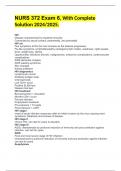
Summary NURS 372 Exam 6, With Complete Solution 2024/2025.
NURS 372 Exam 6, With Complete Solution 2024/2025. HIV Disease characterized by impaired immunity Contracted by sexual contact, parenterally, and perinatally HIV s/s Few symptoms at first but can increase as the disease progresses. Flu-like symptoms, lymphadenopathy (enlarged lymph nodes), weakness, night sweats, fever, weight loss, rashes Opportunistic infections (thrush), malignancies, endocrine complications, cardiovascular complications AIDS dementia complex AIDS wasting syndrome Skin changes Kidney problems HIV diagnostics Lymphocyte counts Antibody-antigen tests Viral load tests Low CD4+ count Positive ELISA test Western blot test HIV treatment Best prevention = education Monitor CD4+ count Prevent infection Prophylactic treatment Pre-exposure = Truvada Post-exposure = cART HIV stage I onset of acute infection responses after an initial invasion by the virus causing overt symptoms. Relatively short phase of disease HIV stage II chronic HIV, can last for years to decades HIV stage III AIDS, characterized by profound reduction of immunity and poor protection against infection. can last for years AIDS Final and most severe stage of HIV infection Characterized by profound reduction of immunity and poor protection against infection. can last for years Anaphylaxis Medical emergency causing blood vessel dilation, decreased cardiac output, and bronchoconstriction anaphylaxis s/s Feelings of apprehension, weakness, impending doom Respiratory symptoms Hypotension Diaphoresis anaphylaxis treatment Prevention - avoid known allergens, wear medical alert bracelet, notify healthcare personnel about specific allergens Carry anaphylaxis kit or epinephrine injector Establish or stabilize airway Discontinue anything that could be causing reaction Call RRT Apply oxygen Be prepared to administer epinephrine for anaphylaxis and diphenhydramine from angioedema and urticaria Other interventions may be needed depending on degree of problem angioedema Severe type of type I hypersensitivity reaction that involves the blood vessels and all layers of the skin, mucous membranes, and subcutaneous tissues in the affected area Lips, face, tongue, larynx, neck angioedema s/s History - drugs, esp those used for BP control S/s - lip swelling, itching in back of throat, deep, firm swelling of face, lips, tongue, and neck, difficulty speaking, drinking, nasal swelling angioedema treatment Stop the reaction, ensure an adequate airway Oxygen, possible intubation or tracheostomy, drug therapy ACEI for hypertension lupus Chronic, progressive autoimmune disorder Tissue integrity is lost via excessive inflammation and overactive immunity leading to organ failure and death Strong genetic connection Triggers include infection, injury, drugs, hormones, exposure lupus s/s Red, macular, facial rash (butterfly rash) Discoid rash - face, scalp, sun-exposure areas Photosensitivity Chronic lesions on mucous membranes Nonerosive arthritis Serosal membrane inflammation Neurologic, hematologic, immunity problems lupus diagnostics ESR Serum complement levels for C3 and C4 ANAs, anti-dsDNA, anti-ssDNA, anti-SM, anti-ENA, antibodies to nuclear membrane phospholipids Blood and urine tests lupus treatment Manage persistent pain, manage fatigue (frequent rest periods), preventing organ failure and reducing SLE activity periods, enhancing self-esteem Avoid sick people Immune suppressants such as corticosteroids, NSAIDs, antimalarial drugs, immune modulators, monoclonal anitibodies lymes disease Systemic infectious disease cause by Borrelia burgdorferi. Often spread through the bite of a deer tick lymes disease stage I occurs with initial bite, lasts 4-5 weeks. If treated with antibiotics at this stage, the disease process can be halted lymes disease stage II occurs 2-12 weeks after tick bite. IV antibiotics given for 30 days at this stage lymes disease stage III months to years after bite -arthralgias and memory changes come in -chronic development lymes disease s/s Stage I - appears with flu-like symptoms, erythema migrans, and pain and stiffness in muscles and joints Stage II - may develop carditis with dysrhythmias, dyspnea, dizziness, or palpitations and CNS disorders such as meningitis, facial paralysis, and peripheral neuritis Stage III - causes arthritis and joint pain lymes disease treatment Prevention - avoid heavily wooded areas especially in the spring and summer, walk in the center of the trail, use insect repellent, wear long sleeves & tuck pants into socks, check yourself and pets for ticks, immediately bathe after being in a wooded area inflammation Five cardinal signs = warmth, redness, swelling, pain, decreased function A syndrome of normal tissue responses to cellular injury, allergy, pathogen presence Can occur without infection, but infection usually triggers inflammation microbiome All microorganisms of normal flora that coexist in and on a person infection Invasion of pathogens into the body, usually triggers inflammation cells involved in infection Neutrophils Macrophages Basophils
Información del documento
- Subido en
- 3 de abril de 2024
- Número de páginas
- 13
- Escrito en
- 2023/2024
- Tipo
- Resumen