The Ontological Argument Notes
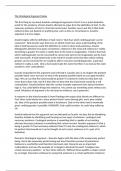
The first thing to say about Anselms ontological argument is that it is an a priori deductive
proof for the existence of God. Anselm attempts to argue from the definition of God. To the
necessary existence of God i.e. that God cannot exist. Another way to put this is that Gods
existence does not depend on anything else, such as time or circumstances. Anselms
argument is in two stages.
Anselm begins with the definition of God: God is “that than which nothing greater can be
conceived”. Next Anselm says that even an atheist must have some understanding of the
idea of God because he needs this definition in order to deny Gods existence. Anselm
distinguishes between two types of existence, existence in the mind and existence in reality.
Something is greater if it exists in reality than in the mind or imagintation. If God is that than
which nothing greater can be conceived he cannot only exist in the imagination and he must
exist necessarily. If God existed only in the mind he would not be that than which nothing
greater can be conceived for we would be able to conceive something greater, a god who
existed in reality as well. Only a fool would make the claim that there is no God as this claim
would be a self- contradiction.
Gaunilo responded to this argument and criticised it. Gaunilo asks us to imagine the greatest
possible island. Once we have an idea of the greatest possible Island we can apply Anselms
logic. We can say that the Island would be greater if it existed in reality but that does not
mean that it does exist. And if it does then to deny that the Island exists would be a self
contradiction. Gaunilo believes that this counter example represents how absurd Anselms
logic is. You cantd define things into existence. You cannot say something exists without any
proof. Weakness of argument is its not based on evidence, not a posteriori.
A response to the Island example is from Plantinga who argue sthat Islands are different to
God- there could always be a more perfect Island- more dancing girls, more pina coladas
etc. Idea of the greatest possible Island is incoherent. God on the other hand is maximally
great- nothing greater is possible. HOWEVER, God could be better, he could stop suffering
etc.
Anselm believed that his argument was not defeated by Gaunilo. He does this by identifying
Gaunilos mistake by identifying and focusing on two types of existence- contingent and
necessary existence. Contingent existence is something that is capable of not existing
whereas Necessary existence is something that cannot no exist. Anselms argument is that a
being is greater if it has necessary existence than if it only has contingnent existence ( which
his perfect Island would as it can be thought of not to exist, existence isn’t a part of its
definition)
Descartes Ontological argument – Descarte begins with the idea of the sumpremely perfect
being. God is the supremely perfect being and must therefore possess all perfections.
Existence is a perfection and therefore God must exist. Descarte was an important
mathmatician and uses the example of a triangle to illustrate his point. Triangles have
certain necessary qualities – to have three sides etc. Without these qualities a shape cannot
be a triangle. Descartes continues by saying that existence is a certain perfection. Existence
The first thing to say about Anselms ontological argument is that it is an a priori deductive
proof for the existence of God. Anselm attempts to argue from the definition of God. To the
necessary existence of God i.e. that God cannot exist. Another way to put this is that Gods
existence does not depend on anything else, such as time or circumstances. Anselms
argument is in two stages.
Anselm begins with the definition of God: God is “that than which nothing greater can be
conceived”. Next Anselm says that even an atheist must have some understanding of the
idea of God because he needs this definition in order to deny Gods existence. Anselm
distinguishes between two types of existence, existence in the mind and existence in reality.
Something is greater if it exists in reality than in the mind or imagintation. If God is that than
which nothing greater can be conceived he cannot only exist in the imagination and he must
exist necessarily. If God existed only in the mind he would not be that than which nothing
greater can be conceived for we would be able to conceive something greater, a god who
existed in reality as well. Only a fool would make the claim that there is no God as this claim
would be a self- contradiction.
Gaunilo responded to this argument and criticised it. Gaunilo asks us to imagine the greatest
possible island. Once we have an idea of the greatest possible Island we can apply Anselms
logic. We can say that the Island would be greater if it existed in reality but that does not
mean that it does exist. And if it does then to deny that the Island exists would be a self
contradiction. Gaunilo believes that this counter example represents how absurd Anselms
logic is. You cantd define things into existence. You cannot say something exists without any
proof. Weakness of argument is its not based on evidence, not a posteriori.
A response to the Island example is from Plantinga who argue sthat Islands are different to
God- there could always be a more perfect Island- more dancing girls, more pina coladas
etc. Idea of the greatest possible Island is incoherent. God on the other hand is maximally
great- nothing greater is possible. HOWEVER, God could be better, he could stop suffering
etc.
Anselm believed that his argument was not defeated by Gaunilo. He does this by identifying
Gaunilos mistake by identifying and focusing on two types of existence- contingent and
necessary existence. Contingent existence is something that is capable of not existing
whereas Necessary existence is something that cannot no exist. Anselms argument is that a
being is greater if it has necessary existence than if it only has contingnent existence ( which
his perfect Island would as it can be thought of not to exist, existence isn’t a part of its
definition)
Descartes Ontological argument – Descarte begins with the idea of the sumpremely perfect
being. God is the supremely perfect being and must therefore possess all perfections.
Existence is a perfection and therefore God must exist. Descarte was an important
mathmatician and uses the example of a triangle to illustrate his point. Triangles have
certain necessary qualities – to have three sides etc. Without these qualities a shape cannot
be a triangle. Descartes continues by saying that existence is a certain perfection. Existence