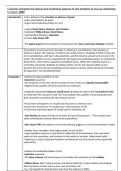
Critically compare the logical and evidential aspects of the problem of evil as challenges
to belief. [40]
Introduction -Evil is defined as the privation or absence of good.
-Evil is what failed to be good.
-Logical and evidential problems of evil.
-Logical: David Hume, Epicurus, John Mackie.
-Evidential: William Rowe, David Hume.
-Soul Deciding Theodicy: Augustine.
-On Evil: John Stuart Mill.
-The logical aspect of the problem of evil presents the most convincing challenge to belief.
The problem of evil arises from the idea of suffering or evil (defined as the privation or
absence of good), the existence of which in the world seems to challenge a belief in God, due
to its contradictions with God’s characteristics, and the immense amount of it present in the
world. The problem of evil is separated into the logical and evidential aspects, as analysed by
David Hume, John Mackie, Augustine and William Rowe. Whilst the evidential aspect is a
somewhat convincing challenge to religious belief, overall, the logical problem of evil
presents the most convincing challenge to the existence of God, which cannot be reconciled
by Augustine’s soul deciding theodicy.
Paragraph 1 -Outline the logical problem of evil:
-Deductive argument.
-The existence of evil rules out the concept of God, as they are logically incompatible.
-Applies all the qualities of God to posit his non-existence.
-Originally proposed by Epicurus, David Hume develops the idea of the ‘Inconsistent Triad’
to undermine the concept of God. The Triad analyses the qualities of God and posits that
they cannot be reconciled with the existence of evil:
-If God were omnipotent: he would have the power to eliminate evil.
-If God were omniscient: he would know of the existence of evil.
-If God were supremely good: he would want to eliminate evil.
-John Mackie develops this idea in his book ‘Evil and Omnipotence.’ “There seems to be
some contradiction between these three propositions.”
-John Stuart Mill: the existence of evil and suffering suggests a cruel and malevolent creator.
-Analyse some strengths of the logical aspect as part of this:
-Logical problem presents a God which is unlike that of the Abrahamic God, and which
seems to lack something, and therefore is not worthy of worship. Undermines belief.
-Suffering is a result of genuine freedom, and therefore we God cannot work as generally
understood.
-Outline the evidential problem of evil:
-Inductive argument.
-The sheer amount and varied types of evil renders the existence of God unlikely.
-William Rowe: daily “intense human and animal suffering” is clear evidence for thinking
that God does not exist and is a clear case of intrinsic evil.
-E.g.: the Spanish flu claimed more lives than the violence in WW1.
to belief. [40]
Introduction -Evil is defined as the privation or absence of good.
-Evil is what failed to be good.
-Logical and evidential problems of evil.
-Logical: David Hume, Epicurus, John Mackie.
-Evidential: William Rowe, David Hume.
-Soul Deciding Theodicy: Augustine.
-On Evil: John Stuart Mill.
-The logical aspect of the problem of evil presents the most convincing challenge to belief.
The problem of evil arises from the idea of suffering or evil (defined as the privation or
absence of good), the existence of which in the world seems to challenge a belief in God, due
to its contradictions with God’s characteristics, and the immense amount of it present in the
world. The problem of evil is separated into the logical and evidential aspects, as analysed by
David Hume, John Mackie, Augustine and William Rowe. Whilst the evidential aspect is a
somewhat convincing challenge to religious belief, overall, the logical problem of evil
presents the most convincing challenge to the existence of God, which cannot be reconciled
by Augustine’s soul deciding theodicy.
Paragraph 1 -Outline the logical problem of evil:
-Deductive argument.
-The existence of evil rules out the concept of God, as they are logically incompatible.
-Applies all the qualities of God to posit his non-existence.
-Originally proposed by Epicurus, David Hume develops the idea of the ‘Inconsistent Triad’
to undermine the concept of God. The Triad analyses the qualities of God and posits that
they cannot be reconciled with the existence of evil:
-If God were omnipotent: he would have the power to eliminate evil.
-If God were omniscient: he would know of the existence of evil.
-If God were supremely good: he would want to eliminate evil.
-John Mackie develops this idea in his book ‘Evil and Omnipotence.’ “There seems to be
some contradiction between these three propositions.”
-John Stuart Mill: the existence of evil and suffering suggests a cruel and malevolent creator.
-Analyse some strengths of the logical aspect as part of this:
-Logical problem presents a God which is unlike that of the Abrahamic God, and which
seems to lack something, and therefore is not worthy of worship. Undermines belief.
-Suffering is a result of genuine freedom, and therefore we God cannot work as generally
understood.
-Outline the evidential problem of evil:
-Inductive argument.
-The sheer amount and varied types of evil renders the existence of God unlikely.
-William Rowe: daily “intense human and animal suffering” is clear evidence for thinking
that God does not exist and is a clear case of intrinsic evil.
-E.g.: the Spanish flu claimed more lives than the violence in WW1.