
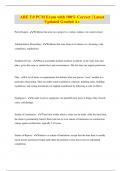
ARE 5.0 PCM Exam with 100% Correct | Latest Updated Graded A+
Party Dispute - Problems that arise on a project (i.e. delays, failures, fee controversies) Administrative Proceeding - Problems that arise from civil statutes (i.e. licensing, code compliance, regulations) Standard of Care - What a reasonably prudent architect would do, in the same time and place, given the same or similar facts and circumstances. The law does not require perfection. Duty - A set of terms or requirements that defines what one person "owes" another in a particular relationship. They are either stated (codified in contracts, building codes, building regulations, and zoning documents) or implied (manifested by following a code of ethics). Negligence - In order to prove negligence, the plaintiff must prove 4 things: duty, breach, cause, and damage. Statute of Limitations - Time limit within which a claim can be made. After the time limit, the claim is permanently barred. Each state has its own statute of limitations on construction claims against architecture, typically 3-10 years. Statute of Repose - Similar to a statute of limitations, except that the time limit is usually much shorter and doesn't begin until either the problem is first discovered or substantial completion.Betterment - Typically applies to negligence claims. Ex: If the architect forgets to include carpeting in the design, the architect would only be responsible for a fraction of the cost (i.e. change order fee or premium difference) because the client would have had to pay for carpeting anyway, had it been shown in the original plans. Joinder - Adding or joining another party to an existing arbitration Consolidation - Act of combining multiple lawsuits into a single suit Copyright Law - Under copyright law, the architect who prepares the architectural plans and drawings has ownership. The architect owns the copyright, and the exclusive legal right to reproduce, publish and sell the drawings. Provisions for copyright are in AIA Document B101. There is no separate AIA form for architectural copyright protection. Instruments of Service - Any representations of the tangible and intangible creative work of the architect and the architect's consultants. Includes studies, surveys, models, sketches, drawings, specs, etc.Efficiency-Based Firms - Firms that specialize in one project type or a narrow range of services. Quick turnaround time. Profitability depends on standard production processes and repeatable project elements. Experience-Based Firms - Firms that have a diversity of project types. Profitability depends on well-managed projects and skillful use of staff resources. Expertise-Based Firms - Firms headed by starchitects. Profitability depends on high fees or expert/unique services. Unincorporated - The individual and the firm are legally one and the same, so all personal assets are at risk if there is a claim. Unincorporated businesses include sole proprietorships and partnerships. Pass-Through Entity - A business entity that has no federal tax liability. Individuals report their shares of the business's income and losses on their personal tax returns. Includes sole proprietorships, partnerships, S-corporations, and limited liability companies. Sole Proprietorship - A business owned by one person. Simplest form of practice. Unincorporated business, so all personal assets are at risk if there is a claim. Not required to pay federal/income tax; income and expenses are included in the individual's personal tax return. Partnership dissolves upon the owner's death. Advantages: ease of setup, total management control by the owner, and possible tax advantages to the ownerDisadvantages: ability to share ownership and risk, and potenti
Información del documento
- Subido en
- 23 de marzo de 2024
- Número de páginas
- 29
- Escrito en
- 2023/2024
- Tipo
- Examen
- Contiene
- Preguntas y respuestas

