
Pesticide Applicator Core Exam With 100% Correct Answers
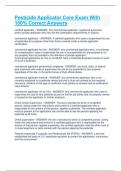
Pesticide Applicator Core Exam With 100% Correct Answers certified applicator - ANSWER- Any Commercial applicator, registered technician, and/or private applicator who has met the certification requirements in Virginia. commercial applicator - ANSWER- A certified applicator who uses or supervises the use of pesticides for purposes other than those covered under a private applicator certification. commercial applicator for hire - ANSWER- any commercial applicator who, in exchange for compensation, uses or supervises the use of any pesticides for any purpose or on any property than as provided in the definition of private applicator: Commercial applicators for hire in VA MUST have a Pesticide Business License or work for such a business. commercial applicator government employee - ANSWER- any local, state, or federal govt employee who uses or supervises the use of any pesticide for any purpose, regardless of the site, in the performance of their official duties commercial applicator inactive - ANSWER- any commercial applicator who is not currently employed in a pesticide-related job and is thus not covered by the required insurance. Holders of this type of certificate must adhere to renewal and re-certification requirements commercial applicator not for hire - ANSWER- Any commercial applicator who uses or supervises the use for any pesticide as part of his/her job duties only on property owned or leased by the applicator or his/her employer. Direct Onsite Supervision - ANSWER- The act or process by which a competent person, acting under the instructions and control of a certified applicator who is responsible for the actions of that person, applies a pesticide. The certified applicator must be present at the application site and be able to see the person applying the pesticide at all times. Direct supervision - ANSWER- the act or process by which a competent person, acting under the instructions and control of a certified applicator who is responsible for the actions of that person, applies a pesticide. the certified applicator must be either near or in close telephone or radio contact with the person applying the pesticide Federal Insecticide, Fungicide, and Rodenticide Act (FIFRA) - ANSWER- a law that established the basis of U.S. pesticide regulation to protect the applicators, consumers, and the environment. pesticide - ANSWER- any substance used to control a pest, or to reduce the unwanted or harmful effects of a pest. Pesticide Business License - ANSWER- a document required of persons in the business of selling, storing, distributing, mixing, recommending the use of, or applying pesticides. pesticide use - ANSWER- application or supervision of an application of pesticide. "use" includes all the routine actives that are part of a pesticide application, such as mixing, loading, cleanup, and disposal. private applicator - ANSWER- A certified applicator who uses or supervises the use of any restricted-use pesticide to produce an agricultural commodity. Recertification - ANSWER- Demonstration of competency by participation in appropriate, approved education courses; or by re-examination. registered technician - ANSWER- a certified applicator who renders services similar to those of a certified commercial applicator. such a person has completed training and demonstrated competency as required for registered technicians but has not met the requirements for commercial certification. restricted-use pesticide - ANSWER- any pesticide classified as restricted use by the EPA. spot treatment - ANSWER- an application of less than 1/10th of an acre occurring on the same day as a larger treatment federal worker protection standard (WPS) - ANSWER- requires growers who hire agricultural labor to make, maintain, and post pesticide application records. annual - ANSWER- A plant that completes its life cycle in one year appendage - ANSWER- an animal body part or organ that projects from the main part of the body biennial - ANSWER- a plant that completes its life cycle in two years. the first year it germinates and grows, the second year it continues to grow, produces fruit, and seeds, and then dies. control - ANSWER- to kill, prevent, or lessen the harmful effects of, to destroy, or to repel an undesirable organism dicot - ANSWER- a plant with two seed leaves and broad, net veined leaves. flower parts are in multiples of fours or fives disease - ANSWER- any abnormal, unhealthy condition caused by an invading organism such as a bacterium or virus. gall - ANSWER- an abnormal plant growth caused by stimuli from an insect or other organism host - ANSWER- an organism infected by a parasite; a plant or animal in which the parasite lives integrated pest management - ANSWER- a system that uses all suitable pest control measures together in a way that keeps pest populations below the levels that cause economic injury invertebrate - ANSWER- An animal without a backbone juvenile hormones - ANSWER- Natural insect chemicals that keep the earlier stages of an insect from changing into the normal adult form. metamorphosis - ANSWER- change in body form during the life cycle of an organism. there are two forms: complete, or gradual. mode of action - ANSWER- how a pesticide works to control a pest mollusk - ANSWER- a soft-bodied invertebrate typically protected by a hard shell nematode - ANSWER- A microscopic, eel-like roundworm. nontarget - ANSWER- Any site or organism other than the site or pest toward which the control measures are being directed. organism - ANSWER- Any living thing parasite - ANSWER- an organism that gets all or part of its food from another organism and in doing so harms its host.
Información del documento
- Subido en
- 22 de marzo de 2024
- Número de páginas
- 18
- Escrito en
- 2023/2024
- Tipo
- Examen
- Contiene
- Preguntas y respuestas

