
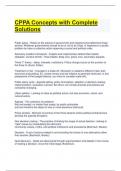
CPPA Concepts with Complete Solutions Public policy - Refers to the actions of government and intentions that determine those actions. Whatever governments choose to do or not to do (Dye). A response to a public problem but also a collective action spawning a social and political order. Advocacy coalition framework - Experts and implementers defend their beliefs (Sabatier, Jenkins -Smith). Three beliefs: deep core, policy core, secondary aspects. Three "I" theory - Ideas, interests, institutions. Policy change occurs at the junction of the three I's (Surel, Palier). Treatment of risk - A budget is a trade -off. Allocation is related to different risks, both economic and political. Ex. create money and risk inflation to generate revenues. In this perspective of the budget balance, you have to consider trade -offs. Public policy cycle - Agenda setting, policy formulation, adoption or decision -making, implementation, evaluation (Jones). But this is not a linear process and policies are constantly changing. Urban politics - Looking at cities as political actors, but also economic, social, and cultural actors. Agenda - The collection of problems that are treated, no matter their scope, by public authorities and are therefore the object of one or more decisions (Garraud). Policy window - Moment of juncture of the three streams where political entrepreneurs develop the agenda (Kingdon). Non-decision making - The practice of limiting the scope of actual decision - making to "safe" issues by manipulating the dominant community values, myths, and political institutions and procedures (Bachrach, Baratz). Decision - A set of actions related to and including the choice of one alternative rather than another (Bachrach, Baratz). Goal discovery - Goals are discovered through argumentation and debate in the course of making a decision, not at the initial stage (Anderson).
Vista previa 1 fuera de 4 páginas
Examen
CPPA Concepts with Complete Solutions
Vista previa 1 fuera de 4 páginas
CPPA Concepts with Complete Solutions Public policy - Refers to the actions of government and intentions that determine those actions. Whatever governments choose to do or not to do (Dye). A response to a public problem but also a collective action spawning a social and political order. Advocacy coalition framework - Experts and implementers defend their beliefs (Sabatier, Jenkins-Smith). Three beliefs: deep core, policy core, secondary aspects. Three "I" theory - Ideas, interests, institutions. Policy change occurs at the junction of the three I's (Surel, Palier). Treatment of risk - A budget is a trade-off. Allocation is related to different risks, both economic and political. Ex. create money and risk inflation to generate revenues. In this perspective of the budget balance, you have to consider trade-offs. Public policy cycle - Agenda setting, policy formulation, adoption or decision-making, implementation, evaluation (Jones). But this is not a linear process and policies are constantly changing. Urban politics - Looking at cities as political actors, but also economic, social, and cultural actors. Agenda - The collection of problems that are treated, no matter their scope, by public authorities and are therefore the object of one or more decisions (Garraud). Policy window - Moment of juncture of the three streams where political entrepreneurs develop the agenda (Kingdon). Non-decision making - The practice of limiting the scope of actual decision- making to "safe" issues by manipulating the dominant community values, myths, and political institutions and procedures (Bachrach, Baratz). Decision - A set of actions related to and including the choice of one alternative rather than another (Bachrach, Baratz). Goal discovery - Goals are discovered through argumentation and debate in the course of making a decision, not at the initial stage (Anderson).
Vista previa del contenido
Información del documento
- Subido en
- 19 de marzo de 2024
- Número de páginas
- 4
- Escrito en
- 2023/2024
- Tipo
- Examen
- Contiene
- Preguntas y respuestas
$12.89
¿Documento equivocado? Cámbialo gratis
Dentro de los 14 días posteriores a la compra y antes de descargarlo, puedes elegir otro documento. Puedes gastar el importe de nuevo.
Escrito por estudiantes que aprobaron
Inmediatamente disponible después del pago
Leer en línea o como PDF

Los indicadores de reputación están sujetos a la cantidad de artículos vendidos por una tarifa y las reseñas que ha recibido por esos documentos. Hay tres niveles: Bronce, Plata y Oro. Cuanto mayor reputación, más podrás confiar en la calidad del trabajo del vendedor.
