
Guidewire Query API with complete solution 2024/2025
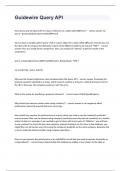
Guidewire Query APIHow do you use the Query API to create a reference to a table called ABPerson? - correct answer var query = ase.Q(ABPerson) Say you have a variable called "query" that is a query object for a table called ABPerson. How do you use the Query API to compare the Nickname column of the ABPerson table to the value of "Will"? - correct answer First, you would do the comparison. Then, you would call "select()" to get the results of the comparison. query. compareIgnoreCase (ABPerson#Nickname, Relop.Equals, "Will") var results Obj = query. Select() Why was the Property Reference class introduced into the Query API? - correct answer Previously the property would be specified as a string, which meant it could be a string for a table that doesn't exist in the db. In that case, the compiler would not catch the error. What is the syntax for specifying a property reference? - correct answer EntityType#Property Why should you exercise caution when using contains()? - correct answer It can negatively affect performance when the queried data set is very large. How should you improve the performance of a query when you need to use the contains() predicate? - correct answer Filter out the dataset using compare() predicates and only execute contains() on a smaller subset of data. For example, if you needed to get all Users with a last name of "Williams," you will have to use contains() to check the last name property. Instead of doing it on ALL Users in the database, you might filter out all inactive users first using the compare() predicate on the active property. Basically, find a way to make this dataset smaller using compare operations. How can you improve the performance of an endsWith() search that you need to execute frequently on a large dataset? - correct answer Denormalize the database by adding a new column to the table in
Información del documento
- Subido en
- 18 de marzo de 2024
- Número de páginas
- 5
- Escrito en
- 2023/2024
- Tipo
- Examen
- Contiene
- Preguntas y respuestas

