
Edexcel A-Level Economics Exam 2024 Questions & Answers 100% accurate!
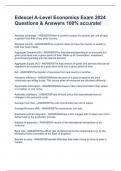
Edexcel A-Level Economics Exam 2024 Questions & Answers 100% accurate! Absolute advantage - ANSWERSWhen a country's output of a product per unit of input is greater than that of any other country. Absolute poverty - ANSWERSWhen a person does not have the income or wealth to fulfil their basic needs. Aggregate Demand (AD) - ANSWERSThe total demand/spending in an economy at a given price level over a given period of time. Made up of consumption, investment, government spending and net external demand. Aggregate Supply (AS) - ANSWERSThe total amount of goods and services that can be supplied in an economy at a given price level over a given period of time. Aid - ANSWERSThe transfer of resources from one country to another. Allocative efficiency - ANSWERSWhere the price of a good is equal to the price consumers are willing to pay. This occurs when all resources are allocated efficiently. Asymmetric information - ANSWERSWhere buyers have more information than sellers in a market, or vice versa. Automatic stabilisers - ANSWERSParts of fiscal policy that automatically react to changes in the economic cycle. Average Cost (AC) - ANSWERSThe cost of production per unit of output. Average Revenue (AR) - ANSWERSThe revenue per unit sold. Backward vertical integration - ANSWERSWhere a firm merges with or takes over a firm further back in the production process. Balance of payments - ANSWERSA record of the international transactions of an economy. Bank rate - ANSWERSThe official rate of interest set by the central bank (e.g. by the Monetary Policy Committee of the Bank of England) Barriers to entry - ANSWERSPotential difficulties that make it hard for firms to enter a market. Barriers to exit - ANSWERSPotential difficulties that make it hard for firms to leave a market. Black market - ANSWERSEconomic activity that occurs without taxation and government intervention. Budget deficit - ANSWERSWhen government spending exceeds tax revenues. Budget surplus - ANSWERSWhen tax revenues exceed government spending. Capital account of the balance of payments - ANSWERSA part of the balance of payments that shows transfers of non-monetary and fixed assets into and out of the economy. Cartel - ANSWERSA group of products who collude to limit output in order to keep prices high. Central bank - ANSWERSThe institution responsible for issuing banknotes in an economy, acting as a lender of last resort, and implementing monetary policy. Ceteris paribus - ANSWERSAll other things remaining equal Circular flow of income - ANSWERSThe flow of national output, income and expenditure between firms and households. Command economy - ANSWERSAn economy where only the government determines the allocation of resources. Comparative advantage - ANSWERSWhen the opportunity cost of producing a good or service is lower than that of any other country. Competition policy - ANSWERSGovernment policy aimed at reducing monopoly power in order to increase efficiency and to ensure fairness for consumers. Concentration ratio - ANSWERSA measure of the dominance of firms in a market. Conglomerate integration - ANSWERSWhere a firm merges with or takes over a firm in a completely different market. Consumer surplus - ANSWERSThe difference between the price a consumer pays and the price they were willing to pay. Consumption - ANSWERSThe purchase of goods and services. Contestability - ANSWERSThe degree to which new entrants find it easy to enter the market. Cost-push inflation - ANSWERSInflation caused by rising costs of production. Cross elasticity of demand (XED) - ANSWERSA measure of the responsiveness of demand of one good/service to a change in price of another good/service. Current account of the balance of payments - ANSWERSA part of the balance of payments that consists of: trade in goods, trade in services, primary income and secondary income. Cyclical unemployment - ANSWERSUnemployment caused by a lack of demand in the economy. Deflation - ANSWERSThe sustained fall in the average price of goods and services in an economy over a period of time. Dema
Información del documento
- Subido en
- 17 de marzo de 2024
- Número de páginas
- 142
- Escrito en
- 2023/2024
- Tipo
- Examen
- Contiene
- Preguntas y respuestas

