

Potter & Perry Chapter 14: Older Adult Question and Answers
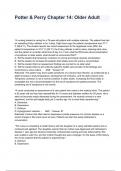
Potter & Perry Chapter 14: Older Adult Question and Answers A nursing student is caring for a 78-year-old patient with multiple sclerosis. The patient has had an indwelling Foley catheter in for 3 days. Eight hours ago the patient's temperature was 37.1° C (98.8° F). The student reports her recent assessment to the registered nurse (RN): the patient's temperature is 37.2° C (99° F); the Foley catheter is still in place, draining dark urine; and the patient is uncertain what time of day it is. From what the RN knows about presentation of symptoms in older adults, what should he recommend first?* A. Tell the student that temporary confusion is normal and simply requires reorientation B. Tell the student to increase the patient's fluid intake since the urine is concentrated C. Tell the student that her assessment findings are normal for an older adult D. Tell the student that he will notify the patient's health care provider of the findings and recommend a urine culture - ANS *Answer: D* Rationale: The patient may have subtle symptoms of a urinary tract infection, as evidenced by a slight increase in body temperature, development of confusion, and the dark-colored urine. Temporary confusion is not a normal condition in older adults. Increasing the fluid intake is acceptable but not a recommendation for the set of symptoms the patient presents. The presenting set of symptoms is not normal. *A nurse conducted an assessment of a new patient who came to the medical clinic. The patient is 82 years old and has had osteoarthritis for 10 years and diabetes mellitus for 20 years. He is alert but becomes easily distracted during the assessment. He recently moved to a new apartment, and his pet beagle died just 2 months ago. He is most likely experiencing:* A. Dementia. B. Depression. C. Delirium. D. Hypoglycemic reaction. - ANS *Answer: B* Rationale: Factors that often lead to depression include presence of a chronic disease or a recent change or life event (such as loss). Patients are alert but easily distracted in conversation. *The nurse is completing a health history with the daughter of a newly admitted patient who is confused and agitated. The daughter reports that her mother was diagnosed with Alzheimer's disease 1 year ago but became extremely confused last evening and was hallucinating. She was unable to calm her, and her mother thought she was a stranger. On the basis of this history, the nurse suspects that the patient is experiencing:* A. Delirium. B. Depression.
Información del documento
- Subido en
- 14 de marzo de 2024
- Número de páginas
- 5
- Escrito en
- 2023/2024
- Tipo
- Examen
- Contiene
- Preguntas y respuestas

