

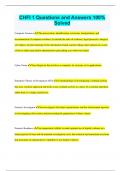
CHFI 1 Questions and Answers 100% Solved
CHFI 1 Questions and Answers 100% Solved Computer forensics The preservation, identification, extraction, interpretation, and documentation of computer evidence, to include the rules of evidence, legal processes, integrity of evidence, factual reporting of the information found, and providing expert opinion in a court of law or other legal and/or administrative proceeding as to what was found. Cyber Crime Any illegal act that involves a computer, its systesm, or its applications. Enterprise Theory of Invetigation (ETI) A methodology of investigating a criminal activity that uses a holistic approach and looks at any criminal activity as a piece of a criminal operation rather than as a single criminal act. Forensic Investigator An investigator who helps organizations and law enforcement agencies in investigating cyber crimes and prosecuting the perpetrators of those crimes. Forensic Readiness An organzation's ability to make optimal use of digital evidence in a limited period of time and ith minimal investigation costs; the technical and nontechnical actions that maximize an organization's capability to use digital evidence. Forensic Science The application of physical sciences to law in the search for truth in civil, criminal, and social behavioral matters for the purpose of ensuring injustice shall not be done to any members of society. Amperage A measurement of the amount of electric current. Bandwidth The width of the range of frequencies that an electronic signal uses on a given transmission medium. Bookrack A small shelf that is used in a forensic lab to hold reference materials. Business Case The justification to upper management or a lender for purchasing new equipment, software, or other tools when upgrading your facility. Configuration Management the process of keeping track of all changes made to hardware, software, and firmware throughout the life of a system; source code management and revision control are part of this. Risk Management the decision-making process involving considerations of political, social, economic, and engineering factors with relevant risk assessments relating to a potential hazard so as to develop, analyze, and compare regulatory options and to select the optimal regulatory response for safety from that hazard. Telecommunications Electronics Material Proteted from Emanating Spurious Transmissions (TEMPEST) The external electromagnetic radiation that radiates from any data processing equipment and the various security measure used to prevent that radiation from being captured or monitored. Best Practices an empirically provent set of methods for performing a task in the best and most efficient way. Bit-stream copy A bity-by-bit copy of the original storage medium. Chain of custody A method for documenting the history and possession of a sample from the time of collection, through analysis and data reporting, to its final disposition. DriveSpy A disk-forensic DOS tool that is designed to emulate and extend the capabilities of DOS to meet forensic needs; it creates a direct diesk-to-disk forensic duplicates, can copy a range of sectors within or between drives, and can process duplicate drives. File Slack The space that exists btween the end of a file and the end of the last cluster of the file; see also slack space. Host-Protected Area (HPA) An area of the drive where a certain portaion of the drive's contents is hidden from the operating system and file system. Incident An event or series of events that threatens the security of computing systems and networks in an organization.
Información del documento
- Subido en
- 9 de marzo de 2024
- Número de páginas
- 5
- Escrito en
- 2023/2024
- Tipo
- Examen
- Contiene
- Preguntas y respuestas

