
Intermediate Accounting I (Exam 1) Chapters 1-5
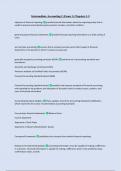
Intermediate Accounting I (Exam 1) Chapters 1-5 objective of financial reporting provide financial information about the reporting entity that is useful to present and potential equity investors, lenders, and other creditors general-purpose financial statements users accrual basis accounting provide financial reporting information to a wide variety of ensures that a company records events that change its financial statements in the periods in which it receives or pays cash generally accepted accounting principles (GAAP) procedures: Securities and Exchange Commission (SEC) common set of accounting standards and American Institute of Certified Public Accountants (AICPA) Financial Accounting Standards Board (FASB) Financial Accounting Standards Board establish and improve standards of financial accounting and reporting for the guidance and education of the public which includes issuers, auditors, and users of financial information Accounting Standards Updates These updates amend the Accounting Standards Codification, which represents the source of authoritative accounting standards Four primary financial statements Income Statement Statement of Cash Flows Balance Sheet Statement of Owner's/Stockholders' Equity Conceptual Framework establishes the concepts that underlie financial reporting. Relevance (Fundamental Quality) accounting information must be capable of making a difference in a decision. Financial information is capable of making a difference when it has predictive value, confirmatory value, or both. Predictive Value if it has value as an input to predictive processes used by investors to form their own expectations about the future Confirmatory value relevant information also helps users confirm or correct prior expectations Faithful Representation (fundamental quality) what really existed or happened Completeness means that the numbers and descriptions match means that all the information that is necessary for faithful representation is provided Neutrality means that a company cannot select information to favor one set of interested parties over another. Unbiased information must be the overriding consideration. Free from Error more accurate (faithful representation) of a financial item Comparability (Enhancing Qualities) enables users to identify the real similarities and differences in economic events between companies. Consistency when a company applies the same accounting treatment to similar events, from period to period. Verifiability Timeliness decisions. occurs when independent measurers, using the same methods, obtain similar results. having information available to decision-makers before it loses its capacity to influence Understandability Decision-makers vary widely in the types of decisions they make, how they make decisions, the information they already possess or can obtain from other sources, and their ability to process the information. Assets probably future economic benefits obtained or controlled by a particular entity as a result of past transactions or events Liabilities Probable future sacrifices of economic benefits arising from present obligations of a particular entity to transfer assets or provide services to other entities in the future as a result of past transactions or events. Equity Residual interest in the assets of an entity that remains after deducting its liabilities. Investments By Owners Increases in net assets of a particular enterprise resulting from transfers to it from other entities of something of value to obtain or increase ownership interests (or equity) in it. Distributions to Owners Decreases in net assets of a particular enterprise resulting from transferring assets, rendering services, or incurring liabilities by the enterprise to owners. Comprehensive Income Change in equity (net assets) of an entity during a period from transactions and other events and circumstances in equity during a period except those resulting from investments by owners and distributions to owners. Revenues Inflows or other enhancements of assets of an entity or settlement of its liabilities during a period from delivering or producing goods, rendering services, or carrying out other activities that constitute the entity's ongoing major or central operations Expenses Gains Outflows or other using up of assets or incurrences of liabilities during a period Increases in equity (net assets) from peripheral or incidental transactions of an entity from all other transactions and other events and circumstances affecting the entity during a period except those that result from revenues or investments by owners. Losses Decreases in equity (net assets) Economic Entity Assumption unity of accountability Going Concern Assumption means that economic activity can be identified with a particular that the company will have a long life Monetary Unit Assumption money is the common denominator of economic activity and provides an appropriate basis for accounting Periodicity Assumption t ime periods implies that a company can divide its economic activities into artificial Historical Cost (Measurement Principle) GAAP requires that companies account for and report many assets and liabilities on the basis of acquisition price. Fair Value "the price that would be received to sell an asset or paid to transfer a liability in an orderly transaction between market participants at the measurement date." Revenue Recognition Principle requires that companies recognize revenue in the accounting period in which the performance obligation Expense Recognition Principle Full disclosure principle "let the expense follow the revenue" it recognizes that the nature and amount of information included in f inancial reports reflects a series of judgmental trade-offs. Assets = Liabilities + Stockholders' Equity General ledger Accounting Equation contains all the asset, liability, and stockholders' equity accounts General journal chronologically lists transactions and other events, expressed in terms of debits and credits to accounts. Trial balance ledger) a list of accounts and their balances at a given time (in order as they appear on the Adjusting entries make it possible to report on the balance sheet the appropriate assets, liabilities, and stockholders' equity at the statement date. Deferrals Prepaid Expenses: Expenses paid in cash before they are used or consumed
Información del documento
- Subido en
- 21 de febrero de 2024
- Número de páginas
- 9
- Escrito en
- 2023/2024
- Tipo
- Examen
- Contiene
- Preguntas y respuestas

