

Chapter 3: Pharmaceutical Development
Introduction
If you want to treat a pathology, you need the active pharmaceutical ingredient (API). But, you also
need other compounds in which you can make up a formulation! We never administer only the API,
but we combine it with other ingredients, the excipients. The active ingredient is not the same as the
drug! The drug is the active ingredient + the excipients. The drug product is what we administer to
the patient; the drug substance is the main ingredient in a medicine that causes the desired effect of
the medicine. The challenge is that the active ingredient must be able to reach the site of action in
the body. Think about the blood, skin, joint, brain, cancer cells, …. As we know, certain treatments
ask for specific drug delivery systems (tablets with release of API in the colon, cell targeting, …). A
number of API has poor physicochemical and/or biopharmaceutical properties.
Introduction – Pharmaceutical development
With the preformulation we will form a physicochemical formulation of the API (also in combination
with potential excipients) and also the biopharmaceutical properties (e.g. permeability
characteristics). This is the phase of the pharmaceutical profiling. The question we ask ourselves here
is if we can transform the compound that we have into a drug and if this can be delivered into the
patient? Can we manufacture this in the lab (small scale), but eventually on a larger scale for the
market? So, the preformulation will be about the drug ability, the formulatability and the
manufacturability. After this, we will research the formulation and process development:
Development of a stable formula with optimal release characteristics of the API: the process
of the formulation (tablets, injection, …)
Development of a robust manufacturing process
Scaling up activities: from lab scale to pilot scale, to clinical scale and to production scale
Material for clinical, pharmacokinetic and toxicology studies
At the end of the developmental phase, there is a transfer of the final formula and process to
production level (“commercial scale”, e.g. batch size of 10 5 tablets)
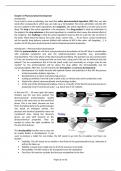
In the past (15 – 20 years ago), the upper
timeline was the way they worked. The
pharmaceutical preformulation studies
started at the same time as the preclinical
phase. This is not ideal, because we lose
time! Everything before the preformulation
was based on biological activity. The
physical and chemical properties were not
considered! Now, during the discovery
phase, we start with research on the
physicochemical properties. They are
needed to select the right candidate for
the pre-clinical phase.
The developability hurdles may or may not
be readily fixable in development. If you
want to produce a tablet for oral intake, the API needs to go into the circulation, but there are
hurdles:
Solubility: The API needs to be soluble in the fluids of the gastrointestinal tract, otherwise it
will not be taken up
Stability: It needs to be stable due to all of the enzymes in the body
Permeability: The API needs to be transported over the epithelium
First-Pass: We need to consider the first-pass metabolism in the liver
Pagina 1 van 11
Introduction
If you want to treat a pathology, you need the active pharmaceutical ingredient (API). But, you also
need other compounds in which you can make up a formulation! We never administer only the API,
but we combine it with other ingredients, the excipients. The active ingredient is not the same as the
drug! The drug is the active ingredient + the excipients. The drug product is what we administer to
the patient; the drug substance is the main ingredient in a medicine that causes the desired effect of
the medicine. The challenge is that the active ingredient must be able to reach the site of action in
the body. Think about the blood, skin, joint, brain, cancer cells, …. As we know, certain treatments
ask for specific drug delivery systems (tablets with release of API in the colon, cell targeting, …). A
number of API has poor physicochemical and/or biopharmaceutical properties.
Introduction – Pharmaceutical development
With the preformulation we will form a physicochemical formulation of the API (also in combination
with potential excipients) and also the biopharmaceutical properties (e.g. permeability
characteristics). This is the phase of the pharmaceutical profiling. The question we ask ourselves here
is if we can transform the compound that we have into a drug and if this can be delivered into the
patient? Can we manufacture this in the lab (small scale), but eventually on a larger scale for the
market? So, the preformulation will be about the drug ability, the formulatability and the
manufacturability. After this, we will research the formulation and process development:
Development of a stable formula with optimal release characteristics of the API: the process
of the formulation (tablets, injection, …)
Development of a robust manufacturing process
Scaling up activities: from lab scale to pilot scale, to clinical scale and to production scale
Material for clinical, pharmacokinetic and toxicology studies
At the end of the developmental phase, there is a transfer of the final formula and process to
production level (“commercial scale”, e.g. batch size of 10 5 tablets)
In the past (15 – 20 years ago), the upper
timeline was the way they worked. The
pharmaceutical preformulation studies
started at the same time as the preclinical
phase. This is not ideal, because we lose
time! Everything before the preformulation
was based on biological activity. The
physical and chemical properties were not
considered! Now, during the discovery
phase, we start with research on the
physicochemical properties. They are
needed to select the right candidate for
the pre-clinical phase.
The developability hurdles may or may not
be readily fixable in development. If you
want to produce a tablet for oral intake, the API needs to go into the circulation, but there are
hurdles:
Solubility: The API needs to be soluble in the fluids of the gastrointestinal tract, otherwise it
will not be taken up
Stability: It needs to be stable due to all of the enzymes in the body
Permeability: The API needs to be transported over the epithelium
First-Pass: We need to consider the first-pass metabolism in the liver
Pagina 1 van 11

