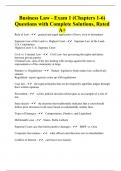
Business Law - Exam 1 (Chapters 1-6) Questions with Complete Solutions, Rated A+
Rule of Law - general and equal application of laws, even to lawmakers Supreme Law of the Land vs. Highest Court - Supreme Law of the Land- U.S. Constitution Highest Court- U.S. Supreme Court Civil vs. Criminal Law - Civil Law- law governing the rights and duties between private parties Criminal Law- area of the law dealing with wrongs against the state as representative of the community at large Statutes vs. Regulations - Statute- legislative body makes law; collectively statutes Regulation- expert agencies come up with regulations Case law - the legal principles that are developed by appellate judges through their written opinions Precendent - a prior judicial decision relied upon as an example of a rule of law Stare decisis - the doctrine that traditionally indicates that a court should follow prior decisions in all cases based on substantially similar facts Types of Damages - Compensatory, Punitive, and Liquidated McDonald's case - Name- Stella Liebeck Supreme Court case that limits punitive damages - BMW vs. Gore Corporate Governance - what officers and directors owe to shareholders Conflict of Interest - can't have two masters Overbreadth Doctrine - congress went too far with a law Libel vs. Slander - Libel- a defamatory written statement communicated to a third party (lIbel- wrItten) Slander- an oral defamatory statement communicated to a third person (Slander- Spoken) Commerce Clause - grants Congress the power to regulate any activity impacting interstate commerce Police Powers - left to the state- local police Due Process - fundamental fairness. as applied to judicial proceedings, adequate notice of a hearing and an opportunity to appear and defend in an orderly tribunal Equal Protection - a provision in the Fourteenth Amendment of the U.S. Constitution that requires all citizens to be treated in a similar manner by the government unless there is a sufficient justification for the unequal treatment Litigation parties - Plaintiff and Defendent Standing - the doctrine that requires the plaintiff in a lawsuit to have a sufficient legal interest in the subject matter of the case
Información del documento
- Subido en
- 16 de febrero de 2024
- Número de páginas
- 4
- Escrito en
- 2023/2024
- Tipo
- Examen
- Contiene
- Preguntas y respuestas