
Paramedic Trauma Final Exam Questions with 100% Correct Answers | Verified | Latest Update 2024
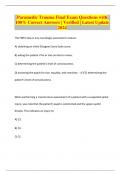
Paramedic Trauma Final Exam Questions with 100% Correct Answers | Verified | Latest Update 2024 The FIRST step in any neurologic assessment involves: A) obtaining an initial Glasgow Coma Scale score. B) asking the patient if he or she can feel or move. C) determining the patient's level of consciousness. D) assessing the pupils for size, equality, and reactivity. - C) determining the patient's level of consciousness. When performing a cranial nerve assessment of a patient with a suspected spinal injury, you note that the patient's pupil is constricted and the upper eyelid droops. This indicates an injury to: A) C3. B) C4. C) C5. D) C6. - A) C3. Inability to feel or move below the level of the nipple line indicates injury to which spinal nerve root? A) C7 B) T1 C) T4 D) L1 - C. T4 A positive Babinski reflex is observed when the: A) toes curve or move downward when the sole of the foot is touched. B) patient responds to pain by flexing the arms and extending the legs. C) patient's reflexes are hyperactive in response to an external stimulus. D) toes move upward in response to stimulation of the sole of the foot. - D) toes move upward in response to stimulation of the sole of the foot. Spinal cord injuries that cause neurogenic shock generally produce: A) cool, clammy skin distal to the site of the spinal cord injury. B) reflex tachycardia due to sympathetic nervous system stimulation. C) flaccid paralysis and complete loss of sensation distal to the injury. D) signs and symptoms that are identical to those of hypovolemic shock. - C) flaccid paralysis and complete loss of sensation distal to the injury. An injured patient's head should be secured to the long backboard only after: A) you have placed padding under the shoulders. B) his or her torso has been secured adequately. C) both of the legs are secured to the board properly. D) a vest-style immobilization device has been applied. - B) his or her torso has been secured adequately.
Información del documento
- Subido en
- 13 de febrero de 2024
- Número de páginas
- 24
- Escrito en
- 2023/2024
- Tipo
- Examen
- Contiene
- Preguntas y respuestas

