
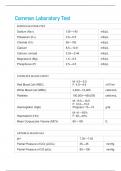
Common Laboratory Test
SERUM ELECTROLYTES
Sodium (Na+) 135—145 mEq/L
Potassium (K+) 3.5—5.5 mEq/L
Chloride (Cl-) 95—105 mEq/L
Calcium 8.5—10.9 mEq/L
Calcium, ionized 2.24—2.46 mEq/L
Magnesium (Mg) 1.5—2.5 mEq/L
Phosphorus (P) 2.5—4.5 mEq/L
COMPLETE BLOOD COUNT
M: 4.5—5.5
Red Blood Cell (RBC) F: 4.0—4.9 x10⁵/ml
White Blood Cell (WBC) 4,500—10,000 cells/mcL
Platelets 100,000—450,000 cells/mcL
M: 13.5—16.5
F: 12.0—15.0
Haemoglobin (Hgb) Pregnant: 10—15 g/dL
M: 41—50%
Haematocrit (Hct) F: 36—44%
Mean Corpuscular Volume (MCV) 80—100 fL
ARTERIAL BLOOD GAS
pH 7.35—7.45
Partial Pressure of CO2 (pCO2) 35—45 mmHg
Partial Pressure of O2 (pO2) 80—100 mmHg
, Bicarbonate (HCO3) 22—26 mEq/L
Base Excess (BE) -2—+2 mEq/L
Oxygen Saturation (SaO2) 95—100%
CHEMISTRY VALUES
Glucose Adults: 70—110 mg/dL
Adults: 7—18
Child: 5—20
Blood Urea Nitrogen (BUN) Infant: 5—15 mg/dL
Serum Creatinine 0.6—1.35 mg/dL
F: 85—132
Creatinine Clearance (CrCl) M: 90—138 mL/min
Albumin 3.4—5.0 g/dL
Bilirubin <1.0 mg/dL
Uric Acid 3.5—7.5 mg/dL
Creatine phosphokinase (CPK) 21—198 units/L
Phases of Diagnostic Testing
Diagnostic testing involves three phases: pre-test, intratest, and post-test.
Nurses have responsibilities for each phase of diagnostic testing.
Pre-test
In the pertest, the main focus is on preparing the client for the diagnostic
procedure. Responsibilities during pre-test include:
▪ Assessment of the patient to assist in determining precautions.
▪ Preparation of the equipment and supplies needed.
▪ Preparation of a consent form, if required.
▪ Providing information and answering client questions about the
procedure.
Intratest
During intratest, the main focus is specimen collection and performing or
assisting with certain diagnostic procedures. Additional responsibilities
during intratest are:
, ▪ Use of standard precautions or sterile technique if necessary.
▪ Providing emotional support to the patient and monitoring the patient’s
response during the procedure.
▪ Ensuring the correct labelling, storage, and transportation of the
specimen.
Post-Test
During the last part of diagnostic testing, the nursing care revolves around
observations and follow-up activities for the patient. For example, if a
contrast media was injected during a CT scan, the nurse should encourage
the patient to increase fluid intake to promote excretion of the dye.
Additional responsibilities during post-test include:
▪ Compare the previous and current test results
▪ Reporting of the results to the appropriate members of the healthcare
team.
Summary of Normal Laboratory Values
Summary of the different normal laboratory values. You can learn more
about each diagnostic testing in the sections ahead.
Erythrocyte Studies
▪ Red Blood Cell Count (RBC): Male adult: 4.5 – 6.2 million/mm3 ; Female
adult: 4.5 – 5.0 million/mm3
▪ Haemoglobin (Hgb): Male: 14-16.5 g/dL; Female: 12-15 g/dL
▪ Haematocrit (Hct): Male: 42 – 52%; Female: 35 – 47%
▪ Mean corpuscular volume (MCV): 78 – 100 μm3 (male) 78 – 102 μm3
(female)
▪ Mean corpuscular haemoglobin (MCH): 25 – 35pg
▪ Mean corpuscular haemoglobin concentration (MCHC): 31 – 37%
▪ Serum iron: Male: 65 – 175 mcg/dL; Female: 50 – 170 mcg/dL
▪ Erythrocyte sedimentation rate (ESR): 0 – 30 mm/hour (value may vary
depending on age)
White Blood Cells and Differential
▪ White Blood Cell (WBC) Count: 4,500 to 11,000 cells/mm³
▪ Neutrophils: 55 – 70% or 1,800 to 7,800 cells/mm³
▪ Lymphocytes: 20 – 40% or 1,000 to 4,800 cells/mm³
▪ Monocytes: 2 – 8% or 0.0 to 800 cells/mm³
▪ Eosinophils: 1 – 4% or 0.0 to 450 cells/mm³
▪ Basophils: 0–2% or 0.0 to 200 cells/mm³
▪ Bands: 0–2 % or 0.0 to 700 cells/mm³
Coagulation Studies
▪ Platelet count (PLT): 150,000 to 400,000 cells/mm³

