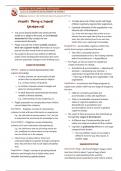
Piaget’s Theory of Infant →
Development →
→ E.g., A boy who has vague idea of how to use a
hammer has also vague idea of how to use other
tools; but, after learning how to use each one,
relates these uses, organizing his knowledge.
→
Disequilibrium
→
→
→
→
COGNITIVE PROCESSES
→ →
Schemes
→ →
→ →
E.g., sucking, looking, and grasping Equilibration
→
→ →
E.g., understanding concept, budgeting, etc. →
→
Assimilation
→
E.g., the child calls all moving vehicle a “car”; he tries
to understand the world using the knowledge he has.
→
Accommodation
→
E.g., the child learns that not all moving vehicle are
cars, modifying his scheme about cars by excluding
→
non-car vehicle out in the category
→
SENSORIMOTOR STAGE
Sensorimotor Stage
Organization
, → →
→ Coordination of Secondary Circular Reactions
Substages →
→
Simple Reflexes
E.g., Look at an object and grasp it simultaneously.
→ →
→ → Intentionality
E.g., may suck even w/o nipples in the mouth
First Habits and Primary Circular Reactions E.g., Infants might manipulate a stick in order to
bring a desired toy within reach.
Tertiary Circular Reactions, Novelty, and Curiosity
→ Habit
→ Circular Reaction → Tertiary Circular Reactions
→ Primary Circular Reaction
→
E.g., An infant accidentally sucked his finger →
searches for finger to suck again; fingers do not
cooperate since they cannot coordinate visual and Internalization of Schemes
manual actions.
→ → Symbol
→
→
Secondary Circular Reactions →
→ Object Permanence
E.g., They may shake a toy by chance → they may →
shake it again because of fascination
→ Secondary Circular Reaction Object Permanence
Development →
→ E.g., A boy who has vague idea of how to use a
hammer has also vague idea of how to use other
tools; but, after learning how to use each one,
relates these uses, organizing his knowledge.
→
Disequilibrium
→
→
→
→
COGNITIVE PROCESSES
→ →
Schemes
→ →
→ →
E.g., sucking, looking, and grasping Equilibration
→
→ →
E.g., understanding concept, budgeting, etc. →
→
Assimilation
→
E.g., the child calls all moving vehicle a “car”; he tries
to understand the world using the knowledge he has.
→
Accommodation
→
E.g., the child learns that not all moving vehicle are
cars, modifying his scheme about cars by excluding
→
non-car vehicle out in the category
→
SENSORIMOTOR STAGE
Sensorimotor Stage
Organization
, → →
→ Coordination of Secondary Circular Reactions
Substages →
→
Simple Reflexes
E.g., Look at an object and grasp it simultaneously.
→ →
→ → Intentionality
E.g., may suck even w/o nipples in the mouth
First Habits and Primary Circular Reactions E.g., Infants might manipulate a stick in order to
bring a desired toy within reach.
Tertiary Circular Reactions, Novelty, and Curiosity
→ Habit
→ Circular Reaction → Tertiary Circular Reactions
→ Primary Circular Reaction
→
E.g., An infant accidentally sucked his finger →
searches for finger to suck again; fingers do not
cooperate since they cannot coordinate visual and Internalization of Schemes
manual actions.
→ → Symbol
→
→
Secondary Circular Reactions →
→ Object Permanence
E.g., They may shake a toy by chance → they may →
shake it again because of fascination
→ Secondary Circular Reaction Object Permanence