NLN PAX Physics Exam (Answerd) Verified Solution
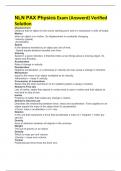
NLN PAX Physics Exam (Answerd) Verified Solution Displacement Distance that an object is from some starting point, and it is measured in units of length. Motion when an object is in motion, it's displacement is constantly changing. -Velocity (speed) -Acceleration Speed Is the distance traveled by an object per unit of time. - Speed equals distance traveled over time. Velocity Speed in a given direction; it therefore tells us two things about a moving object, it's speed and direction. Acceleration Rate of change in velocity Deceleration Negative acceleration, or a decrease in velocity and can cause a change in direction. Momentum equal to the mass of an object multiplied by its velocity. -Momentum = mass X velocity. Conversion of momentum States that the total momentum of an isolated system is always constant. Newton's First law Law of inertia, states that objects in motion tend to stay in motion and that objects at rest tend to stay at rest. Inertia Property of matter that resists any change in motion. Newton's Second Law Describes the relationship between force, mass and acceleration. Force applied on an object equals the mass of the object time it's acceleration. -Force= mass x acceleration ( or f= ma) Newton Is the unit that represents a force that accelerates a mass of 1 kilogram 1 meter per second. Gravity force of attraction between all objects in the universe. Weight The pull of gravity on an object. Density Which is mass per unit volume -Density = mass over volume. Torque Perpendicular force times the lever arm. Lever arm Distance from the axis of rotation to the point where the force is exerted. The farther the force is from the axis of rotation, the easier it is to rotate the object and the more torque is produced. Centripetal Force You must continually exert a force pulling the ball back toward the center of the circle. Newtons Third Law States that for every action there is an equal and opposite reaction. Kinetic Energy Energy associated with motion. Any moving body has this type energy because it is able to do work by moving other bodies. -Kinetic energy = 1/2 (mass x velocity)2 Potential energy Energy stored in a body because of it's position. Work defined as the product of the force applied to an object and the distance through which the force is applied. -Work= force x distance. Joule Unit of energy equal to the work done by a force of 1 newton acting over a distance of 1 meter. Power Rate at which work is done. -Power - force x distance over time . Machine Device that makes work easier by changing the force or the direction of an applied force. Efficiency The work done divided by the energy used to power the machine, or the ratio of work input to work output. Inclined plane Slanted surface used to raise an object Wedge Moving inclined plane Screw Inclined plane wrapped around a cylinder. Lever Simple machine that is free to move around a fulcrum when force is applied. Pulley Chain or rope wrapped around a wheel. Weel and axle Act as a lever that rotates in a circle. Compound machine Combination of two or more simple machines. Atoms Smallest particles of an element that retain all the chemical properties of the element.
Información del documento
- Subido en
- 8 de febrero de 2024
- Número de páginas
- 6
- Escrito en
- 2023/2024
- Tipo
- Examen
- Contiene
- Preguntas y respuestas