Philosophy (Critical Thinking) Test 1
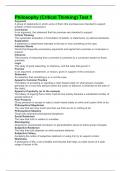
Philosophy (Critical Thinking) Test 1 Argument A group of statements in which some of them (the premises) are intended to support another of them (conclusion) Conclusion In an argument, the statement that the premises are intended to support. Critical Thinking The systematic evaluation or formulation of beliefs, or statements, by rational standards. Explanation A statement or statements intended to tell why or how something is the case. Indicator Words Words that frequently accompany arguments and signal that a premise or conclusion is present. Inference The process of reasoning from a premise or premises to a conclusion based on those premises. Logic The study of good reasoning, or inference, and the rules that govern it. Premise In an argument. at statement, or reason, given in support of the conclusion. Statement An assertion that something is or is not the case. Appeal to Common Practice The fallacy of accepting or rejecting a claim based solely on what groups of people generally do or how they behave (when the action or behavior is irrelevant to the truth of the claim). Appeal to Popularity (or to the masses) The fallacy of arguing that a claim must be true merely because a substantial number of people believe it. Peer Pressure Group pressure to accept or reject a claim based solely on what one's peers think or do. Philosophical Skepticism The view that we know much less than we think we do or nothing at all. Philosophical Skeptics Those who embrace philosophical skepticism. Social Relativism The view that truth is relative to societies. Stereotyping Drawing an unwarranted conclusion or generalization about an entire group of people. Subjective Relativism The idea that truth depends on what someone believes. Subjective Fallacy Accepting the notion of subjective relativism or using it to try to support a claim. Worldview A philosophy of life; a set of beliefs and theories that helps us make sense of a wide range of issues in life. Affirming the Antecedent A valid argument form: (Modus Ponens) If p, then q. p. Therefore, q. Affirming the Consequent An invalid argument form: If p, then q. q. Therefore, p. Antecedent The part of a conditional statement (if p, then q.), the component that begins with the word if. Cogent Argument A strong inductive argument with all true premises. Conditional Statement An "if-then" statement; it consists of the antecedent (the part introduced by the word if) and the consequent (the part introduced by the word then). Consequent The part of a conditional statement (if p, then q) introduced by the word then. Deductive Argument An argument intended to provide logically conclusive support for its conclusion. Denying the Antecedent An invalid argument form: If p, then q. Not p. Therefore, not q. Denying the Consequent A valid argument form: (Modus Tollens) If p, then q. Not q. Therefore, not p. Dependent Premise A premise that depends on at least one other premise to provide joint support to a conclusion. If dependent premise is removed, the support that its linked dependent premises supply to the conclusion is undermined or completely canceled out. Disjunctive Syllogism A valid argument form: Either p or q. Not P. Therefore, q. In the syllogism's second premise, either disjunct can be denied. Hypothetical Syllogism A valid argument made up of three hypothetical, or conditional, statements: If p then q. If q, then r. Therefore, if p, then r. Independent Premise A premise that does not depend on other premises to provide support to a conclusion. If an independent premise is removed, the support that other premises supply to the conclusion is not affected. Inductive Argument An argument in which the premises are intended to provide probable, not conclusive, support for its conclusion. Invalid Argument A deductive argument that fails to provide conclusive support for its conclusion. Modus Ponens A valid argument form: (Affirming the Antecedent) If p, then q. p. Therefore, q. Modus Tollens A valid argument form: (Denying the Consequence) If p, then q. Not q. Therefore, not p. Sound Argument A deductively valid argument that has true premises. Strong Argument An inductive argument that succeeds in providing probable-but not conclusive-support for its conclusion. Syllogism A deductive argument made up of three statements- two premises and a conclusion. Truth-Preserving A characteristic of a valid deductive argument in which the logical structure guarantees the truth of the conclusion if the premises are true. Valid Argument A deductive argument that succeeds in providing conclusive support for its conclusion. Weak Argument An inductive argument that fails to provide strong support for its conclusion. Appeal to Authority The fallacy of relying on the opinion of someone deemed to be an expert who in fact is not an expert.
Información del documento
- Subido en
- 5 de febrero de 2024
- Número de páginas
- 11
- Escrito en
- 2023/2024
- Tipo
- Examen
- Contiene
- Preguntas y respuestas