GNRS 515 Advanced Pathophysiology Exam Questions with Correct Answers
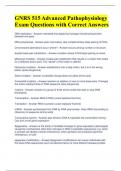
GNRS 515 Advanced Pathophysiology Exam Questions with Correct Answers DNA replication - Answer-untwisted and zipped by hydrogen bonds being broken between two pairs DNA polymerase - Answer-pairs new bases, aka complementary base pairing (ATCG) Chromosome aberrations occur where? - Answer-occurs among number or structure Explain base pair substitution - Answer-mutation where ATCG base pairing is mixed Missense mutation - Answer-A base-pair substitution that results in a codon that codes for a different amino acid. The "sense" of the codon is altered Nonsense mutation - Answer-substitutions into a stop codon, but it is in the wrong place! (quite dangerous) Silent mutation - Answer-nucleotide change does not affect amino acid Frameshift mutation - Answer-insertion or deletion of one or more base pairs. Changes the entire reading frame of DNA sequence (also dangerous) Codons - Answer-consist of a group of three amino acids that start or stop DNA processing Transcription - Answer-DNA to RNA (uracil replaces thymine) Translation - Answer-RNA to protein (uracil replaces thymine) mRNA - Answer-synthesized from DNA by RNA polymerase. Uses tRNA (by binding to ribosome) to sequence amino acids Transcription factors - Answer-also binds to DNA & regulates the transcription timing. Can turn on/off gene expression Epigenetics - Answer-is the study of heritable changes in gene expression (phenotype) caused by mechanisms other than changes in DNA (nucleotide) sequences; e.g. when a somatic cell divides (mitotic inheritance), when gametes are produced (germline inheritance), or both epigenetic modification - Answer-Epigenetic modifications can cause individuals with the same DNA sequences (such as identical twins) to have different disease profiles
Información del documento
- Subido en
- 3 de febrero de 2024
- Número de páginas
- 8
- Escrito en
- 2023/2024
- Tipo
- Examen
- Contiene
- Preguntas y respuestas