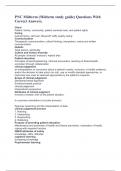
PNC Midterm (Midterm study guide) Questions With Correct Answers.
PNC Midterm (Midterm study guide) Questions With Correct Answers. Client Patient, familiy, community, patient centered care, and patient rights Caring Caring theory, self care, Meyeroff, duffy quality caring Communication Therapeutic communication, critical thinking, interpreters, verbal and written communication Holistic Total person, spirituality Culture and human diversity All people, diversity/ inclusion, implicit bias Patient education Principles of teaching/learning, informal encounters, teaching of illness/health, promotion through collaboration clinical judgement an interpretation or conclusion about a patient's needs, concerns, or health problems, and/or the decision to take action (or not), use or modify standard approaches, or improvise new ones as deemed appropriate by the patient's response Scope of clinical judgement Standards-based approach Evidence-based practice clinical judgement Interpretivist perspective Attributes of clinical judgment Involves a holistic view of the patient situation. Is a process orientation (a circular process). Requires reasoning and the interpretation of data. clinical judgement process 1. Noticing 2. Interpreting 3. Responding 4. Reflecting Purpose of providing patient education Maintenance and promotion of health and illness prevention, restoration of health, coping with impaired function QSEN attributes of safety knowledge, skills, attitudes cognitive learning Increasing knowledge Psychomotor learning acquisition of physical skills Affective learning changes in attitudes, values, and feelings mallows hierarchy of needs ological, safety, love/belonging, esteem, self-actualization Key concepts of patient centered care Respect and dignity, information sharing, participation, and collaboration Elements of Professional Communication courtesy, use of names, trustworthiness, autonomy and responsibility, assertiveness Enculturation the process of learning culture Acculturation the adoption of the behavior patterns of the surrounding culture Personal Philosophy should reflect your commitments, values, and concerns as they relate to future employment. Healthcare Law HIPAA, scope and standards of practice Professional identity Nursing history, uncivilized, nurse humility, comportment Knowledge In order to care, I must understand the others needs and I must be able to respond properly to them, and clearly good intentions do not guarantee this. To care for someone, I must know many things Alternating rhythms In caring for a person, there are times when I do not inject myself into the situation, i dont take a stand one way or another, I do "nothing". And when i undergo this inactivity, i see what resulted from it and may change my behavior accordingly Patience I enable others to grow in their own time and own way Honesty To care for the other, I must see the other as it is and not as what i would like it to be or feel it must be. Trust Caring involves trusting the other to grow in its own time and way Humility Since caring is responsive to the growth of this other, caring involves continuous learning about the other; there is always something more to learn. Humility means overcoming pretentiousness; i am able to present myself as i am without self display and concealment, without posing and indirection Hope There is hope that the other will grow through my caring which is more general than hope. Courage Courage is present in going into the unknown. Courage is performed by having insight from past experiences and it is open and sensitive to the present. Religious care helping patients maintain faithfulness to their belief system and worship practices Spiritual care helping people identify meaning and purpose in life, look beyond the present, and maintain personal relations as well as a relationship with a higher being or life force Hinduism Accepts modern science, past sins cause illness, prolonging life is discouraged, allow time for prayer and purity rituals Sihkism Accepts modern science, females are to be examined by females, removing undergarments causes great distress, allow use or religious symbols, provide time for devotional prayer Buddhism Accepts modern medical science, followers sometimes refuse treatment on holy days, nonhuman spirits invading the body cause illness. They usually accept death at last stage of life and usually permit withdrawal of life support, followers do not practice euthanasia. Good health is maintained by caring for self and others. Medications are not always accepted because belief that chemical substances in the body are harmful Islam Must be able to practice 5 pillars of Islam, faith healing, group prayer is strengthening, do not practice euthanasia, they believe time of death is predetermined and cannot be changed, they maintain a sense of hope and often avoid discussions of death, women prefer female health providers, they usually do not consider organ transplantation or donation and post Mortem examinations Judaism Believes in the sanctity of life, balance between god and medicine,euthanasia is forbidden, allow family to stay with dying patient. Visiting the sick is an obligation Navajos Concepts of health have fundamental place in their concept of humans and their place in the universe. Blessingway is a practice that attempts to remove ill health by means of stories, songs, ritual, prayer, symbols, and paintings. Prefer a holistic approach to health care. Provide teaching about wellness Appalachains External locus of control, nature controls life and health, accepts folk healers. They dislike hospitals and tend not to follow medical regimens but expect to be helped directly when seeking episodic treatment. The become anxious in unfamiliar settings and encourage communication with family and friends when ill. Professional identity a sense of oneself that is influenced by characteristics, norms, and values of the nursing discipline, resulting in an individual thinking, acting, and feeling like a nurse. Incivilty Showing disregard and insolence for others, and causing an atmosphere of disrespect, conflict, and stress. HIPAA (Health Insurance Portability and Accountability Act) law that protects privacy of resident's health information and identifies certain health information that must be kept private and confidential
Información del documento
- Subido en
- 31 de enero de 2024
- Número de páginas
- 5
- Escrito en
- 2023/2024
- Tipo
- Examen
- Contiene
- Preguntas y respuestas