AICE Psychology Vocabulary Questions with Correct Solutions, A+
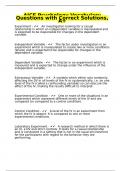
Experiment - An investigation looking for a casual relationship in which an independent variable is manipulated and is expected to be responsible for changes in the dependent variable. Independent Variable - The factor under investigation in an experiment which is manipulated to create two or more conditions (levels) and is expected to be responsible for changes in the dependent variable. Dependent Variable - The factor in an experiment which is measured and is expected to change under the influence of the independent variable. Extraneous Variable - A variable which either acts randomly, affecting the DV in all levels of the IV or systematically, i.e. on one level of the IV (called a confounding variable) so can obscure the effect of the IV, making the results difficult to interpret. Experimental Condition - One or more of the situations in an experiment which represent different levels of the IV and are compared (or compared to a control condition). Control Condition - A level of the IV in an experiment from which the IV is absent. It is compared to one or more experimental conditions. Laboratory Experiment - A research method in which there is an IV, a DV and strict controls. It looks for a casual relationship and is conducted in a setting that is not in the usual environment for the participants with regard to the behavior they are performing. Demand Characteristics - Features of the experimental situation which give away the aims. They can cause participants to try to change their behavior, e.g. to match their beliefs about what is supposed to happen, which reduces the validity of the study. Random Allocation - A way to reduce the effect of confounding variables such as individual differences. Participants are put in each level of the IV such that each person has an equal chance of being in any condition. Repeated Measures Design - An experimental design in which each participant performs in every level of the IV. Participant Variables - Individual differences between participants (such as age, personality and intelligence) that could affect their behavior in a study. They could hide or exaggerate differences between levels of the IV. Order Effects - Practice and fatigue effects are the consequences of participating in a study more than once, e.g in a repeated measures. They cause changes in performance between conditions that are not due to the IV, so can obscure the the effect on the DV. Practice Effect - A situation where participants' performance improves because they experience the experimental task more than once, e.g due to familiarity or learning the task. Fatigue Effect - A situation where participants' performance declines because they have experienced an experimental task more than once, e.g. due to boredom or tiredness. Counterbalancing - Counterbalancing is used to overcome order effects in a repeated measures design. Each possible order of levels of the IV is performed by a different sub-group of participants. This can be described as an ABBA design, as half the participants do condition A then B, and half do B then A. Matched Pairs Design - An experimental design in which participants are arranged into pairs. Each pair is similar in ways that are important to the study and one member of each pair performs in a different level of the IV. Standardization - Keeping the procedure for each participant in an experiment (or interview) exactly the same to ensure that any differences between participants or conditions are due to the variables under investigation rather than differences in the way they were treated. Reliability - The extent to which a procedure, task or measure is consistent, for example that it would produce the same results with the same people on each occasion. Validity - The extent to which the researcher is testing what they claim to be testing.
Información del documento
- Subido en
- 19 de enero de 2024
- Número de páginas
- 11
- Escrito en
- 2023/2024
- Tipo
- Examen
- Contiene
- Preguntas y respuestas