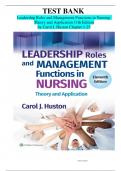
TEST BANK
Leadership Roles and Management Functions in Nursing:
Theory and Application 11th Edition
by Carol J. Huston Chapter 1-25
abirb.com/test
,Chapter 01: Decision Making, Problem Solving, Critical Thinking, and Clinical
Reasoning: Requisites for Successful Leadership and Management
1. The nurse is applying a decision-making process to a clinical challenge. When applying this
process, the nurse must:
a. analyze the root causes of a situation.
b. begin by solving the underlying problem.
c. choose between different courses of action.
d. prioritize the maximum good for the maximum number of people.
ANS: C
Feedback: Decision making is a complex, cognitive process often defined as choosing a
particular course of action. Problem solving is part of decision making and is a systematic
process that focuses on analyzing a difficult situation. It is not always realistic for the nurse
to solve each of the problems contributing to a larger challenge, especially at the beginning
of the decision-making process. The nurse often lacks the time, information, or resources to
analyze the root causes of a situation. Many times, the nurse makes a decision that benefits
the largest number of people, but this is not always feasible or desirable.
PTS: 1 DIF: Moderate REF: Page: 3 OBJ: 1
NAT: Client Needs: Safe and Effective Care Environment: Management of Care
TOP: Chapter Number: 01: Title: Decision Making, Problem Solving, Critical Thinking,
and Clinical Reasoning KEY: Integrated Process: Nursing Process
BLM: Cognitive Level: Apply NOT: Multiple Choice
2. The nurse is applying the traditional problem-solving model when mediating in a conflict
between two colleagues. When applying this model, the nurse should prioritize what task?
a. Identifying the root cause of the conflict
b. Implementing a solution as quickly as possible
c. Eliciting input from other nurses
d. Encouraging each nurse to reflect on his or her actions
ANS: A
Feedback: The traditional problem-solving model attempts to identify the root problem in
situations, a task that can require much time and energy. Efficiency is desirable, but trying
to implement a solution as quickly as possible can result in a hasty and incorrect solution.
Reflective thinking is always beneficial, but this is not a specific component of the
traditional problem-solving model. Outside input may or may not be necessary; this varies
with each individual problem.
PTS: 1 DIF: Moderate REF: Page: 7 OBJ: 1
NAT: Client Needs: Safe and Effective Care Environment: Management of Care
TOP: Chapter Number: 01: Title: Traditional Problem-Solving Process
KEY: Integrated Process: Nursing Process
BLM: Cognitive Level: Analyze NOT: Multiple Choice
3. Which statement is true regarding decision making?
a. Scientific methods provide identical decisions by different individuals for the same
problems.
abirb.com/test
, b. Decisions are greatly influenced by each person’s value system.
c. Personal beliefs can be adjusted for when the scientific approach to problem
solving is used.
d. Past experience has little to do with the quality of the decision.
ANS: B
Feedback: Values, life experience, individual preference, and individual ways of thinking
will influence a person’s decision making. No matter how objective the criteria will be,
value judgments will always play a part in a person’s decision making, either consciously or
subconsciously. It is not possible for a nurse to fully “set aside” personal beliefs when
making a decision, even if the nurse applies the principles of self-reflection.
PTS: 1 DIF: Moderate REF: Page: 17 OBJ: 3
NAT: Client Needs: Safe and Effective Care Environment: Management of Care
TOP: Chapter Number: 01: Title: Values KEY: Integrated Process: Nursing Process
BLM: Cognitive Level: Understand NOT: Multiple Choice
4. The nurse-manager of a short-staffed unit needs to make a decision about a nurse’s request
for an unpaid leave of absence. In order to increase the chance of making a good decision,
the manager should:
a. involve as many people in the decision-making process as possible.
b. begin the decision-making process by presuming the status quo to be the best
option.
c. generate as many different alternatives as possible.
d. prioritize the option that is most innovative.
ANS: C
Feedback: The greater the number of alternatives that can be generated by the decision
maker, the better the final decision will be. Generating multiple alternatives may require
involving more people in the decision-making process, but the process can easily become
unwieldy if too many people are involved. The manager should always consider the status
quo as a possible option, but this is not always considered to be the default option.
Innovation is often a desirable characteristic, but it would be inappropriate to choose an
option solely because it is innovative; many other values must be considered.
PTS: 1 DIF: Moderate REF: Page: 15 OBJ: 4
NAT: Client Needs: Safe and Effective Care Environment: Management of Care
TOP: Chapter Number: 01: Title: Generate Numerous Alternatives
KEY: Integrated Process: Nursing Process
BLM: Cognitive Level: Apply NOT: Multiple Choice
5. An experienced nurse-manager has been described as being a “right-brain thinker.” This
manager’s decision-making process likely prioritizes what characteristic?
a. Linear analysis
b. Intuition
c. Transparency
d. Efficiency
ANS: B
abirb.com/test
, Feedback: Right-brained thinkers have traditionally been characterized as being creative and
intuitive. Linear analysis is more closely aligned with left-brained thinking. Transparency
and efficiency are desirable qualities that are not particularly aligned with either of these
two paradigms.
PTS: 1 DIF: Easy REF: Page: 18 OBJ: 3 | 4
NAT: Client Needs: Safe and Effective Care Environment: Management of Care
TOP: Chapter Number: 01: Title: Brain Hemisphere Dominance and Thinking Styles
KEY: Integrated Process: Nursing Process
BLM: Cognitive Level: Understand NOT: Multiple Choice
6. The nurse-manager is applying an evidence-based approach to a clinical question around
client mobilization. When using a PICO format to search for evidence, the nurse should
identify what?
a. The role of intuition in the decision-making process
b. The preferences of clients and their families
c. The clients for whom the intervention would be relevant
d. Costs associated with a potential change in practice
ANS: C
Feedback: The PICO (patient or population, intervention, comparison, and outcome) format
is used in evidence-based practice to guide the search for the current best evidence to
address a problem. Client and family preferences and cost are included in evidence-based
practice but are not explicit components of the PICO format. Intuition is a component of
decision making but is not specifically included in the PICO format.
PTS: 1 DIF: Moderate REF: Page: 14 OBJ: 5 | 6
NAT: Client Needs: Safe and Effective Care Environment: Management of Care
TOP: Chapter Number: 01: Title: Use an Evidence-Based Approach
KEY: Integrated Process: Nursing Process
BLM: Cognitive Level: Apply NOT: Multiple Choice
7. The nurse-manager is applying the decision-making process when addressing a nurse’s high
rate of absenteeism. This process should result in:
a. an outcome that is desired by all.
b. a chosen course of action.
c. an action that guarantees success.
d. a new understanding of the problem.
ANS: B
Feedback: A decision is made when a course of action has been chosen. A decision may not
always be pleasing to everyone involved in the situation, and success can never be fully
guaranteed. The manager should seek to fully understand the problem, but this is a phase in
decision making, not the result of the process.
PTS: 1 DIF: Easy REF: Page: 3 OBJ: 1
NAT: Client Needs: Safe and Effective Care Environment: Management of Care
TOP: Chapter Number: 01: Title: Decision Making, Problem Solving, Critical Thinking,
and Clinical Reasoning KEY: Integrated Process: Nursing Process
BLM: Cognitive Level: Understand NOT: Multiple Choice
abirb.com/test
Leadership Roles and Management Functions in Nursing:
Theory and Application 11th Edition
by Carol J. Huston Chapter 1-25
abirb.com/test
,Chapter 01: Decision Making, Problem Solving, Critical Thinking, and Clinical
Reasoning: Requisites for Successful Leadership and Management
1. The nurse is applying a decision-making process to a clinical challenge. When applying this
process, the nurse must:
a. analyze the root causes of a situation.
b. begin by solving the underlying problem.
c. choose between different courses of action.
d. prioritize the maximum good for the maximum number of people.
ANS: C
Feedback: Decision making is a complex, cognitive process often defined as choosing a
particular course of action. Problem solving is part of decision making and is a systematic
process that focuses on analyzing a difficult situation. It is not always realistic for the nurse
to solve each of the problems contributing to a larger challenge, especially at the beginning
of the decision-making process. The nurse often lacks the time, information, or resources to
analyze the root causes of a situation. Many times, the nurse makes a decision that benefits
the largest number of people, but this is not always feasible or desirable.
PTS: 1 DIF: Moderate REF: Page: 3 OBJ: 1
NAT: Client Needs: Safe and Effective Care Environment: Management of Care
TOP: Chapter Number: 01: Title: Decision Making, Problem Solving, Critical Thinking,
and Clinical Reasoning KEY: Integrated Process: Nursing Process
BLM: Cognitive Level: Apply NOT: Multiple Choice
2. The nurse is applying the traditional problem-solving model when mediating in a conflict
between two colleagues. When applying this model, the nurse should prioritize what task?
a. Identifying the root cause of the conflict
b. Implementing a solution as quickly as possible
c. Eliciting input from other nurses
d. Encouraging each nurse to reflect on his or her actions
ANS: A
Feedback: The traditional problem-solving model attempts to identify the root problem in
situations, a task that can require much time and energy. Efficiency is desirable, but trying
to implement a solution as quickly as possible can result in a hasty and incorrect solution.
Reflective thinking is always beneficial, but this is not a specific component of the
traditional problem-solving model. Outside input may or may not be necessary; this varies
with each individual problem.
PTS: 1 DIF: Moderate REF: Page: 7 OBJ: 1
NAT: Client Needs: Safe and Effective Care Environment: Management of Care
TOP: Chapter Number: 01: Title: Traditional Problem-Solving Process
KEY: Integrated Process: Nursing Process
BLM: Cognitive Level: Analyze NOT: Multiple Choice
3. Which statement is true regarding decision making?
a. Scientific methods provide identical decisions by different individuals for the same
problems.
abirb.com/test
, b. Decisions are greatly influenced by each person’s value system.
c. Personal beliefs can be adjusted for when the scientific approach to problem
solving is used.
d. Past experience has little to do with the quality of the decision.
ANS: B
Feedback: Values, life experience, individual preference, and individual ways of thinking
will influence a person’s decision making. No matter how objective the criteria will be,
value judgments will always play a part in a person’s decision making, either consciously or
subconsciously. It is not possible for a nurse to fully “set aside” personal beliefs when
making a decision, even if the nurse applies the principles of self-reflection.
PTS: 1 DIF: Moderate REF: Page: 17 OBJ: 3
NAT: Client Needs: Safe and Effective Care Environment: Management of Care
TOP: Chapter Number: 01: Title: Values KEY: Integrated Process: Nursing Process
BLM: Cognitive Level: Understand NOT: Multiple Choice
4. The nurse-manager of a short-staffed unit needs to make a decision about a nurse’s request
for an unpaid leave of absence. In order to increase the chance of making a good decision,
the manager should:
a. involve as many people in the decision-making process as possible.
b. begin the decision-making process by presuming the status quo to be the best
option.
c. generate as many different alternatives as possible.
d. prioritize the option that is most innovative.
ANS: C
Feedback: The greater the number of alternatives that can be generated by the decision
maker, the better the final decision will be. Generating multiple alternatives may require
involving more people in the decision-making process, but the process can easily become
unwieldy if too many people are involved. The manager should always consider the status
quo as a possible option, but this is not always considered to be the default option.
Innovation is often a desirable characteristic, but it would be inappropriate to choose an
option solely because it is innovative; many other values must be considered.
PTS: 1 DIF: Moderate REF: Page: 15 OBJ: 4
NAT: Client Needs: Safe and Effective Care Environment: Management of Care
TOP: Chapter Number: 01: Title: Generate Numerous Alternatives
KEY: Integrated Process: Nursing Process
BLM: Cognitive Level: Apply NOT: Multiple Choice
5. An experienced nurse-manager has been described as being a “right-brain thinker.” This
manager’s decision-making process likely prioritizes what characteristic?
a. Linear analysis
b. Intuition
c. Transparency
d. Efficiency
ANS: B
abirb.com/test
, Feedback: Right-brained thinkers have traditionally been characterized as being creative and
intuitive. Linear analysis is more closely aligned with left-brained thinking. Transparency
and efficiency are desirable qualities that are not particularly aligned with either of these
two paradigms.
PTS: 1 DIF: Easy REF: Page: 18 OBJ: 3 | 4
NAT: Client Needs: Safe and Effective Care Environment: Management of Care
TOP: Chapter Number: 01: Title: Brain Hemisphere Dominance and Thinking Styles
KEY: Integrated Process: Nursing Process
BLM: Cognitive Level: Understand NOT: Multiple Choice
6. The nurse-manager is applying an evidence-based approach to a clinical question around
client mobilization. When using a PICO format to search for evidence, the nurse should
identify what?
a. The role of intuition in the decision-making process
b. The preferences of clients and their families
c. The clients for whom the intervention would be relevant
d. Costs associated with a potential change in practice
ANS: C
Feedback: The PICO (patient or population, intervention, comparison, and outcome) format
is used in evidence-based practice to guide the search for the current best evidence to
address a problem. Client and family preferences and cost are included in evidence-based
practice but are not explicit components of the PICO format. Intuition is a component of
decision making but is not specifically included in the PICO format.
PTS: 1 DIF: Moderate REF: Page: 14 OBJ: 5 | 6
NAT: Client Needs: Safe and Effective Care Environment: Management of Care
TOP: Chapter Number: 01: Title: Use an Evidence-Based Approach
KEY: Integrated Process: Nursing Process
BLM: Cognitive Level: Apply NOT: Multiple Choice
7. The nurse-manager is applying the decision-making process when addressing a nurse’s high
rate of absenteeism. This process should result in:
a. an outcome that is desired by all.
b. a chosen course of action.
c. an action that guarantees success.
d. a new understanding of the problem.
ANS: B
Feedback: A decision is made when a course of action has been chosen. A decision may not
always be pleasing to everyone involved in the situation, and success can never be fully
guaranteed. The manager should seek to fully understand the problem, but this is a phase in
decision making, not the result of the process.
PTS: 1 DIF: Easy REF: Page: 3 OBJ: 1
NAT: Client Needs: Safe and Effective Care Environment: Management of Care
TOP: Chapter Number: 01: Title: Decision Making, Problem Solving, Critical Thinking,
and Clinical Reasoning KEY: Integrated Process: Nursing Process
BLM: Cognitive Level: Understand NOT: Multiple Choice
abirb.com/test