

Glaciation
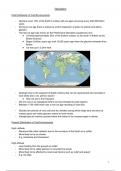
Past Distribution of Cold Environments
- Glaciers cover 10% of the Earth’s surface with ice ages occurring every 200-250million
years
- During an ice age there is presence and/or expansion of polar ice sheets and alpine
glaciers
- The last ice age was known as the Pleistocene Glaciation (quaternary era)
● Covered approximately 30% of the Earth's surface, as far south in Britain as the
Bristol Channel
● Began 2million years ago until 10,000 years ago when the glaciers retreated from
Britain
● Ice was up to 3.2km thick
- Geologic time is the segment of Earth’s history that can be represented and recorded in
rock strata (eon, era, period, epoch)
● Now we are in the Holocene
- We are now in an interglacial where ice has retreated to polar regions
- Between 1750-1850 there was a mini ice age resulting in frost fairs
- Glacials are periods of very cold and dry climates during which large land and sea ice
masses grow and valley glaciers extend to lower levels
- Interglacials are warmer periods where the extent of ice masses begin to retreat
Present Distribution of Cold Environments
High Latitude
- Receives little solar radiation due to the curvature of the Earth so is colder
- More likely to be ice sheets
- E.g. Antarctica and Greenland
High Altitude
- Less heating from the ground so colder
- More likely to be valley glaciers in mountainous areas
- More likely to be affected by local scale factors such as relief and aspect
- E.g. the Alps
1
, Glaciation
Glaciated Landscape Systems
- Glaciers are considered open systems as both energy and matter can be transferred
across the system boundaries into neighbouring systems
- The time scale of a glacial system varies from days to millenia
Formation of Glacial Ice (diagenesis)
- Initially snow falls like flakes (90% air)
- Flakes collect and begin to be compressed by the weight of subsequent snow (becomes
granular ice with 50% air)
- Over time pressure increases causing more melting and expulsion of air (becomes
firn/neve at 30% air)
- Meltwater percolates into the firn and freezes during the following winter to become glacial
ice (20% air)
● This is slower in colder regions where there is little/no seasonal melting
Inputs
- Inputs: precipitation, solar, kinetic and gravitational potential energy, sediment from
weathering, mass movement and avalanches
- Solar thermal energy powers the hydrological cycle which causes evaporation and
subsequent precipitation in the form of snow
● Responsible for atmospheric processes such as wind that input blown snow into the
system
- Gravity provides potential energy as a result of the elevated position of ice masses in the
Earth’s gravitational field
● Results in kinetic energy when debris and snow cause avalanches
- Geothermal energy is an input to the base of the glacier and is responsible for the tectonic
activity that causes uplift of many glacial areas
Throughputs and Stores
- Processes/transfers: transportation, erosion, ice movement, deposition
- The release of frictional heat energy occurs as ice movement leads to an increase in
temperature and the release of latent heat when meltwater within a glacier refreezes
- GPE is stored in rock debris due to its vertical position
Outputs
- Output: calving (breaking away of blocks of an ice sheet/glacier into water), moraine,
ablation including melting, evaporation and sublimation
- Energy leaves the system in the form of heat
2
, Glaciation
Feedback
- If inputs=outputs the glacier is said to be in a state of equilibrium and the size of the glacier
will stay the same
- Glaciers will constantly self regulate as they are in a state of dynamic equilibrium
● The glacier will produce its own response to a disturbance and will gradually change
is form until the balance is restored
- Usually feedback acts to minimise the effects of the disturbance and reestablish the existing
stability using negative feedback
- Rarely, positive feedback will occur to exacerbate the change to the system
Negative example Positive example
1. Glacier in steady state 1. Ice mass grows
2. Increased snowfall in accumulation 2. More ice reflecting sun's energy
zone
3. Glacier advances, more of glacier lies 3. Climate cools further
in ablation zone
4. Output of meltwater increases to the 4. More accumulation of ice
point it is equal to snowfall
Mass Balance
- The mass balance/budget is the difference between the amount of accumulation and
ablation occurring in a glacier over a one year period
- Positive balance is where accumulation exceeds ablation which is normally the case in
winter when temperature are coldest
● The snout will advance
- Negative balance is where ablation exceeds accumulation which is normally the case in
spring and summer when melting occurs due to warmer temperatures
● The snout will retreat
- Due to seasonal variations they may be retreat/advance even when net budget is
positive/negative
- Mass balance is not constant over time due to changes in weather conditions year on year
- Longer term changes can be caused by climate change
- Some glacier have mass balance measurements going back decades which mean
scientists have been able to analyse how mass balance is changing over time
- Physical factors such as aspect can impact glaciated landscapes and how they operate as
a system
● Influence processes of erosion and therefore the shaping of the landscape
- These factors can vary in significance both spatially and temporally
3
Past Distribution of Cold Environments
- Glaciers cover 10% of the Earth’s surface with ice ages occurring every 200-250million
years
- During an ice age there is presence and/or expansion of polar ice sheets and alpine
glaciers
- The last ice age was known as the Pleistocene Glaciation (quaternary era)
● Covered approximately 30% of the Earth's surface, as far south in Britain as the
Bristol Channel
● Began 2million years ago until 10,000 years ago when the glaciers retreated from
Britain
● Ice was up to 3.2km thick
- Geologic time is the segment of Earth’s history that can be represented and recorded in
rock strata (eon, era, period, epoch)
● Now we are in the Holocene
- We are now in an interglacial where ice has retreated to polar regions
- Between 1750-1850 there was a mini ice age resulting in frost fairs
- Glacials are periods of very cold and dry climates during which large land and sea ice
masses grow and valley glaciers extend to lower levels
- Interglacials are warmer periods where the extent of ice masses begin to retreat
Present Distribution of Cold Environments
High Latitude
- Receives little solar radiation due to the curvature of the Earth so is colder
- More likely to be ice sheets
- E.g. Antarctica and Greenland
High Altitude
- Less heating from the ground so colder
- More likely to be valley glaciers in mountainous areas
- More likely to be affected by local scale factors such as relief and aspect
- E.g. the Alps
1
, Glaciation
Glaciated Landscape Systems
- Glaciers are considered open systems as both energy and matter can be transferred
across the system boundaries into neighbouring systems
- The time scale of a glacial system varies from days to millenia
Formation of Glacial Ice (diagenesis)
- Initially snow falls like flakes (90% air)
- Flakes collect and begin to be compressed by the weight of subsequent snow (becomes
granular ice with 50% air)
- Over time pressure increases causing more melting and expulsion of air (becomes
firn/neve at 30% air)
- Meltwater percolates into the firn and freezes during the following winter to become glacial
ice (20% air)
● This is slower in colder regions where there is little/no seasonal melting
Inputs
- Inputs: precipitation, solar, kinetic and gravitational potential energy, sediment from
weathering, mass movement and avalanches
- Solar thermal energy powers the hydrological cycle which causes evaporation and
subsequent precipitation in the form of snow
● Responsible for atmospheric processes such as wind that input blown snow into the
system
- Gravity provides potential energy as a result of the elevated position of ice masses in the
Earth’s gravitational field
● Results in kinetic energy when debris and snow cause avalanches
- Geothermal energy is an input to the base of the glacier and is responsible for the tectonic
activity that causes uplift of many glacial areas
Throughputs and Stores
- Processes/transfers: transportation, erosion, ice movement, deposition
- The release of frictional heat energy occurs as ice movement leads to an increase in
temperature and the release of latent heat when meltwater within a glacier refreezes
- GPE is stored in rock debris due to its vertical position
Outputs
- Output: calving (breaking away of blocks of an ice sheet/glacier into water), moraine,
ablation including melting, evaporation and sublimation
- Energy leaves the system in the form of heat
2
, Glaciation
Feedback
- If inputs=outputs the glacier is said to be in a state of equilibrium and the size of the glacier
will stay the same
- Glaciers will constantly self regulate as they are in a state of dynamic equilibrium
● The glacier will produce its own response to a disturbance and will gradually change
is form until the balance is restored
- Usually feedback acts to minimise the effects of the disturbance and reestablish the existing
stability using negative feedback
- Rarely, positive feedback will occur to exacerbate the change to the system
Negative example Positive example
1. Glacier in steady state 1. Ice mass grows
2. Increased snowfall in accumulation 2. More ice reflecting sun's energy
zone
3. Glacier advances, more of glacier lies 3. Climate cools further
in ablation zone
4. Output of meltwater increases to the 4. More accumulation of ice
point it is equal to snowfall
Mass Balance
- The mass balance/budget is the difference between the amount of accumulation and
ablation occurring in a glacier over a one year period
- Positive balance is where accumulation exceeds ablation which is normally the case in
winter when temperature are coldest
● The snout will advance
- Negative balance is where ablation exceeds accumulation which is normally the case in
spring and summer when melting occurs due to warmer temperatures
● The snout will retreat
- Due to seasonal variations they may be retreat/advance even when net budget is
positive/negative
- Mass balance is not constant over time due to changes in weather conditions year on year
- Longer term changes can be caused by climate change
- Some glacier have mass balance measurements going back decades which mean
scientists have been able to analyse how mass balance is changing over time
- Physical factors such as aspect can impact glaciated landscapes and how they operate as
a system
● Influence processes of erosion and therefore the shaping of the landscape
- These factors can vary in significance both spatially and temporally
3



