

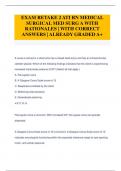
EXAM RETAKE 2 ATI RN MEDICAL SURGICAL MED SURG A WITH RATIONALES | WITH CORRECT ANSWERS | ALREADY GRADED A+ A nurse is caring for a client who has a closed head injury and has an intraventricular catheter placed. Which of the following findings indicates that the client is experiencing increased intracranial pressure (ICP)? (Select all that apply.) A. Flat jugular veins B. A Glasgow Coma Scale score of 15 C. Sleepiness exhibited by the client D. Widening pulse pressure E. Decerebrate posturing ✔✔ C, D, E Flat jugular veins is incorrect. With increased ICP, the jugular veins are typically distended. A Glasgow Coma Scale score of 15 is incorrect. A Glasgow Coma Scale score of 15 indicates neurological functioning within the expected reference range for eye opening, motor, and verbal response. Sleepiness exhibited by the client is correct. Sleepiness or difficulty arousing the client from sleep is an indication of increased ICP. Widening pulse pressure is correct. A widening pulse pressure (increase in systolic with concurrent decrease in diastolic blood pressure) is an indication of increased ICP. Decerebrate posturing is correct. Both decerebrate and decorticate posturing indicate increased ICP. A nurse is preparing a client who has supraventricular tachycardia for elective cardioversion. Which of the following prescribed medications should the nurse instruct the client to withhold for 48 hr prior to cardioversion? A. Enoxaparin B. Metformin C. Diazepam D. Digoxin ✔✔ D. Digoxin Cardiac glycosides, such as digoxin, are withheld prior to cardioversion. These medications can increase ventricular irritability and put the client at risk for ventricular fibrillation after the synchronized countershock of cardioversion. AA A nurse is assessing a client who has acute cholecystitis. Which of the following findings is the nurse's priority? A. Anorexia B. Abdominal pain radiating to the right shoulder C. Tachycardia D. Rebound abdominal tenderness ✔✔ C. Tachycardia When using the urgent vs. nonurgent approach to client care, the nurse should determine that the priority finding is tachycardia. Tachycardia is a manifestation of biliary colic, which can lead to shock. The nurse should position the head of the client's bed flat and report this finding immediately to the provider. A nurse is preparing to admit a client who has dysphagia. The nurse should plan to place which of the following items at the client's bedside? A. Suction machine B. Wire cutters C. Padded clamp D. Communication board ✔✔ A. Suction machine The nurse should ensure that a suction machine is at the bedside of a client who has dysphagia to clear the client's airway as needed and reduce the risk for aspiration. A nurse is caring for a client who is having a seizure. Which of the following interventions is the nurse's priority? A. Loosen the clothing around the client's neck B. Check the client's pupillary response C. Turn the client to the side D. Move furniture away from the client ✔✔ C. Turn the client to the side The greatest risk to this client is hypoxia from an impaired airway. Therefore, the priority intervention the nurse should take is to place the client in a side -lying position to prevent aspiration. A nurse is providing teaching to a client who has hypothyroidism and is receiving levothyroxine. The nurse should instruct the client that which of the following supplements can interfere with the effectiveness of the medication? A. Ginkgo biloba B. Glucosamine C. Calcium D. Vitamin C ✔✔ C. Calcium
Vista previa 4 fuera de 51 páginas
Examen
EXAM RETAKE 2 ATI RN MEDICAL SURGICAL MED SURG A WITH RATIONALES | WITH CORRECT ANSWERS | ALREADY GRADED A+
Vista previa 4 fuera de 51 páginas
A nurse is caring for a client who has a closed head injury and has an intraventricular catheter placed. Which of the following findings indicates that the client is experiencing increased intracranial pressure (ICP)? (Select all that apply.) A. Flat jugular veins B. A Glasgow Coma Scale score of 15 C. Sleepiness exhibited by the client D. Widening pulse pressure E. Decerebrate posturing C, D, E Flat jugular veins is incorrect. With increased ICP, the jugular veins are typically distended
Vista previa del contenido
Información del documento
- Subido en
- 11 de enero de 2024
- Número de páginas
- 51
- Escrito en
- 2023/2024
- Tipo
- Examen
- Contiene
- Preguntas y respuestas
$10.79
¿Documento equivocado? Cámbialo gratis
Dentro de los 14 días posteriores a la compra y antes de descargarlo, puedes elegir otro documento. Puedes gastar el importe de nuevo.
Escrito por estudiantes que aprobaron
Inmediatamente disponible después del pago
Leer en línea o como PDF

Los indicadores de reputación están sujetos a la cantidad de artículos vendidos por una tarifa y las reseñas que ha recibido por esos documentos. Hay tres niveles: Bronce, Plata y Oro. Cuanto mayor reputación, más podrás confiar en la calidad del trabajo del vendedor.
