
• ¿Documento equivocado? Cámbialo gratis
  • Escrito por estudiantes que aprobaron
  • Inmediatamente disponible después del pago
  • Leer en línea o como PDF
Vender
¿Dónde estudias?
Tu idioma
Document preview thumbnail
Vista previa 2 fuera de 5 páginas
Resumen

Summary classic study for learning theories

Document preview thumbnail
Vista previa 2 fuera de 5 páginas

thorough description and evaluation of Watson & Rayner (1921) Little Albert study in terms of Aims, Procedures, Results & Conclusions (APRC) and (SCOUT) for evaluation key terminology in bold / highlighted

Vista previa del contenido

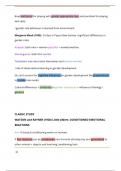
Boys reinforced for playing with gender appropriate toys and punished for playing

with dolls

=gender role behaviour is learned from environment

Margaret Mead (1935): 3 tribes in Papua New Guinea =significant differences in

gender roles

Arapesh: both men + women peaceful + avoided warfare

Mundugumor: both M+F warlike

Tchambuli: men decorated themselves and women worked

=role of observational learning in gender development

SIL can’t account for cognitive influences on gender development like preparedness

to imitate role model

Cultural differences + similarities in gender behaviours = influence of biology /

genetics


CLASSIC STUDY

WATSON and RAYNER (1920) Little Albert: CONDITIONED EMOTIONAL

REACTIONS

Aim: if classical conditioning works on humans

If fear response can be conditioned into 9-month old baby boy and generalised to

other animals + objects and how long conditioning lasts


34

, IV: before conditioning compared to after conditioning

Presented with white rat compared to presented with white, fluffy animals/ objects


Repeated measures design: studies Albert before + after conditioning with rat +other

stimuli (experiencing every conditioning)

DV: n. of fearful behaviors when Albert presented with stimuli

Sample: 1 baby boy aged 9-months at start and 11 at conditioning

His mother was paid 1$ (opportunity)

Procedure: 9-months tested with white rat, rabbit, cotton wool= no fear reaction

(NS)

Banged iron bar= cried (UCR) at loud noise (UCS)

11-months: shown rat 7x paired with striking iron bar = Albert shocked

1 week later: conditioned again

rat presented alone = Albert whimpered

Rat paired with noise 2x again

Rat presented alone = cried

NS now CS = crying is CR

After 10 d: whimpered to rat

Leaned away + cried to rabbit

Crawled away + cried when Santa mask + dog approached =generalisation of

response


35

Información del documento

Nivel de Estudio
Tema
Subido en
4 de enero de 2024
Número de páginas
5
Escrito en
2022/2023
Tipo
Resumen
$5.38

¿Documento equivocado? Cámbialo gratis Dentro de los 14 días posteriores a la compra y antes de descargarlo, puedes elegir otro documento. Puedes gastar el importe de nuevo.
Escrito por estudiantes que aprobaron
Inmediatamente disponible después del pago
Leer en línea o como PDF

Seller avatar
erikakumar
5.0
(1)
Vendido
8
Seguidores
4
Artículos
200
Última venta
7 meses hace


Por qué los estudiantes eligen Stuvia

Creado por compañeros estudiantes, verificado por reseñas

Calidad en la que puedes confiar: escrito por estudiantes que aprobaron y evaluado por otros que han usado estos resúmenes.

¿No estás satisfecho? Elige otro documento

¡No te preocupes! Puedes elegir directamente otro documento que se ajuste mejor a lo que buscas.

Paga como quieras, empieza a estudiar al instante

Sin suscripción, sin compromisos. Paga como estés acostumbrado con tarjeta de crédito y descarga tu documento PDF inmediatamente.

Student with book image

“Comprado, descargado y aprobado. Así de fácil puede ser.”

Alisha Student

Preguntas frecuentes
