Tefl Module 2 Exam Study Guide With Correct Solutions(Updated)
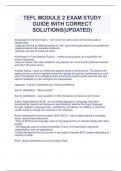
Advantages of General Rubric - -can reuse the same rubric with several tasks or assignments -supports learning by helping learners to "see" good work goes beyond one assignment -supports learner self-evaluation/reflection -learners can help to create the rubric Advantages of Task-Specific Rubrics - -makes scoring easier, as it quantifies the learner responses -easer to create "inter-rater reliability" (any teacher can score another teacher's leaners and "give" the same score) Analytic rubrics - focus on criteria and specific levels of achievement. The teacher will assign points or value to specific criteria then assess the learners' performance in each area. The benefits of an analytical rubric are that the results provide learners with very specific feedback on their strengths and weaknesses. approach - a broad, theoretical way of doing something. ask for clarification - "Who's going?" Ask for clarification - use a question to offer the learner a chance to self-correct Audio-Lingual Method (ALM) - an oral-based approach to language instruction developed by linguists and behavioral psychologists; teaches the target language through repetition, language drills—substituting, reordering, and adding or removing certain words to change the meaning or the emphasis. Basic Interpersonal Communication Skills (BICS) - refer to skills needed in everyday, social, face-to-face interactions. -Think of BICS as the language used on the playground or to interact socially with other people. -The language used is context-embedded. That is, it is meaningful, cognitively undemanding, and non-specialized. -It takes the learner from six months to two years to develop BICS, largely depending on intensity of study. BICS - Basic Interpersonal Communication Skills CALP - Cognitive Academic Language Proficiency Clarification Request - eliciting more information when something is unclear T:What color is your mother's car L: it is white T:okay Cognitive Academic Language Proficiency (CALP) - focuses on proficiency in academic language or language used in the classroom in the various content areas. -Academic language is characterized by being abstract, context-reduced, and specialized. -In addition to acquiring the language, learners need to develop skills such as comparing, classifying, synthesizing, evaluating, and inferring when developing academic competence. -It takes learners at least five years to develop CALP. Competence - is when your learners are able to communicate clearly and understandably their wants, needs, or ideas. -It may not be grammatically accurate and have slightly shuffled syntax, but you clearly understand what they desired to communicate. -The learner may not have the most accurate vocabulary, but they use what they do know to communicate with you. -This is competency, the willingness to attempt, using what they do know to communicate with you. Comprehension Check - checking to see what the learner understood from an activity T:what was the name of the baby L: the baby's name is jojo T: okay. what was the sister's name L: the sister's name is dede Confirmation Check - checking that the learners understand the directions given T:Which dialogue are we reading?" L:The first one
Información del documento
- Subido en
- 1 de enero de 2024
- Número de páginas
- 8
- Escrito en
- 2023/2024
- Tipo
- Examen
- Contiene
- Preguntas y respuestas