Summary, The Adaptive brain
Lecture 1, Chapters 2-4, Electrical Signals of Nerve Cells
How do neurons communicate? →Electrical signalling (and
neurotransmitters)
- a process that underlies all aspects of brain functioning
Neurons:
- Poor generators & conductors of electricity
- Developed mechanism to overcome this limitation
- Based upon the flow of ions across the membrane
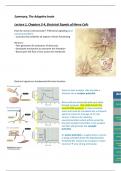
Electrical signals are fundamental for brain function
Touch or heat receptor cells translate a
stimulus into a receptor potential.
Nerve cells are connected with each other
through synapses. One single neuron has
around 1000 synapses. An axon potential
arises and must be translated into a chemical
signal to convey its message to its next
neuron. It does so by releasing
neurotransmitters which will be sensed by
the post-synaptic transmitter in the synapse
and that will generate this synaptic
potential.
An action potential is a signal when a neuron
is being activated above the depolarization
threshold (for instance by receptors or other
neurons) → very strong short pulse.
,Active and passive signals
We have a neuron and two electrodes (electrophysiology). With one we can stimulate the
neuron and the other record the signal in the neuron.
You stick the electrode inside the cell, measuring the potential inside versus outside
(reference electrode in a bath) and you measure the potential difference between these two
electrodes. Nerve cells are hyperpolarized, they have a negative resting membrane potential.
If you have the electrode in the bath, you measure the (before inserting) you do not have a
potential difference=0. When you insert the measuring electrode in the cell, you measure
the cell's resting potential (-50 to -90mV).
• We give a negative injection (e-) of a current and then we see as a response a
negative reflection of this current potential. If you give a twice as big negative
injection, then the hyperpolarization will be twice as strong→ passive responses.
• When we give a positive stimulus (below threshold) this results in depolarization.
• When we increase the amplitude of the positive stimulus twice (reaching threshold),
we get an active response, an action potential. What will happen if we give even
stronger stimulation? →the action potential will not change but the firing frequency
is increased (can be explained by the membrane potential).
One single synapse giving a synaptic potential will not do much, but when more synapses
give synaptic potentials, this can lead to an action potential.
Extra: The bulk of the brain's neurons are excitatory — when they fire, they activate other
neurons and propagate electrical signals throughout the brain. Inhibitory neurons do the
opposite. The volley of chemical messages restrains, or inhibit, other neurons, making them
less likely to fire messages of their own.
So...
• Neurons transfer information via electrical signals
• At rest neurons have a negative resting membrane potential (-50 to -90 mV)
• Injection of negative current induces hyperpolarization
• Injection of positive current induces depolarization
• If depolarization reaches threshold potential an action potential is generated
• An action potential is an all-or-none phenomenon.
,What is the importance of action potentials?
• Carry information: Stimulus intensity is encoded in AP frequency!
• Allow long range signal transduction
Voltage-gated calcium channels will open due to an action potential that has travelled
through the synapse.
This calcium is sensed by a protein synaptotagmin which is found on the vesicles.
Synaptotagmin binds 5 calciums leading to high affinity for the membrane pulling the vesicle
to the membrane and allowing the fusing of the vesicle with the membrane causing
neurotransmitters to be released.
A typical synapse has around 300 vesicles. Only one vesicle fuses as a result of one action
potential. In the hippocampus, the chance of fusion after an action potential is roughly 20%.
, How ion movements produce electrical signals
At rest neurons have a negative potential → resting membrane potential
Resting membrane potential is the electrical potential difference measured across the
membrane (inside with respect to outside→ reference electrode necessary)
• Based on two membrane properties:
-lipid bilayer is impermeable for ions
-specialized ion channels can conduct ions selectively (only one ion group can pass)
• Based on two principles in physics:
-diffusion of particles
-electrical forces between electrical charges
Proteins in the membrane allow ion transport
Lecture 1, Chapters 2-4, Electrical Signals of Nerve Cells
How do neurons communicate? →Electrical signalling (and
neurotransmitters)
- a process that underlies all aspects of brain functioning
Neurons:
- Poor generators & conductors of electricity
- Developed mechanism to overcome this limitation
- Based upon the flow of ions across the membrane
Electrical signals are fundamental for brain function
Touch or heat receptor cells translate a
stimulus into a receptor potential.
Nerve cells are connected with each other
through synapses. One single neuron has
around 1000 synapses. An axon potential
arises and must be translated into a chemical
signal to convey its message to its next
neuron. It does so by releasing
neurotransmitters which will be sensed by
the post-synaptic transmitter in the synapse
and that will generate this synaptic
potential.
An action potential is a signal when a neuron
is being activated above the depolarization
threshold (for instance by receptors or other
neurons) → very strong short pulse.
,Active and passive signals
We have a neuron and two electrodes (electrophysiology). With one we can stimulate the
neuron and the other record the signal in the neuron.
You stick the electrode inside the cell, measuring the potential inside versus outside
(reference electrode in a bath) and you measure the potential difference between these two
electrodes. Nerve cells are hyperpolarized, they have a negative resting membrane potential.
If you have the electrode in the bath, you measure the (before inserting) you do not have a
potential difference=0. When you insert the measuring electrode in the cell, you measure
the cell's resting potential (-50 to -90mV).
• We give a negative injection (e-) of a current and then we see as a response a
negative reflection of this current potential. If you give a twice as big negative
injection, then the hyperpolarization will be twice as strong→ passive responses.
• When we give a positive stimulus (below threshold) this results in depolarization.
• When we increase the amplitude of the positive stimulus twice (reaching threshold),
we get an active response, an action potential. What will happen if we give even
stronger stimulation? →the action potential will not change but the firing frequency
is increased (can be explained by the membrane potential).
One single synapse giving a synaptic potential will not do much, but when more synapses
give synaptic potentials, this can lead to an action potential.
Extra: The bulk of the brain's neurons are excitatory — when they fire, they activate other
neurons and propagate electrical signals throughout the brain. Inhibitory neurons do the
opposite. The volley of chemical messages restrains, or inhibit, other neurons, making them
less likely to fire messages of their own.
So...
• Neurons transfer information via electrical signals
• At rest neurons have a negative resting membrane potential (-50 to -90 mV)
• Injection of negative current induces hyperpolarization
• Injection of positive current induces depolarization
• If depolarization reaches threshold potential an action potential is generated
• An action potential is an all-or-none phenomenon.
,What is the importance of action potentials?
• Carry information: Stimulus intensity is encoded in AP frequency!
• Allow long range signal transduction
Voltage-gated calcium channels will open due to an action potential that has travelled
through the synapse.
This calcium is sensed by a protein synaptotagmin which is found on the vesicles.
Synaptotagmin binds 5 calciums leading to high affinity for the membrane pulling the vesicle
to the membrane and allowing the fusing of the vesicle with the membrane causing
neurotransmitters to be released.
A typical synapse has around 300 vesicles. Only one vesicle fuses as a result of one action
potential. In the hippocampus, the chance of fusion after an action potential is roughly 20%.
, How ion movements produce electrical signals
At rest neurons have a negative potential → resting membrane potential
Resting membrane potential is the electrical potential difference measured across the
membrane (inside with respect to outside→ reference electrode necessary)
• Based on two membrane properties:
-lipid bilayer is impermeable for ions
-specialized ion channels can conduct ions selectively (only one ion group can pass)
• Based on two principles in physics:
-diffusion of particles
-electrical forces between electrical charges
Proteins in the membrane allow ion transport