

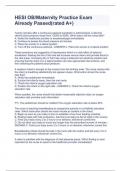
HESI OB/Maternity Practice Exam Already Passed(rated A+)
HESI OB/Maternity Practice Exam Twenty minutes after a continuous epidural anesthetic is administered, a laboring client's blood pressure drops from 120/80 to 90/60. What action will the nurse take? A. Notify the healthcare provider or anesthesiologist immediately B. Continue to assess the blood pressure q5 minutes C. Place the woman in a lateral position D. Turn off the continuous epidural - ANSWER C. Place the woman in a lateral position These symptoms are suggestive of hypotension which is a side effect of epidural anesthesia. Raising the foot of the bed will increase venous return and provide blood to the vital areas. Increasing the IV fluid rate using a balanced non-dextrose solution and ensuring that the client is in a lateral position are also appropriate interventions, and then checking the patients blood pressure. A newborn infant is brought to the nursery from the birthing suite. The nurse notices that the infant is breathing satisfactorily but appears dusky. What action should the nurse take first? A. Notify the pediatrician immediately B. Suction the infant's nares, then the oral cavity C. Check the infant's oxygen saturation rate D. Position the infant on the right side - ANSWER C. Check the infant's oxygen saturation rate When possible, the nurse should first obtain measurable objective data; an oxygen saturation rate provides such information. FYI. The pediatrician should be notified if the oxygen saturation rate is below 90% The nurse is teaching breastfeeding to prospective parents in a childbirth education class. Which instruction should the nurse include as content in the class? A. Begin as soon as your baby is born to establish a four-hour feeding schedule B. Resting helps with milk production. Ask that your baby be fed at night in the nursery C. Feed your baby every 2 to 3 hours or on demand, whichever comes first D. Do not allow your baby to nurse any longer than the prescribed number of minutes - ANSWER C. Feed your baby every 2 to 3 hours or on demand, whichever comes first Breastfeeding infants should be kept in the room with the mother and fed every 2 to 3 hours or on demand--whichever comes first. A client is admitted with the diagnosis of total placenta previa. Which finding is most Already Passed(rated A+)
Información del documento
- Subido en
- 8 de diciembre de 2023
- Número de páginas
- 28
- Escrito en
- 2023/2024
- Tipo
- Examen
- Contiene
- Preguntas y respuestas

