CONTRACT LAW CRYPT SHEET
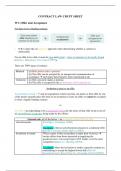
W1: Offer and Acceptance
For there to be a binding contract:
- N.B. Courts take an objective approach when determining whether a contract is
enforceable.
For an offer to be valid, it must be clear and certain + show an intention to be legally bound
(Gibson v Manchester City Council [1979])
There are TWO types of contract:
Bilateral (a) Both parties make a promise
(b) The offer can be accepted by an unequivocal communication of
acceptance each party then bound to what it promised to do
Unilateral (a) Only one party makes a promise
(b) The offer is accepted by the performance of the required act
Invitation to treat vs an offer
An invitation to treat = 1st step in negotiations which may/may not lead to a firm offer by one
of the parties (usually takes the form of an invitation to make an offer). It cannot be accepted
to form a legally binding contract.
vs.
An offer = an undertaking to be contractually bound by the terms of that offer in the event of
an unconditional acceptance being made by the offeree
General rule: all of the below = an invitation to treat NOT an offer
Advertisements Partridge v Crittenden [1968]
Exception: when an advertisement amounts to a unilateral offer
(Carlill v Carbolic Smoke Ball Co (1983)
Invitations to tender When a party wishes to purchase a major item of service
invites offers from those interested in supplying the
goods/services. Can accept/reject ANY tender, even the most
competitive (Spencer v Harding (1870))
Exception: where the invitation to tender expressly contains an
undertaking to accept the highest/lowest bid (Harvela
Investments Ltd v Royal Trust Co. of Canada (Cl) Ltd [1985])
, Display of goods for sale Fisher v Bell [1961]
Auction sales The auctioneer’s request for a bid = invitation to treat
bidder makes an offer which the auctioneer can accept/reject
at the fall of the auctioneer’s hammer = acceptance (Payne
v Cave (1789))
Special consideration: auctions ‘without reserve’
- Many auction sales have a reserve price, if no bid above the
price is received, the seller keeps the goods
- Without reserve = the seller promises to sell to the highest
bidder whatever that bid turns out to be [unilateral contract]
(Barry v Davies [2000])
An offer can be terminated in THREE ways:
(1) Rejection
© Once rejected, it cannot then be accepted (unless offeror makes the same offer again).
o Rejection does not take effect until it is actually communicated to the offeror
© When a counteroffer is made, the original offer is deemed to have been rejected
(Hyde v Wrench (1840))
KEY: Counteroffer vs. a request for information
® Request for information = when an offeree responds to an offer seeking a clarification
of the extent & terms of the offer, or to ascertain if the offeror would consent to
changing certain ancillary aspects of the offer
® Original offer remains open for acceptance w/ a request for info
® See Stevenson, Jacques & Co. v McLean (1880)
(2) Lapse
Passage of time (1) acceptance not made within the period prescribed by the offeror
(2) no period is prescribed, and acceptance is not made within a
reasonable time
Death of a party Offeror: if the offeree knows the offeror has died, the offer will lapse.
However, if the offeree was unaware, offer probably will not lapse.
Offeree: offer lapses – offer cannot be accepted by offeree’s reps
(3) Revocation
An offer can be revoked at ANY time prior to acceptance (Payne v Cave).
Revocation is effective provided the offeror has shown (by words or conduct) a CLEAR
intention to revoke their offer + notice reaches the offeree. Means of communication do not
matter – effective even if communicated by a THIRD PARTY (Dickinson v Dodds)
N.B. W/ unilateral contracts, where the offeree has partly performed the obligation & is
willing and able to complete it = no revocation (Errington v Errington & Woods)
, Communication of an unequivocal acceptance
(1) Acceptance must be in Only the offerees can accept
response to the offer
(2) Acceptance must be ‘Mirror image rule’: acceptance must correspond
unqualified exactly w/ the terms of the offer
Hyde v Wrench (1840)
(3) It may be necessary to follow Acceptance may be communicated in ANY manner
a prescribed mode of acceptance However, if the offeror prescribes the mode of
acceptance, other manners of communication may
not suffice
Tinn v Hoffman (1873) - unless the prescribed mode
of acceptance is made mandatory, another mode
of acceptance which is no less advantageous to the
offeror will bind them
(4) Acceptance MUST BE COMMUNICATED
General rule = acceptance is effective from the time it is communicated to the offeror
* Third party communication of acceptance is possible – a contract can come into
existence where a person other than the offeree informs the offeror of acceptance*
Exception: postal rule - acceptance takes effect from moment the letter is properly posted
= postal rule (Adams v Lindsell (1818))
Postal rule applies even if the letter is delayed or lost in the post (Household Fire
and Carriage Accident Insurance Co. v Grant (1879))
Exceptions to the postal rule:
o (1) if letter was not properly posted
o (2) if it is not contemplated that the post would be used (Henthorn v Fraser)
o (3) if it would be manifestly inconvenient or absurd
o (4) if the letter is incorrectly addressed
o (5) if the offeror has ousted the postal rule (Holwell Securities v Hughes)
*Acceptance by an instantaneous mode of communication = still when it is received by the
offeror (Entores v Miles Far East Corporation [1955] 2 QB 327)
- Email = a form of instantaneous communication – postal rule is inapplicable (Thomas v
BPE Solicitors [2010])
- N.B. Must be sent WITHIN ordinary office hours – (Mondial Shipping and Chartering
BV v Astarte Shipping Ltd [1995]) if not = next working day!
Communication of acceptance = WAIVED in a unilateral contract!
All material terms must be certain and complete for a contract to be binding. Court will only
enforce an agreement that is sufficiently certain. Applies an objective test to decide.
© Agreement on ‘hire-purchase terms’ = too uncertain to be enforced as there are many
different kinds of hire-purchase agreements w/ different terms (Scammell v Ouston)
W1: Offer and Acceptance
For there to be a binding contract:
- N.B. Courts take an objective approach when determining whether a contract is
enforceable.
For an offer to be valid, it must be clear and certain + show an intention to be legally bound
(Gibson v Manchester City Council [1979])
There are TWO types of contract:
Bilateral (a) Both parties make a promise
(b) The offer can be accepted by an unequivocal communication of
acceptance each party then bound to what it promised to do
Unilateral (a) Only one party makes a promise
(b) The offer is accepted by the performance of the required act
Invitation to treat vs an offer
An invitation to treat = 1st step in negotiations which may/may not lead to a firm offer by one
of the parties (usually takes the form of an invitation to make an offer). It cannot be accepted
to form a legally binding contract.
vs.
An offer = an undertaking to be contractually bound by the terms of that offer in the event of
an unconditional acceptance being made by the offeree
General rule: all of the below = an invitation to treat NOT an offer
Advertisements Partridge v Crittenden [1968]
Exception: when an advertisement amounts to a unilateral offer
(Carlill v Carbolic Smoke Ball Co (1983)
Invitations to tender When a party wishes to purchase a major item of service
invites offers from those interested in supplying the
goods/services. Can accept/reject ANY tender, even the most
competitive (Spencer v Harding (1870))
Exception: where the invitation to tender expressly contains an
undertaking to accept the highest/lowest bid (Harvela
Investments Ltd v Royal Trust Co. of Canada (Cl) Ltd [1985])
, Display of goods for sale Fisher v Bell [1961]
Auction sales The auctioneer’s request for a bid = invitation to treat
bidder makes an offer which the auctioneer can accept/reject
at the fall of the auctioneer’s hammer = acceptance (Payne
v Cave (1789))
Special consideration: auctions ‘without reserve’
- Many auction sales have a reserve price, if no bid above the
price is received, the seller keeps the goods
- Without reserve = the seller promises to sell to the highest
bidder whatever that bid turns out to be [unilateral contract]
(Barry v Davies [2000])
An offer can be terminated in THREE ways:
(1) Rejection
© Once rejected, it cannot then be accepted (unless offeror makes the same offer again).
o Rejection does not take effect until it is actually communicated to the offeror
© When a counteroffer is made, the original offer is deemed to have been rejected
(Hyde v Wrench (1840))
KEY: Counteroffer vs. a request for information
® Request for information = when an offeree responds to an offer seeking a clarification
of the extent & terms of the offer, or to ascertain if the offeror would consent to
changing certain ancillary aspects of the offer
® Original offer remains open for acceptance w/ a request for info
® See Stevenson, Jacques & Co. v McLean (1880)
(2) Lapse
Passage of time (1) acceptance not made within the period prescribed by the offeror
(2) no period is prescribed, and acceptance is not made within a
reasonable time
Death of a party Offeror: if the offeree knows the offeror has died, the offer will lapse.
However, if the offeree was unaware, offer probably will not lapse.
Offeree: offer lapses – offer cannot be accepted by offeree’s reps
(3) Revocation
An offer can be revoked at ANY time prior to acceptance (Payne v Cave).
Revocation is effective provided the offeror has shown (by words or conduct) a CLEAR
intention to revoke their offer + notice reaches the offeree. Means of communication do not
matter – effective even if communicated by a THIRD PARTY (Dickinson v Dodds)
N.B. W/ unilateral contracts, where the offeree has partly performed the obligation & is
willing and able to complete it = no revocation (Errington v Errington & Woods)
, Communication of an unequivocal acceptance
(1) Acceptance must be in Only the offerees can accept
response to the offer
(2) Acceptance must be ‘Mirror image rule’: acceptance must correspond
unqualified exactly w/ the terms of the offer
Hyde v Wrench (1840)
(3) It may be necessary to follow Acceptance may be communicated in ANY manner
a prescribed mode of acceptance However, if the offeror prescribes the mode of
acceptance, other manners of communication may
not suffice
Tinn v Hoffman (1873) - unless the prescribed mode
of acceptance is made mandatory, another mode
of acceptance which is no less advantageous to the
offeror will bind them
(4) Acceptance MUST BE COMMUNICATED
General rule = acceptance is effective from the time it is communicated to the offeror
* Third party communication of acceptance is possible – a contract can come into
existence where a person other than the offeree informs the offeror of acceptance*
Exception: postal rule - acceptance takes effect from moment the letter is properly posted
= postal rule (Adams v Lindsell (1818))
Postal rule applies even if the letter is delayed or lost in the post (Household Fire
and Carriage Accident Insurance Co. v Grant (1879))
Exceptions to the postal rule:
o (1) if letter was not properly posted
o (2) if it is not contemplated that the post would be used (Henthorn v Fraser)
o (3) if it would be manifestly inconvenient or absurd
o (4) if the letter is incorrectly addressed
o (5) if the offeror has ousted the postal rule (Holwell Securities v Hughes)
*Acceptance by an instantaneous mode of communication = still when it is received by the
offeror (Entores v Miles Far East Corporation [1955] 2 QB 327)
- Email = a form of instantaneous communication – postal rule is inapplicable (Thomas v
BPE Solicitors [2010])
- N.B. Must be sent WITHIN ordinary office hours – (Mondial Shipping and Chartering
BV v Astarte Shipping Ltd [1995]) if not = next working day!
Communication of acceptance = WAIVED in a unilateral contract!
All material terms must be certain and complete for a contract to be binding. Court will only
enforce an agreement that is sufficiently certain. Applies an objective test to decide.
© Agreement on ‘hire-purchase terms’ = too uncertain to be enforced as there are many
different kinds of hire-purchase agreements w/ different terms (Scammell v Ouston)