
Exit HESI Practice: Fundamentals
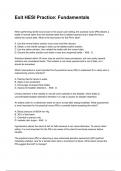
Exit HESI Practice: Fundamentals When performing sterile wound care in the acute care setting, the practical nurse (PN) obtains a bottle of normal saline from the bedside table that is labeled opened and is dated 48 hours before the current date. What is the best action for the PN to take? A. Use the normal saline solution once more and then discard. B. Obtain a new sterile syringe to draw up the labeled saline solution. C. Use the saline solution, then relabel the bottle with the current date. D. Discard the saline solution and obtain a new and unopened bottle. - ANS D. Solutions labeled within 24 hours may be used for clean procedures, but only newly opened solutions are considered sterile. This solution is not newly opened and is out of date, so it should be discarded. Which intervention is most important for the practical nurse (PN) to implement for a client who is experiencing urinary retention? A. Placing client's hands in water. B. Apply a skin protectant. C. Encourage increased fluid intake. D. Assess for bladder distention. - ANS D. Urinary retention is the inability to void all urine collected in the bladder, which leads to uncomfortable bladder distention therefore it is vital to assess for bladder distention. An elderly client in a wheelchair wants to return to bed after eating breakfast. What assessment is most important for the practical nurse (PN) to consider before assisting this client? A. Blood pressure of 86/54 mm Hg B. 30% of diet eaten C. Oriented to person only D. Inelastic skin turgor - ANS A. Hypotension places the client at risk for falls because it can cause dizziness. To ensure client safety, it is most important for the PN to be aware of the client's low blood pressure before transfer. The practical nurse (PN) is observing a new unlicensed assistive personnel (UAP) perform indwelling catheter care for a female client who is incontinent of feces. What action should the PN suggest the UAP to change? A. Frequently rinses the washcloth used to clean the perineum B. Wipes the perineum from front to back C. Applies a skin barrier ointment to irritated perianal areas D. Places the client in a lateral Sims position with the opposite bed rails elevated - ANS A. Even though the washcloth is rinsed frequently, it remains contaminated with fecal materials, and the PN should recommend the use of disposable wipes or separate washcloths, which are less likely to bring fecal flora to the urethral opening. When reading a prescription, what should the practical nurse (PN) verify in addition to the "five rights" of medication administration? A. Anticipated adverse effects B. Required client teaching C. Client's allergies D. Prescriber's signature - ANS D. A legal medication prescription must include the prescriber's signature. The practical nurse (PN) is administering a rectal suppository to a client. What action should be implemented to prevent discomfort during administration? A. Place the suppository high in the rectum. B. Freeze the suppository before insertion. C. Allow the suppository soften before insertion. D. Avoid use of a lubricant with insertion. - ANS C. Allowing the suppository to soften slightly before insertion will decrease the possibility of causing trauma or discomfort to the client. During the initial morning assessment, a client denies dysuria but reports dark amber urine. Which intervention should the practical nurse (PN) implement? A.Provide additional coffee on the client's breakfast tray. B. Exchange the client's grape juice for cranberry juice. C. Bring the client additional fruit at midmorning. D. Encourage additional oral intake of juices and water. - ANS D. Dark amber urine is characteristic of fluid volume deficit, and the client should be encouraged to increase fluid intake. The practical nurse (PN) is assessing several clients before surgery. Which factor in a client's history poses the greatest threat for complications to occur during surgery? A. Taking birth control pills for the past 2 years B. Taking anticoagulants for the past year C. Has recently completed antibiotic therapy D. Has taken laxatives PRN for the last 6 months - ANS B. Anticoagulants increase the risk for bleeding during surgery, which can pose a threat for developing surgical complications. The health care provider should be informed that the client is taking such drugs. Which action should the practical nurse (PN) implement to ensure that eye ointment is distributed evenly across the eye and lid margin? A. Apply the ointment along the upper outer edge of the eyelid from the outer to the inner canthus. B. Instill the ointment along the lower inner edge of the eyelid from the inner to the outer canthus. C. Spread the ointment along the lower outer edge of the eyelid from the outer to the inner canthus. D. Place the ointment along the upper and lower inner edges of the eyelids from the inner to the outer canthus. - ANS B. To instill eye ointment, the practical nurse (PN) would hold the ointment applicator above the lower lid margin and apply a thin stream of ointment along the inner edge of the lower eyelid on the conjunctiva from the inner canthus to the outer canthus. The practical nurse (PN) is assisting with bathing an independent adult client who has a plaster cast on the right forearm. Which action should the PN implement to encourage self-care by the client? A. Wrap the client's cast in a plastic bag. B. Move the client to the bathroom sink. C. Provide back care and foot care as needed. D. Give oral hygiene and perineal care. - ANS C. The PN should provide back care, foot care, and other assistance as needed by the client, but the client's independence should be encouraged and his privacy respected. A mother calls the clinic and states that she does not know how many teaspoons of medication to give her child because the directions on the bottle read, "Give 15 mL." How many teaspoons should the practical nurse (PN) instruct the mother to administer to her child? (Fill in the blank. Type in numbers only as your answer and round to nearest whole number). - ANS 3 tsp. 5 mL = 1 teaspoon. 5 × 3 = 15 mL = 3 teaspoons. The practical nurse (PN) is assessing the orientation of an elderly client. The client is unable to remember the year and reports being lost and unfamiliar with the surroundings. What documentation is the most accurate for the PN to make? A. Demonstrates loss of remote memory B. Exhibits expressive dysphasia C. Has a diminished attention span D. Is disoriented to time and place - ANS D. The client is exhibiting disorientation. The practical nurse (PN) is administering medications to a client via a nasogastric tube. The 0900 medications include a sustained-release spansule. Which action should the PN take when administering the sustained-release drug via the nasogastric tube (NGT)? A. Consult the health care provider for a different drug form that can be crushed. B. Open the spansule and flush the pellets through the tubing. C. Omit the medication and document the reason. D. Advance the tube into the small intestine before giving the medication. - ANS A. Administration of sustained-release (SR) spansules is contraindicated via nasogastric tube so the PN would have to consult the health care provider for a different drug form that can be crushed. Following an open reduction of a fractured femur, a client is placed in skeletal traction. Based on the nursing diagnosis of "Potential impairment of skin integrity related to immobility," which nursing intervention should the practical nurse (PN) implement? A. Release the traction, turn the client, and give back care. B. Turn the client while someone lifts the traction weights and give back care. C. Lubricate the hands, slide them under the client, and give back care. D. Give back care after the client is released from traction. - ANS C. Back care provides the best method for solving immobility problems, such as skin breakdown, when the client is in traction. The spouse of a client with terminal cancer provided the practical nurse (PN) with a copy of the client's living will. What action should the PN take? A. Place a certified copy of the living will in the client's chart. B. Notify the health care provider of the client's wishes. C. Alert the nursing staff of the client's "do not resuscitate" (DNR) status. D. Facilitate a family meeting with the palliative care team. - ANS B. The health care provider needs to be informed of the clientʼs wishes and a prescription written to specify how the staff should respond to medical emergencies. A copy should be placed on the chart, but it does not need to be a certified copy. A living will does not necessarily indicate DNR status. The client and the clientʼs family should be informed about palliative care, but a meeting with the team should be facilitated only at their request.
Información del documento
- Subido en
- 30 de noviembre de 2023
- Número de páginas
- 5
- Escrito en
- 2023/2024
- Tipo
- Examen
- Contiene
- Preguntas y respuestas

