Chapter seven: Cell structure and function
7.2
a eukaryotic cell (means true nucleus) is a type of cell with a membrane-enclosed nucleus
and membrane-enclosed organelles. Organisms met eukaryotic cells are (protists, plants,
fungi and animals) called eukaryotes.
A prokaryotic cell (means before nucleus) is a type of cell lacking a membrane-enclosed
nucleus and membrane-enclosed organelles. Organisms with prokaryotic cells (bacteria and
algae) are called prokaryotes.
Both pro- and eukaryotic have a plasma membrane (or cell membrane): a selective barrier
that lets through oxygen, nutrients and wastes to service of the entire cell. For each
micrometer of membrane, only a limited amount of particular substance can cross per
second, so the ratio of surface area to volume is critical. Area is proportional to a linear
dimension squared, whereas volume is proportional to
the linear dimension cubed. So: smaller objects have a
greater ratio of surface area to volume. Big eukaryotic
cells have not larger cells, but they have more cells.
Inside the cell is a jellylike substance called: cytosol.
All cells contain chromosomes, which carry genetic
information.
All cells contain ribosomes, tiny complexes that make
proteins according to the instructions from the genes.
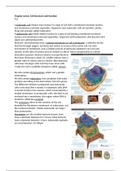
The difference between prokaryotic and eukaryotic
cells is the way DNA is stored. In eukaryotic cells DNA
is stored mostly in the nucleus, which is bounded by a
double membrane. In prokaryotic cells, the DNA is not
enclosed into a membrane, the region where DNA is
located is called the nucleoid.
The cytoplasm refers to the contents of the cell
bounded by the plasma membrane, in eukaryotes: not
the nucleus included. Mostly eukaryotes are larger
than prokaryotes.
Mycoplasts are the smallest bacteria known, they
have a diameter between 0,1-1,0 µm. Most bacteria
have a diameter between 1-5µm. eukaryotes typically
are sized between 10-100µm.
7.2
a eukaryotic cell (means true nucleus) is a type of cell with a membrane-enclosed nucleus
and membrane-enclosed organelles. Organisms met eukaryotic cells are (protists, plants,
fungi and animals) called eukaryotes.
A prokaryotic cell (means before nucleus) is a type of cell lacking a membrane-enclosed
nucleus and membrane-enclosed organelles. Organisms with prokaryotic cells (bacteria and
algae) are called prokaryotes.
Both pro- and eukaryotic have a plasma membrane (or cell membrane): a selective barrier
that lets through oxygen, nutrients and wastes to service of the entire cell. For each
micrometer of membrane, only a limited amount of particular substance can cross per
second, so the ratio of surface area to volume is critical. Area is proportional to a linear
dimension squared, whereas volume is proportional to
the linear dimension cubed. So: smaller objects have a
greater ratio of surface area to volume. Big eukaryotic
cells have not larger cells, but they have more cells.
Inside the cell is a jellylike substance called: cytosol.
All cells contain chromosomes, which carry genetic
information.
All cells contain ribosomes, tiny complexes that make
proteins according to the instructions from the genes.
The difference between prokaryotic and eukaryotic
cells is the way DNA is stored. In eukaryotic cells DNA
is stored mostly in the nucleus, which is bounded by a
double membrane. In prokaryotic cells, the DNA is not
enclosed into a membrane, the region where DNA is
located is called the nucleoid.
The cytoplasm refers to the contents of the cell
bounded by the plasma membrane, in eukaryotes: not
the nucleus included. Mostly eukaryotes are larger
than prokaryotes.
Mycoplasts are the smallest bacteria known, they
have a diameter between 0,1-1,0 µm. Most bacteria
have a diameter between 1-5µm. eukaryotes typically
are sized between 10-100µm.