BTEC Level 3 Extended Diploma in Applied Science
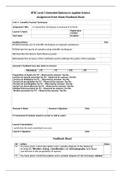
Assignment Front Sheet/Feedback Sheet
Unit 4: Scientific Practical Techniques
Assignment Title: 4.2 Separation Techniques & Assessment of Purity
Registration
Learner’s Name: number:
Start Date: Deadline:
Grading Criteria: Met
P2 Demonstrate use of scientific techniques to separate substances.
P3 Estimate the purity of samples using scientific techniques.
M2 Describe the factors that influence purity
D2 Evaluate the accuracy of the methods used to estimate the purity of the samples.
Assessor’s Feedback (see also sheet on reverse)
Attempted: P2 P3 M2 D3
Preparation of Aspirin for P2 – Observed by assessor: Yes/No
Carried out solvent extraction for P2 – Observed by assessor: Yes/No
Carried out distillation for P2 – Observed by assessor: Yes/No
Carried out precipitation for P2 – Observed by assessor: Yes/No
Carried out centrifugation for P2 – Observed by assessor: Yes/No
Carried out electrophoresis for P2 – Observed by assessor: Yes/No
Melting Point procedure for P3 – Observed by assessor: Yes/No
Titration procedure for P3 – Observed by assessor: Yes/No
Assessor’s Name Assessor’s Signature Date
IV Comments (if student needs to correct or add to work)
Learner’s Declaration:
I certify that the work submitted is my own.
Learner’s Signature Date
Feedback Sheet
GC Action Done
P2 You have given a brief description and a suitable diagram of the following
techniques: filtration, drying, crystallisation and chromatography techniques
(carried out in the preparation of aspirin).
P2 You have given a brief description and a suitable diagram of the technique solvent
, extraction.
P2 You have given a brief description and a suitable diagram of the technique
distillation.
P2 You have given a brief description and a suitable diagram of the technique
precipitation.
P2 You have given a brief description and a suitable diagram of the technique
centrifugation.
P2 You have given a brief description and a suitable diagram of the technique
electrophoresis.
P3 For the chromatography technique you have calculated the Rf values and
commented on them.
P3 You have briefly written up what you did in measuring the melting point in 3 rd
person past tense.
P3 Your measured value for the melting point has been compared to the actual value
from a data source.
P3 You have briefly written up what you did in the titration of river water in 3rd person
past tense.
P3 You have included a full balanced equation for the titration.
P3 You have processed your titration results and calculated the concentration
correctly.
M2 The calculation for the percentage yield of aspirin, produced in Task 1, has been
calculated correctly.
M2 You have shown your working out step-by-step which includes the theoretical yield
to work out the percentage yield.
M2 Factors which may affect the purity of your final product leading up to
re-crystallisation (including filtration and drying) have been discussed.
M2 Also link this to your melting point measured compared to the actual value from
data values.
D2 You have evaluated the accuracy of your results for each of the three methods
used in Task 2 (chromatography, melting point and titration techniques).
D2 Procedural errors and measurement errors have been identified for each of the
techniques.
D2 Workable improvements have been suggested for each error identified.
4.2:
Separation Techniques & Assessment of purity:
Chromatography
Chromatography is an expression used to describe
the technique and process of mixtures. The
mixtures separate by being dissolved in a liquid
called the mobile phase (carrier) which is moulded
into a structure carried by another material known
as the stationary phase. In the process of
chromatography different quantities of the
substances move at different speed which causes
the separation, the separation is solely established
by the differential splitting of the mobile and
stationary phase. If the different substances
Assignment Front Sheet/Feedback Sheet
Unit 4: Scientific Practical Techniques
Assignment Title: 4.2 Separation Techniques & Assessment of Purity
Registration
Learner’s Name: number:
Start Date: Deadline:
Grading Criteria: Met
P2 Demonstrate use of scientific techniques to separate substances.
P3 Estimate the purity of samples using scientific techniques.
M2 Describe the factors that influence purity
D2 Evaluate the accuracy of the methods used to estimate the purity of the samples.
Assessor’s Feedback (see also sheet on reverse)
Attempted: P2 P3 M2 D3
Preparation of Aspirin for P2 – Observed by assessor: Yes/No
Carried out solvent extraction for P2 – Observed by assessor: Yes/No
Carried out distillation for P2 – Observed by assessor: Yes/No
Carried out precipitation for P2 – Observed by assessor: Yes/No
Carried out centrifugation for P2 – Observed by assessor: Yes/No
Carried out electrophoresis for P2 – Observed by assessor: Yes/No
Melting Point procedure for P3 – Observed by assessor: Yes/No
Titration procedure for P3 – Observed by assessor: Yes/No
Assessor’s Name Assessor’s Signature Date
IV Comments (if student needs to correct or add to work)
Learner’s Declaration:
I certify that the work submitted is my own.
Learner’s Signature Date
Feedback Sheet
GC Action Done
P2 You have given a brief description and a suitable diagram of the following
techniques: filtration, drying, crystallisation and chromatography techniques
(carried out in the preparation of aspirin).
P2 You have given a brief description and a suitable diagram of the technique solvent
, extraction.
P2 You have given a brief description and a suitable diagram of the technique
distillation.
P2 You have given a brief description and a suitable diagram of the technique
precipitation.
P2 You have given a brief description and a suitable diagram of the technique
centrifugation.
P2 You have given a brief description and a suitable diagram of the technique
electrophoresis.
P3 For the chromatography technique you have calculated the Rf values and
commented on them.
P3 You have briefly written up what you did in measuring the melting point in 3 rd
person past tense.
P3 Your measured value for the melting point has been compared to the actual value
from a data source.
P3 You have briefly written up what you did in the titration of river water in 3rd person
past tense.
P3 You have included a full balanced equation for the titration.
P3 You have processed your titration results and calculated the concentration
correctly.
M2 The calculation for the percentage yield of aspirin, produced in Task 1, has been
calculated correctly.
M2 You have shown your working out step-by-step which includes the theoretical yield
to work out the percentage yield.
M2 Factors which may affect the purity of your final product leading up to
re-crystallisation (including filtration and drying) have been discussed.
M2 Also link this to your melting point measured compared to the actual value from
data values.
D2 You have evaluated the accuracy of your results for each of the three methods
used in Task 2 (chromatography, melting point and titration techniques).
D2 Procedural errors and measurement errors have been identified for each of the
techniques.
D2 Workable improvements have been suggested for each error identified.
4.2:
Separation Techniques & Assessment of purity:
Chromatography
Chromatography is an expression used to describe
the technique and process of mixtures. The
mixtures separate by being dissolved in a liquid
called the mobile phase (carrier) which is moulded
into a structure carried by another material known
as the stationary phase. In the process of
chromatography different quantities of the
substances move at different speed which causes
the separation, the separation is solely established
by the differential splitting of the mobile and
stationary phase. If the different substances