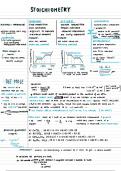
STOICHIOMETRY
COMPOUNDS MIXTURES HOMOGENEOUS
Mixtures -1 compounds •
fixed composition -
variable composition -
uniform state -1 composition
•
pure substance
•
impure substance +
properties
YP"
-
mixtures retain their orig -
•
difficult to separate chemical components of
'
unable to see particles
inch properties mixtures water
individual elements are easily separated salt
eg . air lgases ) r> + ethanol
vodka ( liquids ) metal
j
immehfciblb examples :
examples : water all0YS
↳ tou heterogeneous
water , salt ,
methane saltwater , salad , air HETEROGENEOUS
does not become
homogeneous when mixed chemically combined Physically combined nonuniform composition -1
'
-1
properties state
phase
e e
changes of
g
able to see individual
{
÷'°N
EVAPORATING
matter § § components
(
-
,
NG
d l l £ l
( layers )
> mass stays the same, s MEEK l
S '
' eg oil .
water
+
g l I 1 soda ice+
§ '
density changes
' ' '
o
' '
I 1 salad
+ :
' '
§ ! I 1 i
n
-s - n
(
¥1b
- -
(
SOLID LIQUID LIQUID Wz )
GAS (Ef .
time time
sublimation
* solid
'
horizontal 's as the horizontal as the energy gas
heat energy is used is used to form bonds
to break bonds
deposition
THE MOLE equation
)
this would
(
>
the amount of a moles =
MASI O 5m01s of
-
Nacl has 3.0×10² of Nat "
have 6.0×10
( Mot ) formula " -
substance that has the mass 3-0×10 of Na ions
same number of particles
&
atomic mass : mass of nucleons present in the nucleus
of al atom
as 12g of the c- 12 relative atomic mass :
⑳
ae mass of all the isotopes of an element
isotope formula mass : add to RAM of all the particles in an ionic species .
MUST INCLUDE
>
12g of C- 120T isotope ✗ H2O in the
. formula eg . Cus 04.51-b0 ( for each copper sulfate ioh there are 5
has 6-02×1023 particles molecules of water attached to it . -> unit (M)
* All MASSES ARE COMPAR 1510N -10 112th Of the
'
C- 12 isotope [ NO UNITS ]
mosatoms/molecules
IN
:d 8
molar mass :
mass of 1 mole of an element / molecule / compound lglmol )
1m01 therefore mole of
16×1
when I
eg
Yz
> = a
I 16
.
=
✗ =
oxygen substance is required , mass -
-
molar mass
practice questions a) Caco } ,
40-08 -112.01-1116×37=100-09
( page 6) b) At (01-1)} ,
26^981-(16×3) -1 (1-01×3)=78.01
c) ( NH 4) 2.504 (14.01×2)+(101×8) -132.071-(16×4)=132.17
,
3
Imgdm d) Mgs 04.71-120,24-31-132.07 (16×4)+-11 -01×1411-(16×7)=246-52
=
1-
1ppM
=
convert this
topmol
germoldm-3
IMPORTANT by 5 first whole number
:
always try multiplying a decimal to get a
to calculate the particles in a mole ,
do the number of atoms of the element x
arogadros constant x number of moles
leg if benzene
COUD
=12 atoms)
, STOICHIOMETRY
Empirin and molecular -
to convert from empirical to molecular :
formula ① find the RMM of the empirical formula
② divide the molar mass by the R.AM
Empirical : simplest forma -
③ multiply the value to the empirical formula
la of a substance ( not
chemically correct ) PRACTICE
1 . Molar mass : 172 (1.00-(69.76-111.63))=18-61 & convert % into
Molecular : actual formula 69.76 carbon . mass
substance ( always 11.63
hydrogen 69.76112=581 }
]①
of a
multiple of the empiri 18.61 11-6311 11-63 divide t.by RAM
oxygen
- =
a
cat formula ) 18.61116 = 1.163 Or mass
if empirical contains 5-81511-163=4.9980
decimals
the whole formula
,
multiply 11-6311.163=9.9989
1. 16311.163=1
/② divide by
the smallest
Emalf :
G- 1-1100
number
by a
1 .
by 5 (12.01×5)-1 (10×1-01) -116=86-15 molecular formula :
Ciotlzooz
2 .
by 2 172186.15=1.99622
chemical equations terms :
coefficient the number in front of
:
the symbol lie .
-51420 )
subscript : number of atoms within a molecule lie .
Oz )
state symbols physical: state of reactants / products 1st , -111 (g) tag ]
,
P-rad-iequetiohsl.lt sodium -1
Oxygen
-
> 2 sodium oxide
2. 2 carbon monoxide carbon dioxide
-1
Oxygen -7 2
3. 4 iron -13 oxygen -
> 2 iron 1111 ) oxide
Fe Oz Fez 0 ,
4. magnesium hydroxide -12 nitric acid -
>
magnesium nitrate -12 water
Mg ( 01-11 , HNO } Mg 14031 , H2O
5. 2bb(NO ,)z -
> Zbbo -14N Oz t Oz
6. 4FeSz -1 1102 → ZFEZO } -1 8502
sulfur > molecule in
groups of 8
-
phosphorus > molecule in
groups of 4
-
Magnesium sometimes reacts with nitrogen ( Mg , Nz )
, STOICHIOMETRY
21.540
21.630
21 '
890
21-63-21.54 = 0.09g
practical
reaction is completed
when the mass stops
21-89-21-63 =
026g
increasing
experiment I
" ° °
9T¥
(
> the formula mass "
of magnesium oxide
=3 -702×10
03¥ = 0.008125
( Mgo )
>3
Mg 0-003702 : 0 0.008125
016 5 25
r
0
.
3- 702 .
:
☒ .
125
1 : 2- 19
MgO ,
??
=L
Errors with the experiment :
- the magnesium was not pure ( contained other elements )
-
product was lost when allowing oxygen into the crucibles
COMPOUNDS MIXTURES HOMOGENEOUS
Mixtures -1 compounds •
fixed composition -
variable composition -
uniform state -1 composition
•
pure substance
•
impure substance +
properties
YP"
-
mixtures retain their orig -
•
difficult to separate chemical components of
'
unable to see particles
inch properties mixtures water
individual elements are easily separated salt
eg . air lgases ) r> + ethanol
vodka ( liquids ) metal
j
immehfciblb examples :
examples : water all0YS
↳ tou heterogeneous
water , salt ,
methane saltwater , salad , air HETEROGENEOUS
does not become
homogeneous when mixed chemically combined Physically combined nonuniform composition -1
'
-1
properties state
phase
e e
changes of
g
able to see individual
{
÷'°N
EVAPORATING
matter § § components
(
-
,
NG
d l l £ l
( layers )
> mass stays the same, s MEEK l
S '
' eg oil .
water
+
g l I 1 soda ice+
§ '
density changes
' ' '
o
' '
I 1 salad
+ :
' '
§ ! I 1 i
n
-s - n
(
¥1b
- -
(
SOLID LIQUID LIQUID Wz )
GAS (Ef .
time time
sublimation
* solid
'
horizontal 's as the horizontal as the energy gas
heat energy is used is used to form bonds
to break bonds
deposition
THE MOLE equation
)
this would
(
>
the amount of a moles =
MASI O 5m01s of
-
Nacl has 3.0×10² of Nat "
have 6.0×10
( Mot ) formula " -
substance that has the mass 3-0×10 of Na ions
same number of particles
&
atomic mass : mass of nucleons present in the nucleus
of al atom
as 12g of the c- 12 relative atomic mass :
⑳
ae mass of all the isotopes of an element
isotope formula mass : add to RAM of all the particles in an ionic species .
MUST INCLUDE
>
12g of C- 120T isotope ✗ H2O in the
. formula eg . Cus 04.51-b0 ( for each copper sulfate ioh there are 5
has 6-02×1023 particles molecules of water attached to it . -> unit (M)
* All MASSES ARE COMPAR 1510N -10 112th Of the
'
C- 12 isotope [ NO UNITS ]
mosatoms/molecules
IN
:d 8
molar mass :
mass of 1 mole of an element / molecule / compound lglmol )
1m01 therefore mole of
16×1
when I
eg
Yz
> = a
I 16
.
=
✗ =
oxygen substance is required , mass -
-
molar mass
practice questions a) Caco } ,
40-08 -112.01-1116×37=100-09
( page 6) b) At (01-1)} ,
26^981-(16×3) -1 (1-01×3)=78.01
c) ( NH 4) 2.504 (14.01×2)+(101×8) -132.071-(16×4)=132.17
,
3
Imgdm d) Mgs 04.71-120,24-31-132.07 (16×4)+-11 -01×1411-(16×7)=246-52
=
1-
1ppM
=
convert this
topmol
germoldm-3
IMPORTANT by 5 first whole number
:
always try multiplying a decimal to get a
to calculate the particles in a mole ,
do the number of atoms of the element x
arogadros constant x number of moles
leg if benzene
COUD
=12 atoms)
, STOICHIOMETRY
Empirin and molecular -
to convert from empirical to molecular :
formula ① find the RMM of the empirical formula
② divide the molar mass by the R.AM
Empirical : simplest forma -
③ multiply the value to the empirical formula
la of a substance ( not
chemically correct ) PRACTICE
1 . Molar mass : 172 (1.00-(69.76-111.63))=18-61 & convert % into
Molecular : actual formula 69.76 carbon . mass
substance ( always 11.63
hydrogen 69.76112=581 }
]①
of a
multiple of the empiri 18.61 11-6311 11-63 divide t.by RAM
oxygen
- =
a
cat formula ) 18.61116 = 1.163 Or mass
if empirical contains 5-81511-163=4.9980
decimals
the whole formula
,
multiply 11-6311.163=9.9989
1. 16311.163=1
/② divide by
the smallest
Emalf :
G- 1-1100
number
by a
1 .
by 5 (12.01×5)-1 (10×1-01) -116=86-15 molecular formula :
Ciotlzooz
2 .
by 2 172186.15=1.99622
chemical equations terms :
coefficient the number in front of
:
the symbol lie .
-51420 )
subscript : number of atoms within a molecule lie .
Oz )
state symbols physical: state of reactants / products 1st , -111 (g) tag ]
,
P-rad-iequetiohsl.lt sodium -1
Oxygen
-
> 2 sodium oxide
2. 2 carbon monoxide carbon dioxide
-1
Oxygen -7 2
3. 4 iron -13 oxygen -
> 2 iron 1111 ) oxide
Fe Oz Fez 0 ,
4. magnesium hydroxide -12 nitric acid -
>
magnesium nitrate -12 water
Mg ( 01-11 , HNO } Mg 14031 , H2O
5. 2bb(NO ,)z -
> Zbbo -14N Oz t Oz
6. 4FeSz -1 1102 → ZFEZO } -1 8502
sulfur > molecule in
groups of 8
-
phosphorus > molecule in
groups of 4
-
Magnesium sometimes reacts with nitrogen ( Mg , Nz )
, STOICHIOMETRY
21.540
21.630
21 '
890
21-63-21.54 = 0.09g
practical
reaction is completed
when the mass stops
21-89-21-63 =
026g
increasing
experiment I
" ° °
9T¥
(
> the formula mass "
of magnesium oxide
=3 -702×10
03¥ = 0.008125
( Mgo )
>3
Mg 0-003702 : 0 0.008125
016 5 25
r
0
.
3- 702 .
:
☒ .
125
1 : 2- 19
MgO ,
??
=L
Errors with the experiment :
- the magnesium was not pure ( contained other elements )
-
product was lost when allowing oxygen into the crucibles