10/19/23, 1:04 PM NR602 Midterm Review
NR 602 Midterm Study Guide:
Signs of pregnancy (presumptive, probable, positive)
o Presumptive – Clinical findings include amenorrhea (menstruation is absent), nausea, vomiting,
increased urinary frequency, excessive fatigue, breast tenderness, quickening at 18-20 weeks (All
subjective signs)
o Probable – Clinical findings include uterine enlargement, Braxton hicks contractions (may be
palpated by 28 weeks), uterine souffle (soft blowing sound due to blood pulsating through
placenta), integumentary pigment changes, ballottement, fetal outline definable, positive
pregnancy test, Goodell sign (softening of cervix), Chadwick sign (cervix is blue/purple), Hegar’s
sign (softening of lower uterine segment). {All Objective signs}
o Positive – Fetal heart rate auscultated by fetoscope at 17 – 20 weeks or by Doppler at 10 – 12
weeks, palpable fetal outline, and fetal movement after 20 weeks, visualization of fetus with
cardiac activity by ultrasound (fetal parts visible by 8 weeks). {All Diagnostic}
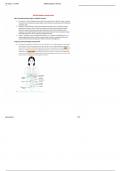
Pregnancy and fundal height measurement
o As pregnancy progresses, the fundus rises out of the pelvis. At 12 weeks’ gestation, the fundus is
located at the level of the symphysis pubis. By week 16, it rises to midway between symphysis
pubis and the umbilicus. By 20 weeks’ gestation, the fundus is typically at the same height as the
umbilicus. Until term, the fundus enlarges approximately 1 cm per week. As the time for birth
approaches, the fundal height drops slightly. This process, which is commonly called lightening,
occurs for a woman who is a primigravida around 38 weeks’ gestation but may not occur for the
woman who is a multigravida until she goes into labor.
o
about:blank 1/16
,10/19/23, 1:04 PM NR602 Midterm Review
Naegele’s rule
o The EDD is calculated by adding seven days to the first day of the last menstrual period,
subtracting three months and adding one year.
Hematological changes during pregnancy
o Anatomically, the kidneys are displaced and increase in size during pregnancy. The renal tubules
dilate, leading to urinary stasis, which in turn increases the risk for urinary tract infections.
Bladder tone is decreased due to the effects of progesterone, which can lead to urinary
frequency and incontinence. Urinary frequency is more common in the first and third trimesters.
Urinary incontinence is most common in women who have had more than one pregnancy
(multiparas)
Hematologic Nonpregnant First Second Third
Measure Women, Ages Trimester Trimester Trimester
19–65
Hemogl
obi
n 12–16g/
dL 11.
6–13.
9 9.
7–14.
8 9.
5–15g/
dL
g/
dL g/
dL
Hemat
ocr
it 37–47% 31–41% 30–39% 28–40%
Redbloodcel
l 3.
5–5.
5/mm3 3.
4– 2.
8–4.
5/mm3 2.
7–4.
4/mm3
count 5.
2/mm3
Whitebl
oodcel
l 4.
5–11/
mm3 4–13/
mm3 6–14/
mm3 6–17/
mm3
count
Indications and contraindications for prescribing combined estrogen vs. progesterone-only
birth control
o Two types of hormonal contraceptives are available: those that contain progestin (progestin-
only) and those that contain progestin and estrogen (combined). Progestin, the synthetic version
of the endogenous hormone progesterone, is highly effective alone as a contraceptive, but may
cause irregular bleeding. The addition of estrogen to progestin in combined methods results in
more predictable bleeding patterns due to stabilization of the endometrium. Estrogen as a single
agent for contraception requires doses that may cause unacceptable risks of serious side effects,
such as thromboembolic events and endometrial hyperplasia. The synergistic activity of estrogen
and progestin makes it possible to combine these hormones in lower doses to produce
successful contraception than would be possible using either hormone alone
o During the first few postpartum weeks, the risk of venous thromboembolism (VTE; deep vein
thromboses and pulmonary emboli) is greatly elevated in all women; consequently, estrogen-
about:blank 2/16
, 10/19/23, 1:04 PM NR602 Midterm Review
containing contraceptives are contraindicated during this time. Progestin-only methods may be
initiated immediately postpartum.
o Progestin-only pills have minimal effects on coagulation factors, blood pressure, or lipid levels
and are generally considered safer for women who have contraindications to estrogen, such as
cardiovascular risk factors, migraine with aura, or a history of VTE.
Menstrual cycle physiology
o The initiation of menstruation, called menarche, usually happens between the ages of
12 and 15. Menstrual cycles typically continue to age 45 to 55, when menopause occurs.
Numerous patterns in the secretion of estrogens and progesterone are possible; in fact,
it is difficult to find two cycles that are exactly the same.
Vaccines during pregnancy
RecommendedEachPr
egnancy Rat
ional
e Ti
ming
I
nfluenza(
flu) Womenwhoar epregnantar
eat Anygestati
on
i
ncreasedri
skforflu-
relat
ed whent he
compli
cati
ons. i
njecti
onis
avai
lable
Tetanus
,di
pht
her
ia,per
tussi
s Aftermaternalvacci
nati
on,ant
ibodi
es Thir
d
(Tdap) crosstheplacentaanddecreasetheri
sk t
rimester
ofpertussi
sinfect
ioninthenewborn. (i
deall
y27–
36weeks ’
gest
ati
on)
Advi
sedI
fatRi
sk Rat
ional
e Ti
ming
Hepat
i
ti
sB Ifthewomani satriskf
oracquir
ingHBV, 3inj
ect
ions
sheshoul dbevaccinat
ed.Indi
cati
ons begi
nningat
i
ncl uder i
skofoccupati
onalexposuret
o anypointi
n
blood,t r
eatmentforasexuall
y gest
ati
on
transmi t
tedinf
ecti
on,morethan1sex
par tneri
nt hepast6months,recent
i
nt ravenousdruguse,andHBsAg–
posi ti
vesexpartner
.
Cont
rai
ndi
cat
ed Rat
ional
e
Measl
es,mumps
,rubel
l
a Thisl
iv
evir
usvacci
nehasa(
theor
eti
cal
)
ri
sktothef
etus.
Var
icel
l
a Thi
sli
vevi
rusvacci
nehasa(
theor
eti
cal
)
about:blank 3/16