
SCIENCE REVISION SHEET:
Atom: The smallest unit of matter
Molecule: Atoms combine to form molecules. A cluster (two or more) of atoms that makes
up an element or a compound.
Element: A pure substance, a substance made up of only one type of atom
Compound: A substance with a combination of two or more elements. Made up of two or
more different types of atoms chemically joined.
Mixture: A material made up of two or more different chemical substances which are not
chemically combined.
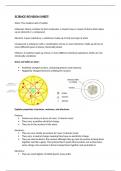
Draw and label an atom:
Positively charged nucleus, containing protons and neutrons
Negatively charged electrons orbiting the nucleus
Explain properties of protons, neutrons, and electrons
Protons:
Protons are heavy in terms of mass. (1 atomic mass)
They carry a positive electrical charge.
They are in the nucleus of the atom.
Neutrons:
They are very similar to protons for mass (1 atomic mass)
They carry a neutral charge meaning they have no electricity charge.
They are also located in the nucleus although they go next to protons to keep them
together (act like a glue). The protons like to push other protons out as they have
same charge, the nuclease is there to keep them together and neutralise it.
Electrons:
They are much lighter (1/1836 atomic mass units)
, They carry a negative charge.
They are located outside the nuclease in electron shells, these shells are organized in
a way that the inner shells are closer to the nucleus and can hold fewer electrons,
while the outer shells are farther away and can hold more electrons. (Electron
configuration)
Using a Bohr model to work out the valance electrons; first 20 elements only.
The Bohr model of an atom is used to describe how electrons are arranged the electrons are
arranged in “shells” around the nucleus. Bohr had stated that electrons are located as close
to the nucleus as possible.
Use the periodic table to find:
Mass number (number of protons and neutrons in an element) = number of protons
Atomic number – number of protons in an element.
Number of neutrons – Mass number – Number of protons
Number of electrons = Number of protons
Define ion, anion, cation. Describe why they form.
An ion is an atom or molecule that has unequal number of electrons and protons resulting in
one way charge being either positive or negative depending on whether the ion had lost or
gained electrons compared to the number of protons.
Anion – When an atom gains electrons and therefore has more electrons it is an anion. –
Typically, nonmetal
When non-metal elements form anions, the ion’s name is different from its ‘parent’ The
suffix “-ide” replaces the end of its name E.g., Chlorine = Chloride ion.

