

The Backwards Brain Bicycle - Smarter Every Day 133
Destin has designed an experience with a backward built bike to see how we learn a new way
of doing a task that we have been used to doing in a certain way for a long time. The bike turns
right when the wheel turns left and vice versa. In this video we have seen that Destin eventually
learns how to ride the backward bike within eight months and once he wants to ride a regular
bike after this period, he struggles. He also tries the same thing with his son and we see that it
takes a lot less effort for his son to learn and adapt to the new bike.
Learning to perform an existing skill in the complete opposite way proved exceptionally
difficult for Destin, taking him eight months. His six-year old son, however, was able to
accomplish this in only two weeks. With this, the video shows that there is a significant
difference in neuroplasticity in a young brain compared to an old one. While Destin eventually
learned to ride the backwards bike, sustaining this new neural pathway wasn’t always
successful. From Destin’s experience, while riding the backwards bike, the simplest distraction
resulted in instant failure of continuing to ride the backwards bike. This shows that the neural
pathway of normally riding a bike is much stronger in Destin’s brain than the newly created one
of riding the backwards bike, while the neural pathways in his son’s brain are much more easily
able to adapt to a new skill. We found kids having the ability to adapt their neural pathways
much easier and faster than adults - as a result of more neuroplasticity - to be the most
remarkable part of this video.
We think the ability or muscle memory to ride a bike could
be formed in the brain by neural connections. We think these
connections are strengthened by repetition of the action of riding the
bike, based on the degree of success. The same process happens
when training a neural network in artificial intelligence. At first the
connections between neurons are random, but based on the
results, certain neural connections are strengthened, until the
network knows which neurons and connections to activate in order
to accomplish its goal - in this case, riding a bike. The illustration
shows a simplified schematic of such a network, where the
thickness of the arrows connecting the nodes signifies the strength
of that connection, and as such the likelihood that connection will be
activated to accomplish a certain goal. We believe that this could be
the mechanism that allows the formation of memory. This mechanism could also explain the
difficulty Destin has to learn to ride the backwards bike. All the connections in his brain are so
strong that it takes a considerable amount of time to overwrite these connections and make a
new path.
We did not know that re-learning a skill that we have done for a long time can be so
challenging. A skill like riding a bike or general motor skills become such automatic reactions
that we can perform without even thinking about them. As a result, we greatly underestimated
the complexity of performing such seemingly simple tasks. We could see through this
experiment that as Destin has mentioned, knowledge is not understanding. We do logically
know how Destin’s bike works and without this experience we could not understand the
challenge of finding a new path of learning for our brain. Our brain truly understands when it
learns. Having the knowledge does not necessarily mean understanding and this experience
succeeded to demonstrate this very well.
Destin has designed an experience with a backward built bike to see how we learn a new way
of doing a task that we have been used to doing in a certain way for a long time. The bike turns
right when the wheel turns left and vice versa. In this video we have seen that Destin eventually
learns how to ride the backward bike within eight months and once he wants to ride a regular
bike after this period, he struggles. He also tries the same thing with his son and we see that it
takes a lot less effort for his son to learn and adapt to the new bike.
Learning to perform an existing skill in the complete opposite way proved exceptionally
difficult for Destin, taking him eight months. His six-year old son, however, was able to
accomplish this in only two weeks. With this, the video shows that there is a significant
difference in neuroplasticity in a young brain compared to an old one. While Destin eventually
learned to ride the backwards bike, sustaining this new neural pathway wasn’t always
successful. From Destin’s experience, while riding the backwards bike, the simplest distraction
resulted in instant failure of continuing to ride the backwards bike. This shows that the neural
pathway of normally riding a bike is much stronger in Destin’s brain than the newly created one
of riding the backwards bike, while the neural pathways in his son’s brain are much more easily
able to adapt to a new skill. We found kids having the ability to adapt their neural pathways
much easier and faster than adults - as a result of more neuroplasticity - to be the most
remarkable part of this video.
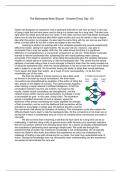
We think the ability or muscle memory to ride a bike could
be formed in the brain by neural connections. We think these
connections are strengthened by repetition of the action of riding the
bike, based on the degree of success. The same process happens
when training a neural network in artificial intelligence. At first the
connections between neurons are random, but based on the
results, certain neural connections are strengthened, until the
network knows which neurons and connections to activate in order
to accomplish its goal - in this case, riding a bike. The illustration
shows a simplified schematic of such a network, where the
thickness of the arrows connecting the nodes signifies the strength
of that connection, and as such the likelihood that connection will be
activated to accomplish a certain goal. We believe that this could be
the mechanism that allows the formation of memory. This mechanism could also explain the
difficulty Destin has to learn to ride the backwards bike. All the connections in his brain are so
strong that it takes a considerable amount of time to overwrite these connections and make a
new path.
We did not know that re-learning a skill that we have done for a long time can be so
challenging. A skill like riding a bike or general motor skills become such automatic reactions
that we can perform without even thinking about them. As a result, we greatly underestimated
the complexity of performing such seemingly simple tasks. We could see through this
experiment that as Destin has mentioned, knowledge is not understanding. We do logically
know how Destin’s bike works and without this experience we could not understand the
challenge of finding a new path of learning for our brain. Our brain truly understands when it
learns. Having the knowledge does not necessarily mean understanding and this experience
succeeded to demonstrate this very well.

