
TEST BANK FOR ADV ANCED PRACTICE NURSING: ESSENTIALS FOR ROLE DEVELOPMENT 4TH EDITION LUCILLE A. JOEL lOMoAR cPSD|25701531 Table of Contents Chapter 1. Advanced Practice Nursing: Doing What Has to Be Done Radicals, Renegades, and Rebels ............ 3 Chapter 2. Emerging Roles of the Advanced Practice Nurse ................................ ................................ ............... 6 Chapter 3. Role Development: A Theoretical Perspective ................................ ................................ ................ 17 Chapter 4. Educational Preparation of Advanced Practice Nurses: Looking to the Future .............................. 22 Chapter 5. Global Perspectives on Advanced Nursing Practice ................................ ................................ ......... 31 Chapter 6. Advanced Practice Nurses and Prescriptive Authority ................................ ................................ .... 37 Chapter 7. Credentialing and Clinical Privileges for the Advanced Practice Registered Nurse ......................... 41 Chapter 8. The Kaleidoscope of Collaborative Practice ................................ ................................ ..................... 46 Chapter 9. Participation of the Advanced Practice Nurse in Health Plans and Quality Initiatives .................... 51 Chapter 10. Public Policy and the Advanced Practice Registered Nurse ................................ ........................... 58 Chapter 11. Resource Management ................................ ................................ ................................ .................. 63 Chapter 12. Mediated Roles: Working With and Through Other People ................................ .......................... 68 Chapter 13. Evidence-Based Practice ................................ ................................ ................................ ................ 71 Chapter 14. Advocacy and the Advanced Practice Nurse................................ ................................ .................. 76 Chapter 15. Case Management and Advanced Practice Nursing ................................ ................................ ...... 80 Chapter 16. The Advanced Practice Nurse and Research ................................ ................................ .................. 89 Chapter 17. The Advanced Practice Nurse: Holism and Complementary and Integrative HealthApproaches . 96 Chapter 18. Basic Skills for Teaching and the Advanced Practice Nurse ................................ ......................... 105 Chapter 19. Culture as a Variable in Practice ................................ ................................ ................................ .. 110 Chapter 20. Conflict Resolution in Advanced Practice Nursing ................................ ................................ ....... 119 Chapter 21. Leadership for APNs: If Not Now, When? ................................ ................................ .................... 125 Chapter 22. Information Technology and the Advanced Practice Nurse ................................ ........................ 130 Chapter 23. Writing for Publication ................................ ................................ ................................ ................. 143 Chapter 24. Measuring Advanced Practice Nurse Performance: Outcome Indicators, Models of Evaluation and the Issue of Value ................................ ................................ ................................ ................................ ..... 151 Chapter 25: An Integrative Review of APRN Outcomes and Performance Improvement .............................. 168 Chapter 26. Starting a Practice and Practice Management ................................ ................................ ............. 170 Chapter 27. The Advanced Practice Nurse as Employee or Independent Contractor: Legal and Contractual Considerations ................................ ................................ ................................ ................................ ................. 178 Chapter 28. The Law, The Courts, and the Advanced Practice Registered Nurse ................................ ........... 184 Chapter 29. Malpractice and the Advanced Practice Nurse ................................ ................................ ............ 196 Chapter 30. Ethics and the Advanced Practice Nurse ................................ ................................ ..................... 201 lOMoAR cPSD|25701531 Chapter 1. Advanced Practice Nursing: Doing What Has to Be Done Radicals, Renegades, and Rebels MULTIPLE CHO ICE 1. The nurse manager of a pediatric clinic could confirm that the new nurse recognized the purpose of the HEADSS Adolescent Risk Profile when the new nurse responds that it is used to assess for needs related to a. anticipatory guidance. b. low-risk adolescents. c. physical development. d. sexual development. ANS: A The HEADSS Adolescent Risk Profile is a psychosocial assessment screening tool which assesses home, education, activities, drugs, sex, and suicide for the purpose of identifying high-risk adolescents and the need for anticipatory guidance. It is used to identify high-risk, not low-risk, adolescents. Physical development is assessed with anthropometric data. Sexual development is assessed using physical examination. REF: 6 OBJ: NCLEX Client Needs Category: Health Promotion and Maintenance 2. The nurse preparing a teaching plan for a preschooler knows that, according to Piaget, the expected stage of development for a preschooler is a. concrete operational. b. formal operational. c. preoperational. d. sensorimotor. ANS: C The expected stage of development for a preschooler (3 to 4 years old) is preoperational. Concrete operational describes the thinking of a school-age child (7 to 11 years old). Formal operational lOMoAR cPSD|25701531 describes the thinking of an individual after about 11 years of age. Sensorimotor describes the earliest pattern of thinking from birth to 2 years old. REF: 5 OBJ: NCLEX Client Needs Category: Health Promotion and Maintenance 3. The school nurse talking with a high school class about the difference between growth and development would best describe growth as a. processes by which early cells specialize. b. psychosocial and cognitive changes. c. qualitative changes associated with aging. d. quantitative changes in size or weight. ANS: D Growth is a quantitative change in which an increase in cell number and size results in an increase in overall size or weight of the body or any of its parts. The processes by which early cells specialize are referred to asdifferentiation. Psychosocial and cognitive changes are referred to as developm ent. Qualitative changes associated with aging are referred to as matu ration. REF: 2 OBJ: NCLEX Client Needs Category: Health Promotion and Maintenance 4. The most appropriate response of the nurse when a mother asks what the Denver II does is that it a. can diagnose developmental disabilities. b. identifies a need for physical therapy. c. is a developmental screening tool. d. provides a framework for health teaching. ANS: C The Denver II is the most commonly used measure of developmental status used by health care professionals; it is a screening tool. Screening tools do not provide a diagnosis. Diagnosis requires a thorough neurodevelopment history and physical examination. Developmental delay, which is suggested by screening, is a symptom, not a diagnosis. The need for any therapy would be identified with a comprehensive evaluation, not a screening tool. Some providers use the Denver II as a framework for teaching about expected development, but this is not the primary purpo se of the tool.
Vista previa 4 fuera de 214 páginas
Examen
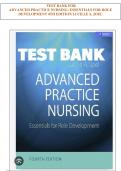
Test Bank For Advanced Practice Nursing: Essentials For Role Development 4Th Edition Lucille A. Joel| Chapter 1-30 With Explained Answers
Vista previa 4 fuera de 214 páginas
The document is designed to help students for their nursing program(s) as well succeed on the NCLEX–RN examination. The book contains 15 chapters, and a final comprehensive examination. Questions are written primarily at the application and analysis level. The questions are either multiple choice, having four response choices, or alternate item format.
Vista previa del contenido
Libro relacionado
Información del documento
- Subido en
- 9 de octubre de 2023
- Archivo actualizado en
- 9 de octubre de 2023
- Número de páginas
- 214
- Escrito en
- 2023/2024
- Tipo
- Examen
- Contiene
- Preguntas y respuestas
$12.50
¿Documento equivocado? Cámbialo gratis
Dentro de los 14 días posteriores a la compra y antes de descargarlo, puedes elegir otro documento. Puedes gastar el importe de nuevo.
Escrito por estudiantes que aprobaron
Inmediatamente disponible después del pago
Leer en línea o como PDF

Los indicadores de reputación están sujetos a la cantidad de artículos vendidos por una tarifa y las reseñas que ha recibido por esos documentos. Hay tres niveles: Bronce, Plata y Oro. Cuanto mayor reputación, más podrás confiar en la calidad del trabajo del vendedor.
