
Ati Exam Study Guide
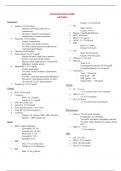
ATI EXAM STUDY GUIDE Lab Values Electrolytes Sodium: 136-145 mEq/L Maintains cell fluids; helps nerves communicate Hct Female: 12-16 g/100 mL Male: 42-52% Female: 37-47% Deviation: changes in neurological complications; seizure precautions Potassium: 3.5-5.0 mEq/L Cardiac complications Too much: stops heart (asystole) Too little: cardiac electrical instability and ventricular dysrhythmias Chloride: 98-106 mEq/L Total calcium: 9.0-10.5 mg/dL Needed for bones, teeth, nerve impulses, muscle contraction, blood clotting Muscle/cardiac implications r/t contractility Imbalance: tingling, spasms Magnesium: 1.3-2.1 mg/dL Cardiac implications Too much: muscle weakness, hypotension, bradycardia Too little: ventricular tachycardia/fibrillation Prevents K+ from being excreted: too little decreased K+ levels heart problems Phosphorus: 3.0-4.5 mg/dL Kidneys BUN: 10-20 mg/dL Creatinine Male: 0.6-1.2 mg/dL Female: 0.5-1.1 mg/dL GFR: 90-120 mL/min Ammonia: 15-110 mg/dL Urine specific gravity: 1.015-1.030 Urine pH: 4.6-8.0 (average 6.0) Urinalysis Negative for: glucose, RBC, WBC, albumin Bacteria 1000 colonies/mL Blood WBC: 5,000-10,000/mm3 Neutrophils: 45-75% Lymphocytes: 16-46% Monocytes: 4-11% Eosinophils: 1-8% Basophils: 0-3% RBC Male: 4.7-6.1 million/mm3 Female: 4.2-5.4 million/mm3 Platelet: 150,000-400,000/mm3 MCV: 80-90 mm3 MCH: 27-31 pg/cell MCHC: 31-37% Hb/cell ESR Male: 0-17 mm/h Female: 0-25 mm/h Iron Male: 80-180 mcg/dL Female: 60-160 mcg/dL Albumin: 3.1-4.3 g/dL Bilirubin Total: 0-1.0 Unconjugated (indirect): 0.2-0.8 mg/dL Conjugated (direct): 0.1-1.0 mg/dL Cholesterol Total: 200 mg/dL LDL (bad): 100 HDL (good): 40 Triglycerides: 150 mg/dL Clotting PT: 11-13 sec 1.5-2x normal value if on Coumadin INR: 0.7-1.8 2-3 if on Coumadin PTT: 25-40 sec 1.5-2x normal value if on heparin Blood Glucose Glucose: 70-105 mg/dL (fasting) Postprandial: 70-140 mg/dL Too much: polydipsia, polyphagia, polyuria Too little: chills, diaphoresis, hunger, altered LOC HgbA1c: 6.5% 7% for diabetics ABG pH: 7.35-7.45 PaCO2: 35-45 mmHg PaO2: 80-100 mmHg HCO3: 22-26 mmol/L Hgb Male: 14-18 g/100 mL Cardiac Creatinine phosphokinase MB (CK-MB): 30-170 units/L Increases 4-6 hours after MI and remains elevated for 24-72 hours Troponin: 0.2 ng/dL Gold standard for determining if there was an MI GI/Endocrine Stomach pH: 1.5-2.5 Liver enzymes ALT/SGPT: 8-20 units/L AST/SGOT: 5-40 units/L (Kaplan says 8-20 units/L) ALP: 42-128 units/L Total protein: 6-8 gm/dL Pancreatic enzymes Amylase: 56-90 IU/L Lipase: 0-110 units/L Prothrombin time: 0.8-1.2 TSH: 0.5-5.0 mcU/mL Med Levels Digoxin: 0.5-2.0 ng/mL Lithium: 0.8-1.4 mEq/L Dilantin: 10-20 mcg/mL Theophylline: 10-20 mcg/mL Metabolic Panel (BMP or CMP): test can be basic or comprehensive; assesses fluid/electro status, glucose, renal and liver function Complete blood count (CBC): assesses amount of cells in blood – platelets, WBC, RBC, Hgb, Hct Arterial Blood Gases (ABGs): assesses for acid-base imbalances in body – test important for respiratory or metabolic conditions Coagulation Levels: assesses clotting times (PT/INR or aPTT) – test important for many blood disorders and for pts on anticoagulants Lipid Panel (Lipid Profile): assesses for risk of cardiovascular disease by measuring lipoproteins, triglycerides, cholesterol Hemoglobin A1C: assesses average blood glucose level during past 3 months – great test to check glucose management in DM pts Drug Levels: assesses amount of drug present in system – many pts are on drugs with very narrow therapeutic drug range; this test helps determine if drug is sub-therapeutic or toxic in pts system Metabolic Panel • Glucose: 70–100 mg/dL • Calcium: 8.5–10.5 mg/L • Chloride: 95–105 mEq/L • Magnesium: 1.5–2.5 mg/dL • Phosphorus:2.5–4.5 mg/dL • Potassium: 3.5–5 mEq/L • Sodium: 135–145 mEq/L • BUN: 5–20 • Serum creatinine: 0.6–1.2 mg/dL • Total Protein: 6.2–8.2 g/dL • Albumin: 3.4–5.4 g/dL • Bilirubin: 0.1–1 mg/dL (1) (formed w/ breakdown of RBC – high levels in pts w/ jaundice) These 3 enzymes found in liver – if elevated, can indicate liver problems and other diseases: • ALP (alkaline phosphatase): 40–120 U/L (international units per liter) • ALT (alanine transaminase): 7–56 U/L • AST (aspartate transaminase) 10–40 U/L *this blood test can be ordered as BMP (basic metabolic panel) or CMP (comprehensive metabolic panel). CMP includes liver function Complete Blood Count • RBC: 4.5–5.5 million • WBC: 5,000–10,000 • Platelets: 150,000–400,000 • Hemoglobin: o 12–16 g/dL (women) o 14–18 g/dL (men) • Hematocrit: o 37–47% (women) o 42–52% (men) Coagulation Levels • INR/PT: o PT (prothrombin time): 10–12 seconds (normal level for pts not on Warfarin) o INR (international normalized ration): 1 (normal level for pts not on Warfarin). When taking anticoagulant Warfarin, INR should be 2–3 INR level calculated from PT level • aPTT (activated partial thromboplastin time): o Normal 30–40 seconds (not on Heparin) o If on Heparin, aPTT needs to be 1.5–2.5 times normal range Red blood cell indices (indices is plural form for index): this is a further look at the RBC. It tells us size of RBC and specifics about hgb, which is helpful w/ anemia (iron deficiency, vit-B12, folate etc.) • Mean Corpuscular Volume (MCV): size of RBC (80-100 fl) • Mean Corpuscular Hgb (MCH): amount of hgb in RBC (27-33 pg) • Mean Corpuscular Hgb Concentration (MCHC): RBC Hgb concentration (33-36 g/dL) • Red Cell Distribution Width (RDW) - (11-15%): measures variation of RBC size Lipid Panel (risk for cardiovascular disease) • LDL (low density lipoprotein): 100 mg/dL (want LOW) • HDL (high density lipoprotein): 60 mg/dL (want HIGH) • Total Cholesterol: 200 mg/dL • Triglycerides: 150 mg/ dL Hemoglobin A1C • 4–6% (target without diabetes) • 7% (target with diabetes) Leukocytosis: high WBC count; Causes: infection, inflammation, leukemia, extreme stress, meds-SE, etc. WBC w/ differential: looks at 5 types of WBCs • Monocytes (4-13%): fights infection and foreign substances • Eosinophils (1-5%): plays role in allergic response and parasite infections • Neutrophils (40-70%): fights bacterial infections • Basophils (0.1-2%): plays role in inflammatory conditions and allergy response • Lymphocytes (20-40%): fights viral infections RBC: 4.5-5.5 million – also called erythrocytes or red blood corpuscles • Main function is transport O2 throughout body and deliver CO2 to lungs to be exhaled….helps detect anemia, hemorrhage, etc. • Anemia: low RBC count • Polycythemia: high RBC; blood cancer – bone marrow make too many RBC Hemoglobin: protein on RBC that helps carry O2 in body • 12–16 g/dL (women) • 14–18 g/dL (men) Hematocrit: amount of RBCs compared to total blood volume • 37–47% (women) • 42–52% (men) Frequently used abbreviations Apply to memory 1. ac – before meals. As in taking medicine before meals 2. ad lib – at liberty 3. B.i.d. – twice daily. As in taking a medicine twice times daily. 4. T.i.d. – three times daily. As in taking a medicine three times daily. 5. Q.i.d. – four times daily. As in taking a medicine four times daily. 6. Q2h – every 2 hours. As in taking a medicine every 2 hours. 7. Q3h – every 3 hours. As in taking a medicine every 3 hours. 8. qAM – every morning 9. qPM – every evening 10. qhs – at bedtime 11. cap – capsule 12. gtt – drops 13. tab – tablets 14. IM – intramuscular 15. SQ – subcutaneous. 16. IV – intravenous 17. BP – blood pressure 18. ADL – Activities of daily living 19. Oral – mouth 20. Axilla – under the arm 21. R – rectal 22. Tympanic – in the ear 23. Canthus – corner of eyes 24. C & S – culture and sensitivity 25. C/O – complaint of 26. CBC – complete blood count 27. WBC – white blood count 28. cc – chief complaint 29. COPD – Chronic obstructive pulmonary disease 30. CVA – Cerebrovascular accident (Stroke) 31. D/C – discontinue 32. DM – diabetes mellitus 33. DNR – Do not resuscitate 34. DVT – deep venous thrombosis (blood clot in large vein). 35. FX – Fracture 36. H&H – History and physical examination 37. h.s. – at bedtime 38. HA – headache 39. HTN – hypertension 40. I&D – incision and drainage 41. IU – international units 42. LLQ – Left lower quadrant 43. LUQ – Left upper quadrant 44. Lytes – electrolytes (potassium, sodium, carbon dioxide, chloride) 45. N/V – nausea or vomiting 46. NPO – Nothing by mouth 47. O.D. – Right eye 48. O.S. – left eye 49. O.U. – both eyes 50. p.o – by mouth 51. PRN – as needed 52. PERRLA – Pupils equal, round, and reactive to light and accommodation 53. PMI – point of maximum impulse 54. R/O – Rule out 55. RLQ – Right lower quadrant 56. RUQ – right upper quadrant 57. SOB – shortness of breath 58. UA or u/a – urinalysis 59. URI – Upper respiratory infection 60. UTI – urinary tract infection 61. O&P – Ova & parasites 62. Tachy – fast 63. Brady – slow 64. Hypo – low 65. Hyper – high 66. Pnea – breathing 67. TB – Tuberculosis 68. ANA – American Nurse Association 69. ROM – Range of motion 70. PROM – Passive range of motion 71. w/ - with 72. BM – bowel movement 73. NKA – no known allergies 74. HOB – Head of Bed 75. ICU – Intensive Care Unit 76. DX – diagnosis 77. FBS – fasting blood sugar 78. PT – patient or pint 79. STAT – at once or immediately 80. VS – vital signs 81. W/C – wheelchair 82. TPR – temperature, pulse, respiration 83. CBR – complete bed rest Common Medical Definitions 1. Cyanosis- slightly bluish, gray, or dark purple discoloration of the skin, resulting from the presence of abnormally reduced amounts of oxygenated hemoglobin in the blood. 2. Erythema- redness or inflammation of the skin or mucous membranes resulting from dilation and congestion of superficial capillaries. Examples are mild sunburn, nervous blushes, injury resulting from trauma or infection. 3. Erythematous – pertaining to erythema (redness) 4. Eschar – necrotic tissue that may be hard, soft, or soggy. It may be black or brown. 5. Dysphagia – difficulty swallowing 6. Dyspepsia – vague feelings of epigastric discomfort 7. Dysmenorrhea – painful menstruation 8. Dysgeusia – a distortion to the sense of taste 9. Dyspnea – shortness of breath 10. Air embolism – an abnormal circulatory condition in which air travels through the bloodstream and becomes lodged in a blood vessel. 11. Anasarca – severe generalized edema 12. Urticaria – itching skin eruption characterized by welts of varying sizes w/ well defined inflamed margins and pale centers. Also called hives 13. Wheals – irregularly shaped, elevated areas, white in the center with a pale red periphery, w/ superficial localized edema, vary in size (hives, mosquito bite). 14. Pustulant vesicles – small, circumcised pus; containing elevations of the skin. 15. ABCs – airway, breathing, and circulation
Información del documento
- Subido en
- 29 de septiembre de 2023
- Número de páginas
- 152
- Escrito en
- 2023/2024
- Tipo
- Examen
- Contiene
- Preguntas y respuestas

