Financiering hoorcollege/boek
aantekeningen
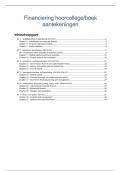
Inhoudsopgave
HC 1 – Bedrijfspolitiek en waardering H1 H3 H7..................................................................................................2
Chapter 1 – Introduction to corporate finance...............................................................................................2
Chapter 3 – Financial statement analysis........................................................................................................3
Chapter 7 – Equity valuation...........................................................................................................................6
HC 2 – Investeren: kasstromen, H8 H9 H10.........................................................................................................9
H8 – Net present value and other investment criteria....................................................................................9
Chapter 9 – Making capital investment decisions.........................................................................................11
Chapter 10 – Project analysis and evaluation...............................................................................................12
HC 3 – Investeren: vermogenskosten, H11 H12 H13..........................................................................................15
Chapter 11 – Some lessons from recent capital market history...................................................................15
Chapter 12 – Return, risk and the security market line................................................................................17
Chapter 13 – Cost of capital..........................................................................................................................19
HC 5 – Vermogensstructuur en financiering, H14 H15 H16 H17.......................................................................23
Chapter 14 – Raising capital..........................................................................................................................23
Chapter 15 – Financial leverage and capital structure policy.......................................................................25
Chapter 17 – Short-term financial planning and management.....................................................................29
HC 6 – Multinations, financieel gedrag, fusies, H18 (-18.8) H19 H22................................................................34
Chapter 18 – International corporate finance...............................................................................................34
Chapter 19 – Behavioral finance...................................................................................................................36
Chapter 22 – Mergers and acquisitions.........................................................................................................38
HC 7 – Risico’s en opties, H20 H21.....................................................................................................................42
Chapter 20 – Financial risk management......................................................................................................42
Chapter 21 – Options and corporate finance................................................................................................44
,HC 1 – Bedrijfspolitiek en waardering H1 H3 H7
Chapter 1 – Introduction to corporate finance
Value creation in corporate finance
- Corporate finance (= investment + financing + liquidity) > value creation
Financial manager responsibilities
- Overall goal is to maximize value form cash
o Buy assets that earn more cash than they cost
o Choose long-term investments to increase firm value
o Ensure efficient tax policy
o Raise cheap external financing
Financial management decisions
- Three basic types
1. Capital budgeting = the process of planning and managing a firm’s
long-term investments
2. Capital structure = the mixture of long-term debt and equity
maintained by a firm
a. Long-term debt = long-term borrowing by the firm (longer than
year) to finance its long-term investments
b. Equity = the amount of money raised by the firm that comes
from the owners’ (shareholders’) investment
3. Working capital management = management of a firm’s short-term
assets and liabilities
The goal of financial management
- Possible goals: survive, maximize profits, avoid distress, be the best,
maximize sales, earnings growth
- Appropriate goal = maximize the current value per share of the existing
equity
The triple bottom line
- Triple bottom line = the concept that corporate objectives should focus
equally on society, the environment, and profit
o People – how can you get the most out of your company’s workforce?
What investments can you make to create value for shareholders
through improving the human capital of your workers and operations
that affect the welfare and productivity of your people? How do you
measure success?
o Planet – what activities does your firm engage in
that maximizes its positive impact on the
environment and sustainable operations? How do
you measure success?
o Profit – what can your firm do to maximize its
financial profit?
, - A key issue with the triple bottom line is the difficulty in accurately measuring
in monetary terms the effect a company has on society and the environment
Primary versus secondary markets
- Primary market = refer to the original sale of securities by governments and
corporations
- Secondary markets = those in which these securities are bought and sold
after the original sale
Macroeconomic policy levers on markets
- Macroeconomic policy is concerned with government decisions that impact the
economic environment
- Governments pull economic levers to achieve their objectives. The four main
levers are:
1. Fiscal policy > government spending & taxes
2. Monetary policy > interest rates & money supply
3. Exchange rate policy > to improve country trade competitiveness
European monetary union
- There are three components to the European monetary union:
1. The Euro
2. European Central Bank (ECB)
3. Centralized monetary policy
Chapter 3 – Financial statement analysis
The annual report
- The annual report presents three financial statements:
1. The statement of financial position (balance sheet)
2. The income statement
3. The statement of cash flows
- Financial statements have two main users: 1) internal stakeholders, 2)
external stakeholders
1.The statement of financial position
- Statement of financial position = showing a firm’s accounting value on a
particular date
- Assets = liabilities + shareholders’ equity
o Assets = represent investments made by company
Non-current assets = asset that has a life > 1 year
Tangible non-current assets = trucks
Intangible non-current assets = patent
Current assets = cash & accounts receivable
o Liabilities and equity represent how investment are financed
1.1 Net working capital
- Net working capital = current assets – current liabilities
- It is important to ensure that net working capital is positive
- Positive net working capital means that enough cash will be available to pay
off liabilities arising
, 1.2 Market value versus book value
- The values in the statement of financial position for the firm’s assets are book
values and generally are not what the assets are actually worth
- Under International Accounting Standards (IAS) financial statements in
Europe can show assets in two ways:
1. Historical cost model = assets are valued at what the firm paid for them
2. Fair value amount = presents an asset’s value as what it is worth in the
market today
2. The income statement
- Income statement or statement of comprehensive income = measures
performance over period of time
- Net income = revenues – expenses
- Three important considerations:
1. Non-cash items = expenses charged against revenues that do not
directly affect cash flow such as depreciation
2. Time
3. Costs
2.1 Tax rates
- Average tax rates = % of income that is paid in taxes
o Average tax rate = tax bill / taxable income
- Marginal tax rate = tax you pay if you earn one more unit of currency
o Use this rate in any investment analysis – it is the rate that you would
be taxed on any additional income
3. Statement of cash flows
- Cash flow is the most important item to take from financial statements
- Cash flow is NOT the same as net working capital
- Cash flow from assets = cash flows to creditors + cash flow to shareholders
- Total cash flow comes from operating activities, investing activities and
financing activities
o Operating cash flow = cash generated from a firm’s normal business
activities
o Cash flow from investing activities = cash generated or expended
from a firm’s long-term investments
o Cash flow from financing activities = cash generated or expended as
a result of a firm’s debt and equity choices
Ratio analysis
- Financial ratios = relationships determined from a firm’s financial information
and used for comparison purposes
- It is important to be able to analyze a firm’s financial statements and compare
them to those of other firms
aantekeningen
Inhoudsopgave
HC 1 – Bedrijfspolitiek en waardering H1 H3 H7..................................................................................................2
Chapter 1 – Introduction to corporate finance...............................................................................................2
Chapter 3 – Financial statement analysis........................................................................................................3
Chapter 7 – Equity valuation...........................................................................................................................6
HC 2 – Investeren: kasstromen, H8 H9 H10.........................................................................................................9
H8 – Net present value and other investment criteria....................................................................................9
Chapter 9 – Making capital investment decisions.........................................................................................11
Chapter 10 – Project analysis and evaluation...............................................................................................12
HC 3 – Investeren: vermogenskosten, H11 H12 H13..........................................................................................15
Chapter 11 – Some lessons from recent capital market history...................................................................15
Chapter 12 – Return, risk and the security market line................................................................................17
Chapter 13 – Cost of capital..........................................................................................................................19
HC 5 – Vermogensstructuur en financiering, H14 H15 H16 H17.......................................................................23
Chapter 14 – Raising capital..........................................................................................................................23
Chapter 15 – Financial leverage and capital structure policy.......................................................................25
Chapter 17 – Short-term financial planning and management.....................................................................29
HC 6 – Multinations, financieel gedrag, fusies, H18 (-18.8) H19 H22................................................................34
Chapter 18 – International corporate finance...............................................................................................34
Chapter 19 – Behavioral finance...................................................................................................................36
Chapter 22 – Mergers and acquisitions.........................................................................................................38
HC 7 – Risico’s en opties, H20 H21.....................................................................................................................42
Chapter 20 – Financial risk management......................................................................................................42
Chapter 21 – Options and corporate finance................................................................................................44
,HC 1 – Bedrijfspolitiek en waardering H1 H3 H7
Chapter 1 – Introduction to corporate finance
Value creation in corporate finance
- Corporate finance (= investment + financing + liquidity) > value creation
Financial manager responsibilities
- Overall goal is to maximize value form cash
o Buy assets that earn more cash than they cost
o Choose long-term investments to increase firm value
o Ensure efficient tax policy
o Raise cheap external financing
Financial management decisions
- Three basic types
1. Capital budgeting = the process of planning and managing a firm’s
long-term investments
2. Capital structure = the mixture of long-term debt and equity
maintained by a firm
a. Long-term debt = long-term borrowing by the firm (longer than
year) to finance its long-term investments
b. Equity = the amount of money raised by the firm that comes
from the owners’ (shareholders’) investment
3. Working capital management = management of a firm’s short-term
assets and liabilities
The goal of financial management
- Possible goals: survive, maximize profits, avoid distress, be the best,
maximize sales, earnings growth
- Appropriate goal = maximize the current value per share of the existing
equity
The triple bottom line
- Triple bottom line = the concept that corporate objectives should focus
equally on society, the environment, and profit
o People – how can you get the most out of your company’s workforce?
What investments can you make to create value for shareholders
through improving the human capital of your workers and operations
that affect the welfare and productivity of your people? How do you
measure success?
o Planet – what activities does your firm engage in
that maximizes its positive impact on the
environment and sustainable operations? How do
you measure success?
o Profit – what can your firm do to maximize its
financial profit?
, - A key issue with the triple bottom line is the difficulty in accurately measuring
in monetary terms the effect a company has on society and the environment
Primary versus secondary markets
- Primary market = refer to the original sale of securities by governments and
corporations
- Secondary markets = those in which these securities are bought and sold
after the original sale
Macroeconomic policy levers on markets
- Macroeconomic policy is concerned with government decisions that impact the
economic environment
- Governments pull economic levers to achieve their objectives. The four main
levers are:
1. Fiscal policy > government spending & taxes
2. Monetary policy > interest rates & money supply
3. Exchange rate policy > to improve country trade competitiveness
European monetary union
- There are three components to the European monetary union:
1. The Euro
2. European Central Bank (ECB)
3. Centralized monetary policy
Chapter 3 – Financial statement analysis
The annual report
- The annual report presents three financial statements:
1. The statement of financial position (balance sheet)
2. The income statement
3. The statement of cash flows
- Financial statements have two main users: 1) internal stakeholders, 2)
external stakeholders
1.The statement of financial position
- Statement of financial position = showing a firm’s accounting value on a
particular date
- Assets = liabilities + shareholders’ equity
o Assets = represent investments made by company
Non-current assets = asset that has a life > 1 year
Tangible non-current assets = trucks
Intangible non-current assets = patent
Current assets = cash & accounts receivable
o Liabilities and equity represent how investment are financed
1.1 Net working capital
- Net working capital = current assets – current liabilities
- It is important to ensure that net working capital is positive
- Positive net working capital means that enough cash will be available to pay
off liabilities arising
, 1.2 Market value versus book value
- The values in the statement of financial position for the firm’s assets are book
values and generally are not what the assets are actually worth
- Under International Accounting Standards (IAS) financial statements in
Europe can show assets in two ways:
1. Historical cost model = assets are valued at what the firm paid for them
2. Fair value amount = presents an asset’s value as what it is worth in the
market today
2. The income statement
- Income statement or statement of comprehensive income = measures
performance over period of time
- Net income = revenues – expenses
- Three important considerations:
1. Non-cash items = expenses charged against revenues that do not
directly affect cash flow such as depreciation
2. Time
3. Costs
2.1 Tax rates
- Average tax rates = % of income that is paid in taxes
o Average tax rate = tax bill / taxable income
- Marginal tax rate = tax you pay if you earn one more unit of currency
o Use this rate in any investment analysis – it is the rate that you would
be taxed on any additional income
3. Statement of cash flows
- Cash flow is the most important item to take from financial statements
- Cash flow is NOT the same as net working capital
- Cash flow from assets = cash flows to creditors + cash flow to shareholders
- Total cash flow comes from operating activities, investing activities and
financing activities
o Operating cash flow = cash generated from a firm’s normal business
activities
o Cash flow from investing activities = cash generated or expended
from a firm’s long-term investments
o Cash flow from financing activities = cash generated or expended as
a result of a firm’s debt and equity choices
Ratio analysis
- Financial ratios = relationships determined from a firm’s financial information
and used for comparison purposes
- It is important to be able to analyze a firm’s financial statements and compare
them to those of other firms