
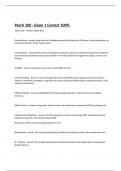
Psych 100 - Exam 1 Correct 100%
John Locke - Answer Tabula Rasa Structuralism - Answer Early school of thought promoted by Wundt and Titchener; used introspection to reveal the structure of the human mind. Functionalism - Answer Early school of thought promoted by James and influenced by Darwin; explored how mental and behavioral processes function—how they enable the organism to adapt, survive, and flourish. Humility - Answer Awareness of our own vulnerability to error Critical Thinking - Answer A way of thought that does not blindly accept arguments and conclusions. Rather, it examines assumptions, appraises the source, discerns hidden biases, evaluates evidence, and assesses conclusions. Wilhelm Wundt - Answer Established the first psychology laboratory at the University of Leipzig, Germany. William James - Answer A legendary teacher-writer who authored an important 1980 psychology text. Margaret Floy Washburn - Answer The first woman to receive a psychology PHD; synthesized animal behaviour research in the Animal Mind (1908). Became the APA's second female president in 1921. Behaviorism - Answer The view that psychology should be an objective science that studies behavior B. F. Skinner - Answer This leading behaviorist rejected introspection and studied how consequences shape behavior. Sigmund Freud - Answer The controversial ideas of this famed personality theorist and behaviorist have influenced humanity's self-understanding. humanistic psychologists - Answer historically significanr perspective that emphasized human growth potential. Drew attention to ways that current environmental influences can nurture or limit our growth potential, and to the importance of having our needs for love and acceptance satisfied. Psychology - Answer The science of behavior and mental processes. Cognitive Neuroscience - Answer The interdisciplinary study of the brain activity linked with cognition (including perception, thinking, memory, and language). Nature-nurture issue - Answer The longstanding controversy over the relative contributions that genes and experience make to the development of psychological traits and behaviours. Plato - Answer Greek philosopher who assumed that we inherit character and intelligence and that certain ideas are inborn. natural selection - Answer The principle that those chance inherited traits that better enable an organism to survive and reproduce in a particular environment will most likely be passed on to succeeding generations. evolutionary psychology - Answer "How are we humans alike because of our common biology and evolutionary history?" The study of evolution of behaviour and the mind, using principles of natural selection. Behavior genetics - Answer "How are we diverse because of our differing genes and environments?" The study of the relative power and limits of genetic and environmental influences on behavior. Aristotle - Answer _____ said that there is nothing in the mind that does not first come in from the external world through the senses. Empirical Approach - Answer When testing those claiming to be able to see auras around people's heads, magician James Randi issued this challenge: "Then if I were to step behind a wall barely taller than I am, you could determine my location from the aura visible above my head, right?" This type of challenge demonstrates: Behaviorist; Humanistic psychologist - Answer John B. Watson is a ____; while Rogers is a ____ Biophysical Approach - Answer An integrated approach that incorporates biological, psychological, and social-cultural levels of analysis. Positive Psychology - Answer The scientific study of human flourishing, with the goals of discovering and promoting strengths and virtues that help individuals and communities to thrive.
Información del documento
- Subido en
- 25 de septiembre de 2023
- Número de páginas
- 7
- Escrito en
- 2023/2024
- Tipo
- Examen
- Contiene
- Preguntas y respuestas

