

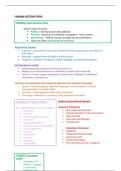
Language and Power Notes:
THEORIST: Shan Wareing (1999)
Stated 3 types of power:
Political – held by people with authority
Personal – based on an individual’s occupation / role in society
Social Group – held by a group of people due to social factors.
These are either instrumental or influential.
INFLUENTIAL POWER
A person / group doesn’t have any authority but tries to gain power and influence
over others.
Persuade – support them via politics and the media.
Features = assertions, metaphors, loaded language, embedded assumptions.
INSTRUMENTAL POWER
Authoritative power because of who the person is.
People use instrumental power to maintain or enforce their authority.
Features = formal register, imperatives, modal verbs, mitigation, conditional,
declaratives, Latinate lexis.
FEATURES OF LANGUAGE AND POWER IN WRITTEN AND SPOKEN DISCOURSE
1. Lexical = emotive language, figurative language, forms of address, synthetic
personalisation (Fairclough 1989).
2. Grammar = interrogatives, modal verbs, imperatives.
3. Phonology = alliteration, assonance, rising and falling intonation.
Language and Power in Politics Spoken Conversational Features
Use ‘political rhetoric’, which includes: Dominant Participant
Repetition Sets subject and the tone
Rule of 3 Changes direction of the conversation
1st person plural pronouns Talks the most
Hyperbole Interrupts and Overlaps
Rhetorical questions Unresponsive
Change in tone and intonation
Leading questions Submissive Participant
Use lists Responds
Imperatives Follows directional change
Humour Listens the most
Tautology Avoids interrupting
prevarication Use more formal forms of address
THEORIST: Fairclough
(1984)
‘Language and
Power’ = language
is a tool that
THEORIST: Shan Wareing (1999)
Stated 3 types of power:
Political – held by people with authority
Personal – based on an individual’s occupation / role in society
Social Group – held by a group of people due to social factors.
These are either instrumental or influential.
INFLUENTIAL POWER
A person / group doesn’t have any authority but tries to gain power and influence
over others.
Persuade – support them via politics and the media.
Features = assertions, metaphors, loaded language, embedded assumptions.
INSTRUMENTAL POWER
Authoritative power because of who the person is.
People use instrumental power to maintain or enforce their authority.
Features = formal register, imperatives, modal verbs, mitigation, conditional,
declaratives, Latinate lexis.
FEATURES OF LANGUAGE AND POWER IN WRITTEN AND SPOKEN DISCOURSE
1. Lexical = emotive language, figurative language, forms of address, synthetic
personalisation (Fairclough 1989).
2. Grammar = interrogatives, modal verbs, imperatives.
3. Phonology = alliteration, assonance, rising and falling intonation.
Language and Power in Politics Spoken Conversational Features
Use ‘political rhetoric’, which includes: Dominant Participant
Repetition Sets subject and the tone
Rule of 3 Changes direction of the conversation
1st person plural pronouns Talks the most
Hyperbole Interrupts and Overlaps
Rhetorical questions Unresponsive
Change in tone and intonation
Leading questions Submissive Participant
Use lists Responds
Imperatives Follows directional change
Humour Listens the most
Tautology Avoids interrupting
prevarication Use more formal forms of address
THEORIST: Fairclough
(1984)
‘Language and
Power’ = language
is a tool that

