
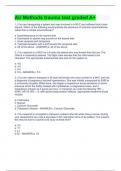
Air Methods trauma test graded A+
1.) You are transporting a patient who was involved in a MVC and suffered blunt chest trauma. Which of the following would indicate the presence of a tension pneumothorax rather than a simple pneumothorax? a. Hyperresonance on the injured side b. Decreased or absent lung sounds on the injured side c. Acute dyspnea and tachypnea d. Tracheal deviation with a shift toward the uninjured side e. All of the above - ANSWER-e. All of the above 2.) You respond to a MVC for a 4-year-old patient who was thrown from the car. The child is in respiratory distress. The flight crew decides that the child needs to be intubated. The appropriate endotracheal tube size for this patient is: a. 4.0 b. 4.5 c. 5.0 d. 5.5 - ANSWER-c. 5.0 3.) You are called to transport a 24-year-old female who was involved in a MVC and has a diagnosis of pregnancy induced hypertension. She was initially transported by EMS to a community hospital. While there, she began to experience acute elevations in blood pressure which the facility treated with hydralazine, a magnesium bolus, and a magnesium infusion at 3 grams per hour. In transport you note the following: BP — 90/40, HR 78, RR — 6, with absent deep tendon reflexes. Appropriate treatment would include: a. Fluid bolus b. Narcan c. Calcium Gluconate d. Potassium infusion - ANSWER-c. Calcium Gluconate 4.) You respond to a hospital to transport a patient who fell while riding a horse. During your assessment you note a decrease in the respiratory drive of tie patient. You suspect this may be due to a spinal cord injury at what level? a. C4 b. T1 c. L1 d.S2 - ANSWER-a. C4 5.) You arrive on scene of a MVC involving a female victim who is 36 weeks pregnant. During your assessment you note the fetal heart rate is 190 beats per minute. A normal fetal heart rate should be between beats per minute: a. 100 & 140 b. 120 & 160 c. 140 & 180 d. 160 & 200 - ANSWER-b. 120 & 160 6.) You are transporting a patient who was suffered a closed head injury during a motorcycle crash. During the transport you notice the following: HR 48, BP 220/110, GCS 3, Left pupil 5 mm non reactive. The most appropriate intervention would be controlled hyperventilation to an endpoint of: a. Respiratory rate greater than 30/min. b. Tidal volume greater than 800cc c. 02 sat. greater than 96% d. EtC02 level 30-35 mmHg - ANSWER-d. EtC02 level 30-35 mmHg 7.) What treatment is NOT indicated in the routine management of the above patient? a. Administration of 100% oxygen b. Fluid resuscitation to a MAP of 80 mmHg systolic if the patient is hypotensive c. Maintaining EtC02 at 25 mmHg d. Stabilization of the cervical spine - ANSWER-c. Maintaining EtC02 at 25 mmHg 8.) You are called to transport a patient with an open femur fracture. Bone fragments are protruding through the skin, despite application of a traction splint by EMS providers. The foot on the affected side is warm and pink, with intact sensation. The flight crewmember should: a. Continue to pull traction until the bone fragments are no longer visible. b. Apply a moist dressing to the wound and give pain management as necessary. c. Discontinue the traction splint d. Push the bone fragments in. - ANSWER-b. Apply a moist dressing to the wound and give pain management as necessary. 9.) You are called to transport a patient from the scene. EMS has found the patient lying on the side of the road. You suspect a head injury with an increase in the ICP. Which of the following sets of vitals is most compatible with the diagnosis of isolated head injury with increased ICP? a. 80/60, HR 50 b. 80/60, HR 130 c. 170/100, HR 50 d. 170/100, HR 130 - ANSWER-c. 170/100, HR 50
Información del documento
- Subido en
- 5 de septiembre de 2023
- Número de páginas
- 12
- Escrito en
- 2023/2024
- Tipo
- Examen
- Contiene
- Preguntas y respuestas

