Escrito por estudiantes que aprobaron Inmediatamente disponible después del pago Leer en línea o como PDF ¿Documento equivocado? Cámbialo gratis 4,6 TrustPilot
logo-home
Ensayo

P1 - Explain the function of computer hardware components

Puntuación
2.0
(1)
Vendido
1
Páginas
8
Grado
P
Subido en
28-05-2017
Escrito en
2015/2016

Understand the components of computer systems: 1. Internal system unit components: processors; motherboard; BIOS; power supply; fan and heat sink or cooling; hard drive configuration and controllers eg SATA, IDE, EIDE, master, slave; ports eg USB, parallel, serial; internal memory eg RAM, ROM, cache; specialized cards eg network, graphic cards 2. Peripherals: output devices eg monitor, printer, plotter; input devices eg camera, scanner; cabling eg coaxial, optical, twisted pair 3. Backing storage: types eg disks, pen drives, optical media, flash memory cards; portable and fixed drives; performance factors eg data transfer rate, capacity 4. Operating system software: operating system examples eg LINUX, Windows, DOS, MAC OS; command line and GUI operating systems; operating system functions and services eg machine and peripheral management, security, file management; device drivers; features eg ability to customize, support for connectivity of portable media, security, stability and reliability, ease of management, associated utilities, cost and support for the user. 5. Software utilities: security eg virus protection, firewalls; clean up tools eg for removal of cookies, internet history, defragmentation; drive formatting.

Mostrar más Leer menos
Institución
Grado

Vista previa del contenido

COMPONENTS OF COMPUTER SYSTEMS
There are five categories regarding to computer systems: Input, output, backing storage, OS software and
software utilities. Each category has an essential purpose to ensure the computer runs smoothly.


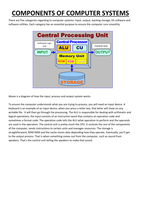
Arithmetic Logic
Unit Control Unit


Above is a diagram of how the input, process and output system works.

To ensure the computer understands what you are trying to process, you will need an input device. A
keyboard is an example of an input device, when you press a letter key, that letter will show on any
writable file. It will then go through the processing. The ALU is responsible for dealing with arithmetic and
logical operations; the input consists of an instruction word that contains an operation code and
sometimes a format code. The operation code tells the ALU what operation to perform and the operands
are used in the operation. The control unit is pretty much the CPU. It controls the rest of the components
of the computer, sends instructions to certain units and manages resources. The storage is
straightforward, ROM RAM and the cache stores data depending how they operate. Eventually, you’ll get
to the output process. That is when something comes out from the computer, such as sound from
speakers. That’s the control unit telling the speakers to make that sound.

Escuela, estudio y materia

Nivel de Estudio
Editores
Tema
Curso

Información del documento

Subido en
28 de mayo de 2017
Número de páginas
8
Escrito en
2015/2016
Tipo
ENSAYO
Profesor(es)
Desconocido
Grado
P

Temas

$4.90
Accede al documento completo:

¿Documento equivocado? Cámbialo gratis Dentro de los 14 días posteriores a la compra y antes de descargarlo, puedes elegir otro documento. Puedes gastar el importe de nuevo.
Escrito por estudiantes que aprobaron
Inmediatamente disponible después del pago
Leer en línea o como PDF


Documento también disponible en un lote

Reseñas de compradores verificados

Se muestran los comentarios
7 año hace

2.0

1 reseñas

5
0
4
0
3
0
2
1
1
0
Reseñas confiables sobre Stuvia

Todas las reseñas las realizan usuarios reales de Stuvia después de compras verificadas.

Conoce al vendedor

Seller avatar
Los indicadores de reputación están sujetos a la cantidad de artículos vendidos por una tarifa y las reseñas que ha recibido por esos documentos. Hay tres niveles: Bronce, Plata y Oro. Cuanto mayor reputación, más podrás confiar en la calidad del trabajo del vendedor.
rapidhelp Pearson
Seguir Necesitas iniciar sesión para seguir a otros usuarios o asignaturas
Vendido
2539
Miembro desde
8 año
Número de seguidores
1938
Documentos
78
Última venta
2 año hace
Personal Folder of BTEC L3 IT Practitioners (Achived D*DD)

Former CANDI student studying Computer Forensics in Middlesex University. Achieved D*DD in BTEC L3 Extended Diploma in IT Practitioners. Work inspired by others and own research, only uploading theoretical documents. I\\\'d like to stress the fact that you should not completely copy the work, but use the provided work as a guide to what you need to write. If you have any queries, feedback, or anything else. Feel free to send me a message and I\\\'ll reply as soon as possible!

Lee mas Leer menos
3.3

65 reseñas

5
20
4
12
3
12
2
9
1
12

Documentos populares

Recientemente visto por ti

Por qué los estudiantes eligen Stuvia

Creado por compañeros estudiantes, verificado por reseñas

Calidad en la que puedes confiar: escrito por estudiantes que aprobaron y evaluado por otros que han usado estos resúmenes.

¿No estás satisfecho? Elige otro documento

¡No te preocupes! Puedes elegir directamente otro documento que se ajuste mejor a lo que buscas.

Paga como quieras, empieza a estudiar al instante

Sin suscripción, sin compromisos. Paga como estés acostumbrado con tarjeta de crédito y descarga tu documento PDF inmediatamente.

Student with book image

“Comprado, descargado y aprobado. Así de fácil puede ser.”

Alisha Student

Preguntas frecuentes