
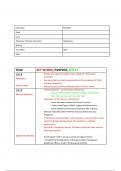
Chancellor President
Ebert
Cuno
Stressman (100 day chancellor) Hindenburg
Brüning
Von Papen Hitler
Hitler
YEAR KEY WORDS, PURPOSE, EFFECT
1918 - People who signed armistace were called the “November
Criminals”
Armistace
- Germany had to accept responsibility for the outbreaks of WW1
and pay reparations.
Kaiser exiled - Rioting because Germans blamed Kaiser for their defeat.
1919 - Weimar Republic - parliamentary democracy:
- Guaranteed freedom of speech, religion and equality.
New constitution
- Men AND women over 20 could vote
- Opposition to the Weimar constitution:
- Some Germans wanted the Kaiser to return,
- many senior figures didn’t support the democracy
- Some wanted a communist revolution like in Russia.
- National Assembly met in Weimar because Berlin was too
dangerous
- Proportional representation. Gave everyone a say, but led to some
extremist groups gaining power and coalitions - unstable
government.
- Article 48 - emergency decree, President could pass laws without
Reichstag approval.
Spartacist uprising
- Communists tried to set up a communist government.
- Occupied the headquarters of the government newspaper,
telephone offices, tried to bring a general strike.
, - Difficult to end the revolt because of limited troops.
- Government used Freikorps (volunteer soldiers)
- Freikorps hated communism, so stopped the revolt quickly.
- Alsace Lorraine given to France
Treaty of Versailles
- Eupen and Malmedy given to Belgium
- War Guilt
- Reparations of 136,000 million marks
- Military forces cut - no tanks or submarines, army limited to
100,000 men and could only be used internally.
German Workers’ - Led by Anton Drexler.
party formed - Hitler worked for the army to monitor activities of extreme political
groups.
- He gathered information from the Workers’ party, but agreed with
their ideals;
- Democracy was weak
- Jews were to blame for weakness
- Socialists had betrayed Germany by signing the Treaty of
Versailles.
1920 - happened because Ebert tried to disband two Freikorps units.
- Freikorps marched into Berlin to declare Dr. Wolfgang Kapp leader.
Kapp Putsch
- Kapp = extreme Nationalist , had support of army officers
- German army refused to stop Freikorps. They felt sympathetic.
- Ebert moved the government out of Berlin
- Ebert brought about a general strike: gas, water, electricity
- City was not able to function.
- Kapp didn’t have support he needed, so fled to Sweden.
- Freikorps disbanded
- Showed that the government had little military power.
1921 - Hitler was in charge of propaganda for the German Workers’ Party
- Renamed it to NSDAP (national socialist German workers’ party)
Hitler becomes
- Anti-communist ideals, antisemitism to blame people for
leader of Nazis
Germany’s defeat, destruction of the Treaty of Versailles.
- Party increased to 1,100
- They bought a newspaper (People’s Observer)
- Hitler introduced the swastika and arm salute, and controlled the
party like a military leader.
- Powerful connections like General Ludendorff.
- Stormtroopers were the SA


