
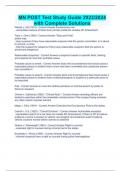
MN POST Test Study Guide 2023/2024 with Complete Solutions
Weeks v. US (1914) - Correct Answer Exclusionary rule - warrantless seizure of items from private residence violates 4th Amendment Terry v. Ohio (1968) - Correct Answer "Stop and Frisk" police may: - stop a person if they have reasonable suspicion that the person committed, or is about to commit, a crime - frisk the suspect for weapons if they have reasonable suspicion that the person is armed and dangerous Reasonable Suspicion - Correct Answer a suspicion based on specific facts, training, and experience; less than probable cause Probable cause to arrest - Correct Answer facts and circumstances that would cause a reasonable person to believe that a crime has been committed and a particular person has committed it Probable cause to search - Correct Answer facts and circumstances that would cause a reasonable person to believe that a evidence/property is located in a particular place to be searched frisk - Correct Answer an over-the-clothes pat-down or minimal search by police to discover weapons Chimel v. California (1969) - "Chimel Rule" - Correct Answer arresting officers are limited to searches within the immediate vicinity/control of the suspect being arrested; any other search requires warrant Mapp v. Ohio (1961) - Correct Answer Extended the Exclusionary Rule to the states Carroll v. U.S. (1925) - "Carroll Doctrine" - Correct Answer Automobile exception - warrantless search of a car does not violate 4th Amendment, if there is PC to believe evidence a crime is present in vehicle, and exigent circumstances exist to believe vehicle could be moved before warrant is obtained Gideon v. Wainwright (1963) - Correct Answer Right to counsel - extended right to counsel during criminal trial to the states Escobedo v. Illinois (1964) - Correct Answer Right to counsel - criminal suspects have a right to counsel during police interrogations
Información del documento
- Subido en
- 10 de agosto de 2023
- Número de páginas
- 23
- Escrito en
- 2023/2024
- Tipo
- Examen
- Contiene
- Preguntas y respuestas

