exam 2 study guide
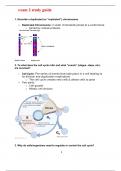
1. Describe a duplicated (or “replicated”) chromosome.
• Replicated Chromosome: 2 sister chromatids joined at a centromere
o Joined by cohesin proteins
2. To what does the cell cycle refer and what “events” (stages, steps, etc.)
are involved?
• Cell Cycle: The series of events that take place in a cell leading to
its division and duplication (replication)
o The cell cycle creates new cells & allows cells to grow
• Two parts:
o Cell growth
o Mitotic cell division
3. Why do cells/organisms need to regulate or control the cell cycle?
1
, exam 2 study guide
• Make sure that the cells are developing & functioning properly
• Get rid of old, damaged, diseased, “malfunctioning” cells
4. How do cells/organisms regulate or control the cell cycle? Explain the role of
checkpoints. Explain the chemical control system that gets cells through the
G2 checkpoint.
• Cell cycle regulated by molecular signals in the cytoplasm & checkpoints
• Three major checkpoints: G1, G2, and M checkpoints
• The presence or absence of specific chemical signals determines
whether a cell stops or proceeds through a checkpoint in the cell cycle
• G1: Restriction Checkpoint
o Signals determine whether the cell…
▪ A) Pauses & enters G0, where the cell “hangs out” and
does the job it was intended to do
▪ B) Passes the G1 checkpoint and enters “S” (synthesis)
▪ C) Passes the G1 checkpoint and undergoes apoptosis (cell
death)
• G2 Checkpoint:
o Cell assess if preparations are “ok”
o If yes, signals direct the cell to enter “M” (mitotic phase)
o Maturation Promoting Factor (MPF): A particular cyclin-Cdk
complex needed to get through the G2 checkpoint
▪ Cyclin is gradually synthesized during S and G2
▪ Cyclin concentration high enough binds to & is
activated by a particular Cdk protein complex now
called MPF
▪ MPF signal moves the cell through the G2 checkpoint & into
mitosis
▪ MPF NOT at G1 checkpoint
• M Checkpoint:
o Cell assesses if mitosis proceeded successfully
o If yes, signals direct the cell to enter cytokinesis (cell division)
2
, exam 2 study guide
5.What is the general purpose of mitotic cell division? Describe the step-wise
process of mitotic cell division. Compare the number of chromosomes before
the start of mitosis, at each step, and at the end.
• Mitosis: Cell division that preserves the parental number of
chromosomes in the two daughter cells
o Asexual reproduction
• General purpose of Mitosis:
o Create new cells quickly (replication)
o Growth & repair
▪ Replace worn-out or damaged cells
▪ Enable multicellular organisms to grow
Mitosis diploid (2n) diploid (2n)
• Interphase
o G1
▪ Cell grows in size and synthesizes mRNA proteins
o Synthesis (S)
▪ Chromosomes (DNA) replicate
▪ Centrosomes replicate
o G2
▪ Rapid cell growth & protein synthesis
• Prophase
o Centrosomes move to opposite poles
o Spindle microtubules start to lengthen
o Nuclear membrane begins to dissolve
o Nucleolus disintegrates
o DNA begins to condense into distinct, replicated chromosomes
• Prometaphase
o Nuclear membrane is gone
o Chromosomes are clearly distinct
3
, exam 2 study guide
o A kinetochore (kt) appears at each centromere
o Spindle is complete
o Aster forms
• Metaphase
o Spindle microtubules move the chromosomes
o Chromosomes line up single file along the
midline/equator/metaphase plate
• Anaphase
o Centromeres split
o Spindle microtubules pull apart sister chromatids toward opposite
poles
• Telophase & Cytokinesis
o Spindle disassembles
o Nuclear membrane reforms
o Nucleolus reappears
• Result of Mitosis:
o 2 diploid (2n) daughter cells
o Same number of chromosomes as parent cell
o Identical DNA sequences as parent cell
▪ “Clones” of parent cell
4