
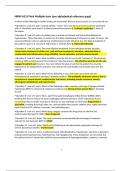
NRNP 6531 Week 11 Final Exam Multiple Tests (Alphabetical Reference)
1Question: In which of the following is further testing not warranted? 2 Question: 1 out of 1 point. Central obesity, “moon” face, and dorsocervical fat pad are associated with: 3 Question: 1 out of 1 point. An elderly man is started on lisinopril and hydrochlorothiazide for hypertension. Three days later, he returns to the office complaining of left great toe pain. On exam, the nurse practitioner notes an edematous, erythematous tender left great toe. The likely precipitant of this patient’s pain is: 4 Question: 1 out of 1 point. The most effective treatment of non-infectious bursitis includes: 5 Question: 1 out of 1 point. What conditions must be met for you to bill “incident to” the physician, receiving 100% reimbursement from Medicare? 6 Question: 1 out of 1 point. Which of the following is not a risk factor associated with the development of syndrome X and type 2 diabetes mellitus? 7 Question: 1 out of 1 point. Which of the following is not a common early sign of benign prostatic hyperplasia (BPH)? 8 Question: 1 out of 1 point. Steve, age 69, has gastroesophageal reflux disease (GERD). When teaching him how to reduce his lower esophageal sphincter pressure, which substances do you recommend that he avoid? 9 Question: 1 out of 1 point. Which drug category contains the drugs that are the first line Gold standard therapy for COPD? 10 Question: 1 out of 1 point. The most commonly recommended pharmacological treatment regimen for low back pain (LBP) is: 11 Question: 1 out of 1 point. Which of the following is not appropriate suppression therapy for chronic bacterial prostatitis? 12 Question: 1 out of 1 point. A patient presents with dehydration, hypotension, and fever. Laboratory testing reveals hyponatremia, hyperkalemia, and hypoglycemia. These imbalances are corrected, but the patient returns 6 weeks later with the same symptoms of hyperpigmentation, weakness, anorexia, fatigue, and weight loss. What action(s) should the nurse practitioner take? 16 Question: 1 out of 1 point. You are assessing a patient after a sports injury to his right knee. You elicit a positive anterior/posterior drawer sign. This test indicates an injury to the: 17 Question: 1 out of 1 point. A 32-year-old female patient presents with fever, chills, right flank pain, right costovertebral angle tenderness, and hematuria. Her urinalysis is positive for leukocytes and red blood cells. The nurse practitioner diagnoses pyelonephritis. The most appropriate management is: 19 Question: 1 out of 1 point. A middle-aged man presents to urgent care complaining of pain of the medial condyle of the lower humerus. The man works as a carpenter and describes a gradual onset of pain. On exam, the medial epicondyle is tender, and pain is increased with flexion and pronation. Range of motion is full The most likely cause of this patient’s pain is: 21 Question: 1 out of 1 point. The best test to determine microalbuminuria to assist in the diagnosis of diabetic neuropathy s to measure albumin in a spot urine sample, collected either as the first urine in the morning or at random, for example, at the medical visit. This method is accurate: 22 Question: 1 out of 1 point. What is the first symptom seen in the majority of patients with Parkinson’s disease? 23 Question: 1 out of 1 point. The most commonly recommended method for prostate cancer screening in a 55-year-old male is: 24 Question: 1 out of 1 point. Martin, age 24, presents with an erythematous ear canal, pain, and a recent history of swimming. What do you suspect? 25 Question: 1 out of 1 point. Which of the following symptoms suggests a more serious cause of back pain? 28 Question: 1 out of 1 point. A patient taking levothyroxine is being over-replaced. What condition is he at risk for? 29 Question: 1 out of 1 point. Which of the following is the most common cause of low back pain? 30 Question: 1 out of 1 point. Which is the most common cause of end-stage renal disease in the United States? 31 Question: 1 out of 1 point. A 77-year-old female presents to the office complaining a sudden swelling on her right elbow. She denies fever, chills, trauma, or pain. The physical exam reveals a non-tender area of swelling over the extensor surface over the right elbow with evidence of trauma or irritation. The nurse practitioner suspects: 32 Question: 1 out of 1 point. A 60-year-old female patient complains of sudden onset unilateral, stabbing, surface pain in the lower part of her face lasting a few minutes, subsiding, and then returning. The pain is triggered by touch or temperature extremes. Physical examination is normal. Which of the following is the most likely diagnosis? 33 Question: 1 out of 1 point. Beth, age 49, comes in with low back pain. An x-ray of the lumbosacral spine is within normal limits. Which of the following diagnoses do you explore further? 34 Question: 1 out of 1 point. A patient exhibits extrapyramidal side effects of antipsychotic medications. Which of the following symptoms would lead you to look for another diagnosis? 35 Question: 1 out of 1 point. Phalen’s test, 90°wrist flexion for 60 seconds, reproduces symptoms of: 37 Question: 1 out of 1 point. The most common cause of elevated liver function tests is: 38 Question: 1 out of 1 point. Reed-Sternberg B lymphocytes are associated with which of the following disorders: 39 Question: 1 out of 1 point. Which of the following is a potential acquired cause of thrombophilia? 41 Question: 1 out of 1 point. A 75-year-old female is diagnosed with primary hyperparathyroidism and asks the nurse practitioner what the treatment for this disorder is. The nurse practitioner explains: 43 Question: 1 out of 1 point. A 25-year-old overweight patient presents with a complaint of dull achiness in his groin and history of a palpable lump in his scrotum that “comes and goes”. On physical examination, the nurse practitioner does not detect a scrotal mass. There is no tenderness, edema, or erythema of the scrotum, the scrotum does not transilluminate. What is the most likely diagnosis? 44 Question: 1 out of 1 point. Dave, age 38, states that he thinks he has an ear infection because he just flew back from a business trip and feels unusual pressure in his ear. You diagnose barotrauma. What is your next action? 46 Question: 1 out of 1 point. The physiological explanation of syncope is: 47 Question: 1 out of 1 point. A 20-year-old male patient complains of “scrotal swelling.” He states his scrotum feels heavy but denies pain. On examination, the nurse practitioner notes transillumination of the scrotum. What is the most likely diagnosis? 48 Question: 1 out of 1 point. A 32-year-old male patient complains of urinary frequency and burning on urination for 3 days. Urinalysis reveals bacteriuria. He denies any past history of urinary tract infection. The initial treatment should be: 49 Question: 1 out of 1 point. Diagnostic radiologicalstudies are indicated for low back pain: 51 Question: 1 out of 1 point. An 81-year-old female is diagnosed with type 2 diabetes. When considering drug therapy for this patient, the nurse practitioner is most concerned with which of the following side effects? 53 Question: 1 out of 1 point. The diagnosis of human papilloma virus (HPV) infection in males is usually made by: 54 Question: 1 out of 1 point. Which history is commonly found in a patient with glomerulonephritis? 55 Question: 1 out of 1 point. A patient complains of generalized joint pain and stiffness associated with activity and relieved with rest. This patient history is consistent with which of the following disorders? 56 Question: 1 out of 1 point. The most common presentation of thyroid cancer is: 57 Question: 1 out of 1 point. The obligatory criteria for diagnosis of muscular dystrophy (MD) are: 58 Question: 1 out of 1 point. The diagnosis which must be considered in a patient who presents with a severe headache of sudden onset, with neck stiffness and fever, is: 59 Question: 1 out of 1 point. A 60-year-old male patient with multiple health problems presents with a complaint of erectile dysfunction (ED). Of the following, which medication is most likely to be causing the problem? 60 Question: 1 out of 1 point. A 72-year-old patient exhibits sudden onset of fluctuating restlessness, agitation, confusion, and impaired attention. This is accompanied by visual hallucinations and sleep disturbance. What is the most likely cause of this behavior? 61 Question: 1 out of 1 point. Which of the following set ofsymptoms should raise suspicion of a brain tumor? 62 Question: 1 out of 1 point. The cornerstone of treatment for stress fracture of the femur or metatarsalstressfracture is: 63 Question: 1 out of 1 point. Sally, a computer programmer, has just been given a new diagnosis of carpal tunnel syndrome. Your next step is to: 64 Question: 1 out of 1 point. Marsha presents with symptoms resembling both fibromyalgia and chronic fatigue syndrome, which have many similarities. Which of the following is more characteristic of fibromyalgia? 65 Question: 1 out of 1 point. The cardinalsign of infectious arthritisis: 66 Question: 1 out of 1 point. Diagnostic evaluation for urinary calculi includes: 70 Question: 1 out of 1 point. A 15-year-old female patient is 5 feet tall and weighs 85 pounds. You suspect anorexia and know that the best initial approach is to: 71 Question: 1 out of 1 point. A 63-year-old man presents to the office with hematuria, hesitancy, and dribbling. Digital rectal exam (DRE) reveals a moderately enlarged prostate that is smooth. The PSA is 1.2. What is the most appropriate management strategy for you to follow at this time? 73 Question: 1 out of 1 point. A positive drawer sign supports a diagnosis of: 75 Question: 1 out of 1 point. A 14-year-old female cheerleader reports gradual and progressive dull anterior knee pain, exacerbated by kneeling. The nurse practitioner notesswelling and point tenderness at the tibial tuberosity. X-ray is negative. What is the most likely diagnosis? 77 Question: 1 out of 1 point. Jack, age 55, comes to the office with a blood pressure of 144/98 mm Hg. He states that he did not know if it was ever elevated before. When you retake his blood pressure at the end of the exam, it remains at 144/98. What should your next action be? 79 Question: 1 out of 1 point. Martin is complaining of erectile dysfunction. He also has a condition that has reduced arterial blood flow to his penis. The most common cause of this condition is: 80 Question: 1 out of 1 point. Successful management of a patient with attention deficit hyperactivity disorder (ADHD) may be achieved with: 81 Question: 1 out of 1 point. What diabetic complications result from hyperglycemia? 82 Question: 1 out of 1 point. In which of the following presentations is further diagnostic testing not warranted? • Thistestisnotmandatoryifothertestclearlyindicatediabeticneuropathy. 83 Question: 1 out of 1 point. The most common symptoms of transient ischemic attack (TIA) include: 85 Question: 1 out of 1 point. Establishment of a definitive diagnosis of osteomyelitis requires: 86 Question: 1 out of 1 point. Which of the following is the most common causative organism of no gonococcal urethritis? 88 Question: 1 out of 1 point. A 30-year-old female patient presents to the clinic with heat intolerance, tremors, nervousness, and weight loss inconsistent with increased appetite. Which test would be most likely to confirm the suspected diagnosis? 90 Question: 1 out of 1 point. Potential causes of hypocalcemia include which of the following? 92 Question: 1 out of 1 point. Which of the following is a contraindication for metformin therapy? 93 Question: 1 out of 1 point. The organism most often associated with prostatitis is: 94 Question: 1 out of 1 point. The most effective intervention(s) to prevent stroke is (are): 95 Question: 1 out of 1 point. What is the most commonly abused substance? 98 Question: 1 out of 1 point. An obese hyperlipidemic patient, newly diagnosed with type 2 diabetes mellitus, has fasting glucose values 180 to 250 mg/Dl. What is the most appropriate initial treatment to consider? 100 Question: 1 out of 1 point. Prolonged PT suggests: START OF NEW TEST, #2 2 Question: 1 out of 1 point. A patient presents with dehydration, hypotension, and fever. Laboratory testing reveals hyponatremia, hyperkalemia, and hypoglycemia. These imbalances are corrected, but the patient returns 6 weeks later with the same symptoms of hyperpigmentation, weakness, anorexia, fatigue, and weight loss. What action(s) should the nurse practitioner take? 5 Question: 1 out of 1 point. Which of the following is a potential acquired cause of thrombophilia? 8 Question: 1 out of 1 point. Differential diagnosis of proteinuria includes which of the following? 10 Question: 1 out of 1 point. Question 35 The nurse practitioner diagnoses epididymitis in a 24-yearold sexually active male patient. The drug of choice for treatment of this patient is: 11 Question: 1 out of 1 point. How do you respond when Jessica, age 42, asks you what constitutes a good minimum cardiovascular workout? 12 Question: 1 out of 1 point. The intervention known to be most effective in the treatment ofsevere depression, with or without psychosis, is: 21 Question: 1 out of 1 point. Which of the following accounts for half of the bladder tumors among men and one third in women? 23 Question: 1 out of 1 point. A 21-year-old female presents to the office complaining of urinary frequency and urinary burning. The nurse practitioner suspects a urinary tract infection when the urinalysis reveals: 26 Question: 1 out of 1 point. The initial clinicalsign of Dupuytren’s contracture is: 33 Question: 1 out of 1 point. A nurse practitioner diagnoses a 60-year-old male with balanitis. Which disease is commonly associated with balanitis? 34 Question: 1 out of 1 point. Josh, age 22, is a stock boy and has an acute episode of low back pain. You order and NSAID and tell him which of the following? 35 Question: 1 out of 1 point. A 72-year-old female patient reports a 6-month history of gradually progressive swollen and painful distal interphalangeal (DIP) joints of one hand. She has no systemic symptoms, but the erythrocyte sedimentation rate (ESR), antinuclear antibody (ANA), and rheumatoid factor (RF) are all minimally elevated. What is the most likely diagnosis? 38 Question: 1 out of 1 point. A patient has been taking fluoxetine (Prozac) since being diagnosed with major depression, first episode, 2 months ago. She reports considerable improvement in her symptoms and her intention to discontinue the medication. What should be the nurse practitioner’s recommendation? 39 Question: 1 out of 1 point. A typical description of a tension headache is: 40 Question: 1 out of 1 point. Jennifer says that she has heard that caffeine can cause osteoporosis and asks you why. How do you respond? 41 Question: 1 out of 1 point. Which of the following set ofsymptoms should raise suspicion of a brain tumor? 43 Question: 1 out of 1 point. Diagnostic confirmation of acute leukemia is based on: 44 Question: 1 out of 1 point. Which of the following antibiotics should not be prescribed for a pregnant woman in the 3rd trimester? 46 Question: 1 out of 1 point. Who is at a higher risk for developing nephrolithiasis? 53 Question: 1 out of 1 point. A 28-year-old female presents to the office requesting testing for diagnosis of hereditary thrombophilia. Her father recently had a deep vein thrombosis, and she is concerned about her risk factors. The nurse practitioner explains that: 54 Question: 1 out of 1 point. Martin, a 58-year-old male with diabetes, is at your office for his diabetes follow up. On examining his feet with monofilament, you discover that he has developed decreased sensation in both feet. There are no open areas or signs of infection on his feet. What health teaching should Martin receive today regarding the care if his feet? 57 Question: 1 out of 1 point. Potential causes of septic arthritis include which of the following? 58 Question: 1 out of 1 point. Which of the following is the best response to a woman who has just admitted she is a victim of spousal abuse? 62 Question: 1 out of 1 point. A patient has been diagnosed with generalized anxiety disorder (GAD). Which of the following medications may be used to treat generalized anxiety disorder? 64 Question: 1 out of 1 point. Sam, age 67, is a diabetic with worsening renal function. He has frequent hypoglycemic episodes, which he believes means that his diabetes is getting “better.” How do you respond? 67 Question: 1 out of 1 point. A 35-year-old male presents with a complaint of low pelvic pain, dysuria, hesitancy, urgency, and reduced force of stream. The nurse practitioner suspects acute bacterial prostatitis. Which of the following specimens would be least helpful for diagnosis? 69 Question: 1 out of 1 point. A patient has just been diagnosed with Bell’s palsy. He is understandably upset and has questions about the prognosis. Your response should be: 70 Question: 1 out of 1 point. What is the first step in the treatment of uric acid kidney stones? 71 Question: 1 out of 1 point. Urine cultures should be obtained for which of the following patients? 73 Question: 1 out of 1 point. A patient has been diagnosed with hypothyroidism and thyroid hormone replacement therapy is prescribed. How long should the nurse practitioner wait before checking the patient’s TSH? 77 Question: 1 out of 1 point. The hallmark of neurofibromatosis (von Recklinghausen’s disease) present in almost 100% of patients is: 82 Question: 1 out of 1 point. A patient presenting for an annual physical exam has a BMI of 25 kg/m2 This patient would be classified as: 84 Question: 1 out of 1 point. Diagnostic evaluation of hypothyroidism reveals: 85 Question: 1 out of 1 point. Diagnostic radiological studies are indicated for low back pain: 88 Question: 1 out of 1 point. The correct treatment for ankle sprain during the first 48 hours after injury includes: 89 Question: 1 out of 1 point. The most reliable indicator(s) of neurological deficit when assessing a patient with acute low back pain is(are): 91 Question: 1 out of 1 point. Risk factors for include which of the following? 92 Question: 1 out of 1 point. Major depression occurs most often in which of the following conditions? 93 Question: 1 out of 1 point. Which of the following medications increase the risk for metabolic syndrome? 97 Question: 1 out of 1 point. A 27-year-old female patient with epilepsy is well controlled with phenytoin (Dilantin). She requests information about contraception. The nurse practitioner should instruct her that while taking phenytoin: 98 Question: 1 out of 1 point. Risk factors for prostate cancer include all of the following except: 101 Question: 1 out of 1 point. Maria, age 17, was raped when she was 13-year-old. She is now experiencing sleeping problems, flashbacks, and depression. What is your initial diagnosis? NEW TEST #3 5 Question: 1 out of 1 point. Diabetes screening recommendations for asymptomatic adults age 45 and over include which of the following: 9 Question: 1 out of 1 point. A child with type 1 diabetes mellitus has experienced excessive hunger, weight gain and increasing hyperglycemia. The Somogyi effect is suspected. What steps should be taken to diagnose and treat this condition? 10 Question: 1 out of 1 point. Potential side effects of levofloxacin include which of the following? 12 Question: 1 out of 1 point. Which of the following is the most common complication of the myelodysplastic syndromes? 15 Question: 1 out of 1 point. Which of the following is characteristic of a manic episode? 16 Question: 1 out of 1 point. Which of the following characteristics are associated with prepatellar bursitis? 20 Question: 1 out of 1 point. A middle-aged female presents complaining of recent weight loss. The physical exam reveals an enlarged painless cervical lymph node. The differential diagnosis for this patient’s problem includes: 21 Question: 1 out of 1 point. What is the most common cause of Cushing’s syndrome? 26 Question: 1 out of 1 point. A diabetic patient is taking low dose enalapril for hypertension. A record of the patient’s blood pressure over 4 weeks ranges from 130 to 142 mmHg systolic and 75 to 85 mmHg diastolic. How should the nurse practitioner respond? 30 Question: 1 out of 1 point. Your patient has an elevated mean cell volume (MCV). What should you be considering in terms of diagnosis? 31 Question: 1 out of 1 point. What information should patients with diabetes and their families receive about hypoglycemia? 35 Question: 0 out of 1 point. At what age is screening most likely to detect scoliosis? 41 Question: 1 out of 1 point. Which of the following is NOT a characteristic of type 2 diabetes mellitus? Which of the following is NOT a characteristic of type 1 diabetes mellitus? CHAPTER FOUR Quiz 1.Question: All of the following are characteristic of Type 2 diabetes mellitus except 2. Question: Which of the following is not characteristic of Type 1 diabetes mellitus? Medical conditions related to metabolic syndrome are? 42 Question: 1 out of 1 point. The most accurate measure of diabetes control is: 43 Question: 1 out of 1 point. Microalbuminuria is a measure of: 53 Question: 1 out of 1 points A patient has HIV infection and is having a problem with massive diarrhea. You suspect the cause is: 56 Question: 1 out of 1 point. The nurse practitioner is following a child with juvenile rheumatoid arthritis (JRA) who has been previously diagnosed and is being managed for the disease by a pediatric rheumatologist. The mother asks for information about the child’s long-term prognosis. What isthe most appropriate reply? 59 Question: 0 out of 1 point. Which factors are associated with high risk for foot complications in a patient with diabetes mellitus? 60 Question: 1 out of 1 point. Which of the following is the most common causative organism of nongonococcal urethritis? 61 Question: 0 out of 1 points A 65-year-old patient complains of recurrent bilateral temporal headaches, malaise, muscle aches, and low-grade fever. The headache is described as superficial tenderness rather than deep pain. Giant cell arteritisissuspected. Appropriate treatment is: 64 Question: 1 out of 1 point. The most reliable diagnostic indicator of gout is: 82 Question: 0 out of 1 point. A patient with HIV infection has a fever of unknown origin (FUO). Which of the following is a possible cause of FUO in a patient with HIV? 85 Question: 1 out of 1 point. After treating a patient for Helicobacter pylori infection, what test do you order to see if it has been cured? 86 Question: 1 out of 1 point. Which of the following physical modalities recommended for treatment of rheumatoid arthritis provides the most effective long term pain relief? 88 Question: 1 out of 1 point. Other than smoking cessation, which of the following slows the progression of COPD in smokers? 93 Question: 1 out of 1 point. What intervention does the American College of Rheumatology recommend as first line therapy for osteoarthritis? 97 Question: 1 out of 1 point. The best test to determine microalbuminuria to assist in the diagnosis of diabetic neuropathy: 99 Question: 0 out of 1 point. A 26-year-old female presents with elbow pain that is described as aching and burning. There is point tenderness along the lateral aspect of the elbow and painful passive flexion and extension. She reports she has been playing tennis almost daily for the past month. The most likely diagnosis is:
Información del documento
- Subido en
- 9 de agosto de 2023
- Número de páginas
- 13
- Escrito en
- 2023/2024
- Tipo
- Examen
- Contiene
- Preguntas y respuestas

