

Anatomy and Physiology of the Lungs
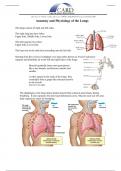
The lungs consist of right and left sides.
The right lung has three lobes:
Upper lobe, Middle lobe, Lower lobe
The left lung has two lobes:
Upper lobe, Lower lobe
The heart sits in the mid chest extending into the left side
Starting from the trachea (windpipe), two large tubes known as bronchi (airways)
separate and distribute air to the left and right sides of the lungs.
Bronchi gradually form more generations,
like a tree branch, and become smaller and
smaller.
As they spread to the ends of the lungs they
eventually form a grape-like structure known
as the alveoli.
(shown to the right).
The diaphragm is the large dome shaped muscle that contracts and relaxes during
breathing. It also separates the chest and abdominal cavity. Muscles near our ribs also
help expand our chest for breathing.
, Oxygen is inhaled and released from the lungs to the blood.
Air reaches the alveoli (air sacs) where oxygen then moves from the air sacs into the
capillaries through their thin walls.
Capillaries are tiny blood vessels that carry oxygenated blood to the blood stream that
supplies our body.
Carbon dioxide is released
from the blood to the lungs
and exhaled.
Carbon Dioxide moves
FROM capillaries
(tiny blood vessels) into the
alveoli.
Too much carbon dioxide in
the blood results from
hypoventilation (too little
breathing).
Too little carbon dioxide in
the blood results from
hyperventilation (too much/
DLCO is your “Diffusion Rate” and is measured during pulmonary
or rapid breathing).
function testing. It measures how much oxygen is diffusing (moving)
from your lungs into your blood. Normal diffusion rates are 80-120%.
Your DLCO __________________
Tiny hairs, called cilia, line the bronchi.
Cilia move back and forth in an
ongoing motion– like a wave.
Mucus is carried on top of cilia.
This is the first line of defense for in-
fection by moving foreign objects, like
bacteria or viruses, out of the lungs.
The lungs consist of right and left sides.
The right lung has three lobes:
Upper lobe, Middle lobe, Lower lobe
The left lung has two lobes:
Upper lobe, Lower lobe
The heart sits in the mid chest extending into the left side
Starting from the trachea (windpipe), two large tubes known as bronchi (airways)
separate and distribute air to the left and right sides of the lungs.
Bronchi gradually form more generations,
like a tree branch, and become smaller and
smaller.
As they spread to the ends of the lungs they
eventually form a grape-like structure known
as the alveoli.
(shown to the right).
The diaphragm is the large dome shaped muscle that contracts and relaxes during
breathing. It also separates the chest and abdominal cavity. Muscles near our ribs also
help expand our chest for breathing.
, Oxygen is inhaled and released from the lungs to the blood.
Air reaches the alveoli (air sacs) where oxygen then moves from the air sacs into the
capillaries through their thin walls.
Capillaries are tiny blood vessels that carry oxygenated blood to the blood stream that
supplies our body.
Carbon dioxide is released
from the blood to the lungs
and exhaled.
Carbon Dioxide moves
FROM capillaries
(tiny blood vessels) into the
alveoli.
Too much carbon dioxide in
the blood results from
hypoventilation (too little
breathing).
Too little carbon dioxide in
the blood results from
hyperventilation (too much/
DLCO is your “Diffusion Rate” and is measured during pulmonary
or rapid breathing).
function testing. It measures how much oxygen is diffusing (moving)
from your lungs into your blood. Normal diffusion rates are 80-120%.
Your DLCO __________________
Tiny hairs, called cilia, line the bronchi.
Cilia move back and forth in an
ongoing motion– like a wave.
Mucus is carried on top of cilia.
This is the first line of defense for in-
fection by moving foreign objects, like
bacteria or viruses, out of the lungs.

