

Theories of ageing
Eriksons life stages theory
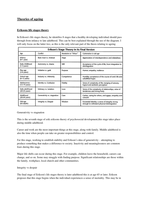
In Erikson's life stages theory, he identifies 8 stages that a healthy developing individual should pass
through from infancy to late adulthood. This can be best explained through the use of the diagram. I
will only focus on the latter two, as this is the only relevant part of the thesis relating to ageing
Generativity vs stagnation
This is the seventh stage of erik eriksons theory of psychosocial development,this stage takes place
during middle adulthood.
Career and work are the most important things at this stage, along with family. Middle adulthood is
also the time when people can take on greater responsibilities and control.
For this stage, working to establish stability and Erikson’s idea of generativity – attempting to
produce something that makes a difference to society. Inactivity and meaninglessness are common
fears during this stage.
Major life shifts can occur during this stage. For example, children leave the household, careers can
change, and so on. Some may struggle with finding purpose. Significant relationships are those within
the family, workplace, local church and other communities.
Integrity vs despair
The final stage of Erikson's life stages theory is later adulthood this is at age 65 or later. Erikson
proposes that this stage begins when the individual experiences a sense of mortality. This may be in
Eriksons life stages theory
In Erikson's life stages theory, he identifies 8 stages that a healthy developing individual should pass
through from infancy to late adulthood. This can be best explained through the use of the diagram. I
will only focus on the latter two, as this is the only relevant part of the thesis relating to ageing
Generativity vs stagnation
This is the seventh stage of erik eriksons theory of psychosocial development,this stage takes place
during middle adulthood.
Career and work are the most important things at this stage, along with family. Middle adulthood is
also the time when people can take on greater responsibilities and control.
For this stage, working to establish stability and Erikson’s idea of generativity – attempting to
produce something that makes a difference to society. Inactivity and meaninglessness are common
fears during this stage.
Major life shifts can occur during this stage. For example, children leave the household, careers can
change, and so on. Some may struggle with finding purpose. Significant relationships are those within
the family, workplace, local church and other communities.
Integrity vs despair
The final stage of Erikson's life stages theory is later adulthood this is at age 65 or later. Erikson
proposes that this stage begins when the individual experiences a sense of mortality. This may be in

