

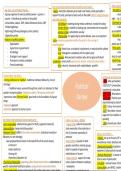
Key to successful political parties (including case studies): - Party systems
Key Ideas around Political Parties: - - Media- interaction between party leaders and media, media perception + - One party sy
A group organised to exercise political power -> govern a support for party, portrayal of party unity to the public (affects voting behaviour -assoc
country -> Manifesto (a promise to the public) and public opinions) right. – Eg- Ch
-Conservative, Labour, UKIP, Liberal Democrats Green, SNP -Ed Miliband- stuttering during media conference, mocked for eating -Dominant-pa
-Political legitimacy -Gordon Brown- mocked for slacking jaw, introverted and not assertive -Is dem
-Right wing/Left wing ideologies (centre parties) -Jeremy Corbyn- antisemitism scandal accountability
-Opposition parties -Theresa May- not appearing for public debates, seen as incompetent -Two party sy
Features of political parties: - -Unity- unanimous agreement within the party for the running of -Two p
- Organisation state/ideologies parties are dis
- A goal to be in government -May- Brexit issue, no majority in parliament, no majority within cabinet -Three party s
- An ideology -Blair- Managed to completely unit the Labour party -uncom
- Strategies to win support -Johnson- Removed party members who did not agree with Brexit leads to coaliti
- Procedures to select candidates -Leadership- voters prefer experienced, decisive, charismatic party leaders -Multi-Party s
- Formal leaderships -Blair- decisive, charismatic with media/debates, youthful -comm
representatio
Conservatives- key ideas: - Consensual and adversaria
- Strong preference for tradition- traditional institutes (Monarchy, church, - 1940- Atlee and welfare s
marriage)
-Traditional values survived through time, which is a testament to their Political -2010-2017- Conservative p
investments in education
quality+ strong foundation- Chesterton called it “democracy of the dead”
Parties
-1997-2015- New labour a
-Importance order (Edmund Burke) ‘good order is the foundation of all good -1979-1990- Thatcher prom
things’ and privatising key industri
-Pragmatic approach -2017- Labour won massive
-Pessimistic approach to human nature -2015- New labour increasi
wage but from coalition in
Key thinkers that developed Conservative party: - Labour- key ideas: - Old lab spending
-Early conservative- labelled tories (gaelic for thief), supported monarchy - Clause IV (4)- called for democratic -1983- Kinnock poor attem
-Edmund Burke- change should be gradual state ownership of key industries in
-Benjamin Disraeli (1860’s) -One nation Conservatism, (industrial revolution+ the UK (common ownership of Labour- key thinkers : -
Marxism as a new ideology) produce) - Fabians- set up in the early 19th ce
-Laws proposed (took interest in the benefit for all the social classes): -Social reform- Equality for both revolutionary means. Beatrice and
-Factory Act genders and ethnic minority groups, - Democratic Socialists-Capitalism w
-Public Health Act belief in equality of opportunity, implement, taking control of produ
-Housing Act redistribution of income - Ramsey Macdonald – in power in1
-Elementary Education Act -Trade unionism- support for trade reforms were implemented
-Churchill and Macmillan supporting Labour Government reforms- redistribution of unions, balance between employers -Tony Blair- removed clause 4 from
wealth, nationalised healthcare system, compassionate conservatism (Mac) + employees -Clemet Atlee- post WW2, creation
Key Ideas around Political Parties: - - Media- interaction between party leaders and media, media perception + - One party sy
A group organised to exercise political power -> govern a support for party, portrayal of party unity to the public (affects voting behaviour -assoc
country -> Manifesto (a promise to the public) and public opinions) right. – Eg- Ch
-Conservative, Labour, UKIP, Liberal Democrats Green, SNP -Ed Miliband- stuttering during media conference, mocked for eating -Dominant-pa
-Political legitimacy -Gordon Brown- mocked for slacking jaw, introverted and not assertive -Is dem
-Right wing/Left wing ideologies (centre parties) -Jeremy Corbyn- antisemitism scandal accountability
-Opposition parties -Theresa May- not appearing for public debates, seen as incompetent -Two party sy
Features of political parties: - -Unity- unanimous agreement within the party for the running of -Two p
- Organisation state/ideologies parties are dis
- A goal to be in government -May- Brexit issue, no majority in parliament, no majority within cabinet -Three party s
- An ideology -Blair- Managed to completely unit the Labour party -uncom
- Strategies to win support -Johnson- Removed party members who did not agree with Brexit leads to coaliti
- Procedures to select candidates -Leadership- voters prefer experienced, decisive, charismatic party leaders -Multi-Party s
- Formal leaderships -Blair- decisive, charismatic with media/debates, youthful -comm
representatio
Conservatives- key ideas: - Consensual and adversaria
- Strong preference for tradition- traditional institutes (Monarchy, church, - 1940- Atlee and welfare s
marriage)
-Traditional values survived through time, which is a testament to their Political -2010-2017- Conservative p
investments in education
quality+ strong foundation- Chesterton called it “democracy of the dead”
Parties
-1997-2015- New labour a
-Importance order (Edmund Burke) ‘good order is the foundation of all good -1979-1990- Thatcher prom
things’ and privatising key industri
-Pragmatic approach -2017- Labour won massive
-Pessimistic approach to human nature -2015- New labour increasi
wage but from coalition in
Key thinkers that developed Conservative party: - Labour- key ideas: - Old lab spending
-Early conservative- labelled tories (gaelic for thief), supported monarchy - Clause IV (4)- called for democratic -1983- Kinnock poor attem
-Edmund Burke- change should be gradual state ownership of key industries in
-Benjamin Disraeli (1860’s) -One nation Conservatism, (industrial revolution+ the UK (common ownership of Labour- key thinkers : -
Marxism as a new ideology) produce) - Fabians- set up in the early 19th ce
-Laws proposed (took interest in the benefit for all the social classes): -Social reform- Equality for both revolutionary means. Beatrice and
-Factory Act genders and ethnic minority groups, - Democratic Socialists-Capitalism w
-Public Health Act belief in equality of opportunity, implement, taking control of produ
-Housing Act redistribution of income - Ramsey Macdonald – in power in1
-Elementary Education Act -Trade unionism- support for trade reforms were implemented
-Churchill and Macmillan supporting Labour Government reforms- redistribution of unions, balance between employers -Tony Blair- removed clause 4 from
wealth, nationalised healthcare system, compassionate conservatism (Mac) + employees -Clemet Atlee- post WW2, creation

